Filmtype
Accessibility
Custom type
Topic
Accessibility
Garden of Hope
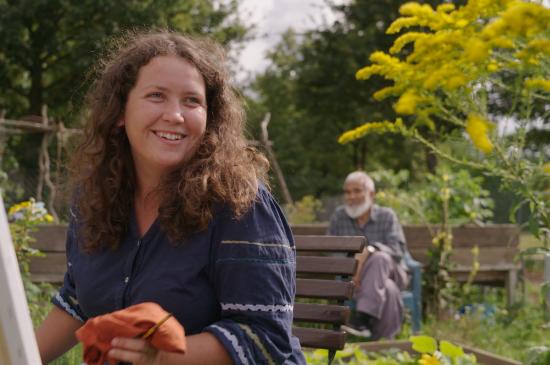
“We don’t fit together”, one of them says of the “motley crew” tending a garden plot in a pre-fab estate in Schwerin. At first, everyone “muddles through” alone: Omar from Syria, who struggles with being voiceless in a foreign land. Manfred, a widower who thinks of his wife every day and looks after everyone. Kateryna from Ukraine, who tries to paint over the war with colourful pictures. Fawze, who lost his homeland three times. Ronny, Wiebke and Max, who are trying to make a fresh start after a life of drugs and violence. Sabine, whose laughter and mischief flare up briefly and vanish again. Petra, who cannot afford to go to a concert after a lifetime of hard work. Richard, who hangs up mirrors not to be alone. Abdul from Afghanistan, master of okra. They communicate with their hands, feet and “russki jasyk”, swap tips on the right way to plant garlic and on tools, soon sit together under the chestnut tree, singing, fighting for the project … And from her balcony Mrs. Müller recites Goethe, following it up with a peace poem. DEFA veteran Dieter Schumann and his cinematographer Michael Kockot achieve what was once the origin and virtue of documentary film: giving the unheard a voice through precise observation, a voice based on closeness, trust and respect. The neighbourhood garden is a site of “small miracles”. One of them is this film.
Grit Lemke
Screenings & Tickets
Credits
Contact
mueller@neuevisionen.de
Good Evening, Beautiful
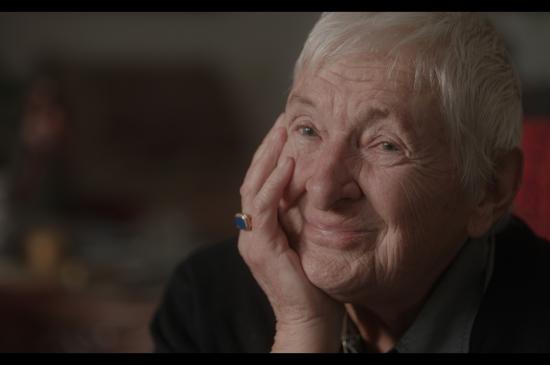
„A little flame that lit up and inspired people to tell different stories about the GDR.” This is how a protagonist describes the 1977 book “Guten Morgen, du Schöne” (Good morning, beautiful) by the writer Maxie Wander, a collection of records in which a wide variety of women talk about themselves. One of the most successful books in the GDR and one of the most influential in German literary history: It affected generations of women (and men!) and encouraged them to question their own lives – ample reason for the director to let a few of the women look back on the book and their lives today. It is about equal rights and emancipation, life plans and rebellion, dreams and failure, love and sexuality, mothers and fathers, men and women, happiness and loneliness, death and, above all, the hunger for life. With respect and great tenderness, Susanne Schüle films faces and bodies on which time has left its mark. Age and beauty, fragility and strength. On the visual level, the stories are subtly commented on by amateur footage: bodies marching in step to the ideologies, Hitler salutes and mass rallies. Again and again contrasted with naked bodies, the wild and non-conformist life beyond the dictatorships. War, peeling potatoes, kisses, children. This is how it was. This is how it is. In the end, the monologues of the past lead up to a contemporary dialogue between the sexes and generations. A flame.
Grit Lemke
Screenings & Tickets
Free entry
Free entry
Credits
Contact
info@shootfromthehip.de
Growing Wild
“How long have you known each other?” – “Six funerals.” Having grown old as a gay man is a privilege in the wake of the Aids crisis. At “Lebensort Vielfalt”, a Berlin housing project for lesbian, gay, bisexual, trans and intersexual persons, lived experiences are exchanged among three generations. They used to be pigeonholed, today children might just be allowed to learn to speak before they define themselves. A wild kind of growing up and ageing. All residents share the desire to be safe, even from having-to-explain-themselves. The camera roams the house, crosses the corridor, moves from one balcony to another, looks out of the window onto the street, develops new perspectives. Social backsliding is registered; sometimes new happiness is found. On deceased persons’ birthdays, the raspberry cake is cut. Falling asleep, the sound of riot rises again.
Jan Künemund
Contains mentions of discrimination against LGBTQIA2S+ persons
Screenings & Tickets
Free entry
Credits
Contact
mail@robcrosse.com