Topic
- Activism
- Animated Documentary
- Archival Footage
- Arts/Culture
- Coming of Age
- Eastern German
- Environment
- Experimental
- Family
- Gender
- History
- Human Rights
- Humour
- Labour/Economy
- LGBTQIA2S+
- Music
- Politics/Current Affairs
- Portrait/Biography
- Psyche/Mind
- Science/Technology
- Social Issues
- Underrepresented Communities
- War/Conflict
- Youth
Filmtype
Accessibility
Custom type
Topic
- Activism
- Animated Documentary
- Archival Footage
- Arts/Culture
- Coming of Age
- Eastern German
- Environment
- Experimental
- Family
- Gender
- History
- Human Rights
- Humour
- Labour/Economy
- LGBTQIA2S+
- Music
- Politics/Current Affairs
- Portrait/Biography
- Psyche/Mind
- Science/Technology
- Social Issues
- Underrepresented Communities
- War/Conflict
- Youth
Accessibility
Ten to Twenty Spoil Heaps
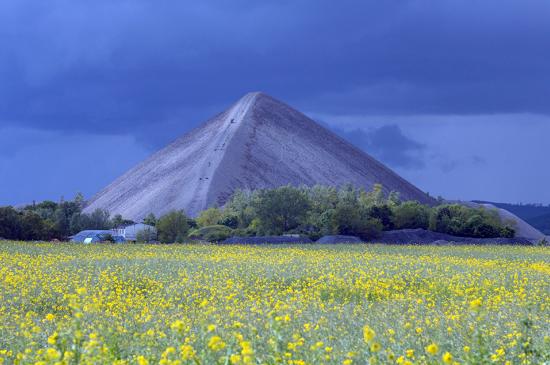
Mansfeld, an East German mining region: The land is gone, but the slag heaps are still there. As a mighty colossus on a barren plain, as the top of a pyramid behind a terraced house, as a dark line on the horizon. These piles of former mining waste have become imposing landmarks. Emerson Culurgioni views them as sediments of history. The carefully framed tableaus of an empty, post-industrial landscape, crossed only occasionally by a Simson moped gang whizzing by, recall James Benning’s exploration of a human-made environment. In contrast to the stillness of the images, a stream of far-reaching reflections about soil and resources, war and crises, labour and destruction, East and West, origin and identity, home and belonging meanders on the soundtrack. Layer by layer, long-dumped memories are uncovered. At the end is the question: What value do we attach to them.

Grit Lemke
Screenings & Tickets
Credits
Contact
emerson@posteo.de
The Class of 1990
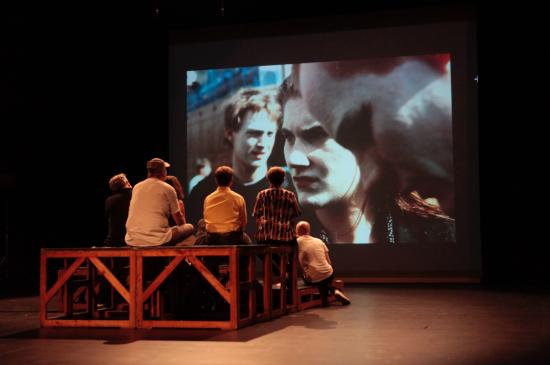
A theatre stage, Hamlet: the "call for freedom": The ones who declaim it have learned their craft. Right here, in Rostock, they had begun their studies a month before the German reunification. 35 years later, they remember. 1990: They come from different backgrounds, from East and West. They are strangers, live in prefabricated homes. And they quickly find themselves in a maelstrom sweeping across the whole of the East: Like the factories around them, the theatre school is to be "phased out". At the same time, the "Sonnenblumenhaus" is burning in Rostock-Lichtenhagen. They must learn to organise themselves. Like pieces of a jigsaw, individual tales, supplemented by archive images and historical rehearsal videos, come together to form a picture of those times. Embodied by today’s students, who re-enact scenes from the past, the past is reflected in the present. The story of the East German student movement of the early 1990s has been almost completely erased from the collective memory today. As in Rostock, nothing at Leipzig University reminds us that the existence of a number of scientific or artistic institutes and institutions is owed solely to their commitment. "Die Klasse von 1990" is an urgently needed corrective to a Western-dominated historiography, and a lesson in self-empowerment and democracy.
Grit Lemke
Screenings & Tickets
Credits
Contact
office@poison-berlin.com
Transition
On New Year's Eve 2023, Thomas Heise begins to shoot his new film. It is to be called “Übergang”. His idea: A film in the “Heimatfilm” tradition revolving around Berlin’s Schönhauser Allee, where he has lived for decades. The author is to be a character in the film. A few months later, Heise falls seriously ill and dies. The small team continues to work on the film, unearthing unpublished texts and images from Heise’s estate and archives. “Images are […] encompassing”, Heiner Müller is quoted, but dreams curdle quickly. As soon as the personal story becomes a false image, it is gently but persistently put into perspective. A touching email exchange Heise had with a female high-school graduate in Karlsruhe who is searching for truth contains a whole primer for documentary filmmaking: “See what you would not otherwise see. Stay patient. […] Never expect financial security. Be happy about that. Because it won’t change.” Peter Badel and Chris Wright have not produced a hermetic artist tribute, but have, utterly in the spirit of Heise, pieced together fragments of lived history.
Jan Künemund
Contains mentions of death
Screenings & Tickets
Free entry