The Young Eyes films are a perfect match for all over 12 and are nominated for the Young Eyes Award, chosen by a jury of people aged 12 to 16.
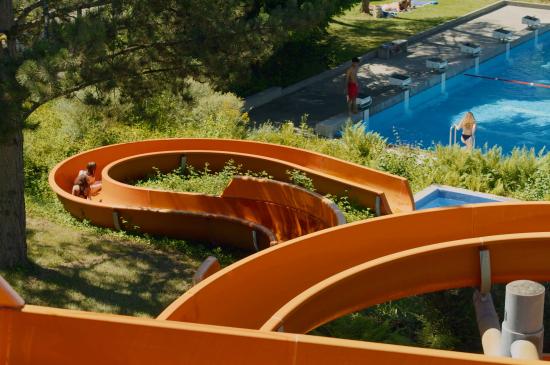
A public swimming pool complex in the middle of a forest which is soon to be renovated: between water slides, French fries, TikTok and sun cream, six teenagers spend the long summer days in the “Badi”, as outdoor pools are called in Swiss German. It is a place to discuss, laugh, try things out and simply hang out together. Whether on the grass, in the water or between the different pools, their conversations revolve around everything that currently moves them. This sun-kissed film accompanies these adolescents at a moment of transition. They talk about the past, think about the future and try to find out who they are and how they will find their place in a changing world. The film stays close to their glances, conversations and encounters, taking an unvarnished look into the inner world of these adolescents – their curiosities, their humour, their contradictions and their insecurities. For one summer long, the Badi becomes a place where childhood and future can exist alongside each other. And while the orange slide is dismantled, the question of what will remain of this summer bubbles up through the water.
Lina Dinkla
Free entry
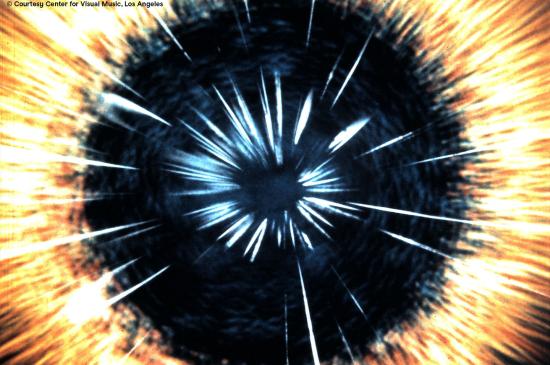
Created using still and moving images sourced from NASA’s STEREO satellite solar observation mission, “Black Rain” turns unprocessed scientific data into a raw and glitched-out perspective on nearby interplanetary space. Embracing the artefacts, the film gives us an unmanicured and almost voyeuristic view of space, distant from the glamour of sci-fi or the carefully colourised images normally released by NASA to the press, as we track solar winds, coronal mass ejections and passing comets, sometimes recognisable only as blurs of lines and pixels, across a monochrome background of stars and the milky way.
Ben Sassen
Photosensitivity warning: Contains flashes of light that may trigger seizures for people with visual sensitivities.
Everyone who longs for tenderness is welcome aboard the Pompelmo Express, a huge pink rocket ship. Together with a number of diverse passengers who shimmer in all the colours of the rainbow, Delfino, Rita and Zenf journey through the cosmos of possibilities. While a party rages on in the spaceship, Zenf discovers a fiery comet through his huge telescope. At an atmospheric tea party, Delfino falls head over heels in love with Carlos, and Rita begins to quarrel with her body. The infinite expanse and warm darkness of space envelop the friends benignly and offer a space to live out the most varied needs. “Say goodbye to your lonely days.”
Franka Sachse
Contains depictions of nudity
Pioneering multimedia artist and computer animator Lillian Schwartz created “Galaxies” during the early period of her 33-year tenure as artist-in-residence at renowned North American research facility Bell Labs. The piece draws on modeled simulations of galaxies from NASA’s Langley Research Center, which were rendered on a powerful mainframe computer and given to Schwartz to turn into a complete film. Schwartz, who had a background in Japanese calligraphy and painting and whose work often intersects art and technology, approached the material creatively, layering, distorting and colourising the images to breathe new life into the scientific data, with visually striking effect.
Ben Sassen
Photosensitivity warning: Contains flashes of light that may trigger seizures for people with visual sensitivities.
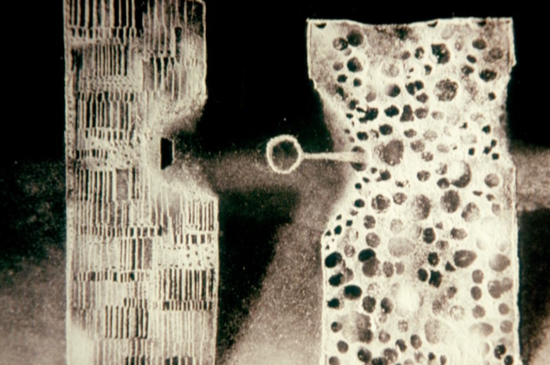
The RK12 galaxy is twenty-eight billion kilometres away from earth and contains a sandy desert planet inhabited by an extraterrestrial species. Without sunlight, these creatures live off the energy of movement itself. They produce time, love music and push their mortal gods back into space when they are tired of them. A fictitious reportage that showcases Piotr Kamler’s extraordinary skill. In addition to a feature-length sci-fi film, the Polish avant-garde film artist created a number of original and technically outstanding short films. “Green Planet” is a masterful stop motion animation in which Kamler brings delicate shapes made of fine sand to life. Carefully directed lighting, contrasts and focus create a fantastical world whose spatial depth is impressive. The music by Ivo Malec, a pioneer of electro-acoustic and New Music, reinforces the otherworldly atmosphere of the distant setting.
Franka Sachse
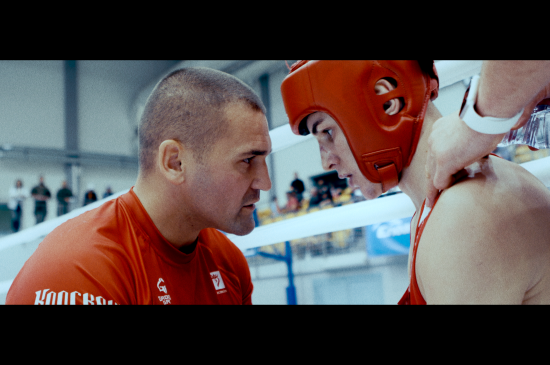
Łukasz dreams of becoming a professional boxer. His mother Monika supports him as much as she can. But the fact that this means he has to move to a sport boarding school over 500 kilometres away is something she can’t fathom. For who will do his washing there and make sure that he turns up to training on time? For Łukasz, the move is a step towards independence, but also a test of his abilities among like-minded people. Between hard training, new friendships and first love, the boarding school doesn’t just become a springboard for his sporting career, but also the place where he comes of age. Over five years, Adam Roszkowski accompanies his taciturn protagonist on his way to the Polish junior championships. In a blend of observation and discreet staging, everyday training routines, family moments and a first date come together to form a narrative that is so close to its characters that the documentary format almost melts into the background. Entirely indebted to the principle of show, don’t tell, “Growing Up” also gives an account of the dedication needed for competitive sport and the price it carries as well as of the silent battles needed to go one’s own way.
Tina Jany
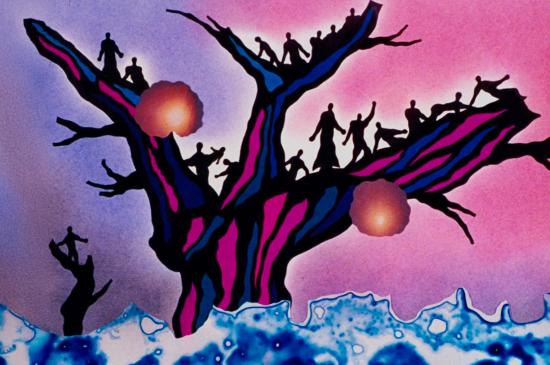
A Slavic legend whose essence can also be found in Tibetan records inspired the two Soviet scientists Mikhail Vasin and Alexander Shcherbakov to formulate their “Hollow Moon” hypothesis in 1970. In this hypnotic film, the Hungarian director, autodidact and graphic designer Sándor Reisenbüchler probes the theory in a highly poetical manner, sending us across the centuries from an imagined past to a distant future. His unmistakeable collages, which he brought to life with meticulous precision working alone at the animation table, combined with experimental moving image material, recall memories of analogue projections and the liquid light shows of the 1960s. Organic shapes and colourful patterns generate a fascinating pull which carries us through a magical portal into a hypothetical space ship inside the moon.
Franka Sachse
Photosensitivity warning: Contains flashes of light that may trigger seizures for people with visual sensitivities.
Sisters Nazieh, Shazieh and Hanieh are from Afghanistan and live with their father at a refugee camp in Athens without any idea of how long they will stay there. Their mother has already arrived in Germany, where a new law now prevents the family from reuniting there as planned. They start growing up in a situation where waiting is the norm. The film accompanies the trio over seven years and shows the fragile normality they establish separately and together in the face of adversity: sport training sessions, language classes and shooting their own film scenes, which are marked by their experiences as refugees. Educator and filmmaker Christos Stefanou got to know the three sisters at the refugee camp, where he worked for five years as a teacher. Aware of the vulnerability of their situation and this phase in life, he follows a collaborative approach in his first feature-length documentary. Drawing on close-up observation, he captures the three sisters’ gestures, thoughts and everyday routines, which reveals their developmental steps and the passing of time not just in physical terms. And while their learning successes sometimes lose any meaning in the face of their constantly changing life situation, one essential question remains: will the family manage to get back together despite all the imponderabilities?
Tina Jany
At a vocational college for the hotel industry, Alma, Moussa, Chaïli, Sarah and their classmates swap their everyday clothes, smartphones and chewing gum for uniforms and serving trays. At the college restaurant and in the classroom, they learn the rules and precisely processes linked to French restaurant service: a field in which tradition, discipline and perfection are a priority. Strict, yet fair, the teachers convey the value of a profession that demands patience and putting one’s needs to the side above all else. Between teaching sessions and the different components of service, the portrait of a generation confronted with the expectations of the labour market comes into focus: they need to learn a profession and conform while simultaneously looking for recognition and their own path. The film observes these young people in their training routines with sympathy and attentiveness and explores the contrasts between the idealised image of gastronomy and the harsh reality. For them, this training isn’t always a decision based on conviction, but merely one of the few possible paths into professional life. A lively, unadorned look at becoming an adult and looking for one’s place in a future that offers little and demands many compromises.
Lina Dinkla
In November 2013, the European Space Agency (ESA), as part of the SWARM Mission, launched three identical satellites into orbit to study our home planet’s magnetic field more closely. The translation of the measured data into sound makes the fluctuations in the magnetic field of our planet audible. Kamil Czapiga, whose intermedia art project “Cosmodernism”, founded in 2019, is an exploration of a very personal version of abstraction in the micro- and macrocosm, combines these sounds with fascinating material from his moving image universe. Even though they seem alien and unreal, his compositions are made from entirely earthly ingredients like oils, dyed water and magnetic liquids, which are stimulated to undergo chemical reactions in microscopically small film sets. Home-made mechanisms and special lighting enhance the resulting footage to a visual experience that seems out of this world.
Franka Sachse
Created in collaboration with the European Space Agency
Where a black hole is characterised by a region of space in which objects become trapped and prevented from escaping, a white hole is a hypothetical region of spacetime which cannot be entered from the outside, but from within which things can emerge and be released. Such is the setting for this visually rich, hypnotically abstract journey into the universe's expansive voids. “White hole” was released towards the end of a period of exceptional creative experimentation for director Toshio Matsumoto, one of Japan’s most highly acclaimed and masterful experimental film and video makers. In contrast to his earlier celluloid work, “White hole” uses video synthesizers and heavy image processing to achieve a salient cinematic experience, reminiscent of Stanley Kubrick’s 'Stargate’ sequence from “2001: A Space Odyssey”, with similar overtones of psychedelic, and perhaps consciousness expanding cosmological exploration.
Ben Sassen
Photosensitivity warning: Contains flashes of light that may trigger seizures for people with visual sensitivities.
In fluid sequence, the birth of a world is depicted as a bioastronomical event. Nebulous, whirling gaseous spheres condense, becoming molten membranes, then a flashing planet. Descent into its erupting electronic forces, to the nucleus, finds the life-spark doubling and multiplying, ascending toward consciousness, into crystal symmetries. An awareness of the whole is focused into the beginning of superconsciousness. This film was preserved with the support of the National Film Preservation Foundation.
Pyramid Films
Photosensitivity warning: Contains flashes of light that may trigger seizures for people with visual sensitivities.
International Leipzig Festival for Documentary and Animated Film
26 October to 1 November 2026
Leipziger Dok-Filmwochen GmbH
Katharinenstraße 17
04109 Leipzig
Germany
info [at] dok-leipzig [dot] de (info[at]dok-leipzig[dot]de)
+49 (0)341 30864-0