Topic
- Activism
- Animated Documentary
- Archival Footage
- Arts/Culture
- Coming of Age
- Digital Culture
- Eastern German
- Environment
- Experimental
- Family
- Gender
- History
- Human Rights
- Humour
- Labour/Economy
- LGBTQIA2S+
- Music
- Politics/Current Affairs
- Portrait/Biography
- Psyche/Mind
- Religion/Spirituality
- Science/Technology
- Social Issues
- Sports
- Underrepresented Communities
- War/Conflict
- Youth
Filmtype
Accessibility
Custom type
Topic
- Activism
- Animated Documentary
- Archival Footage
- Arts/Culture
- Coming of Age
- Digital Culture
- Eastern German
- Environment
- Experimental
- Family
- Gender
- History
- Human Rights
- Humour
- Labour/Economy
- LGBTQIA2S+
- Music
- Politics/Current Affairs
- Portrait/Biography
- Psyche/Mind
- Religion/Spirituality
- Science/Technology
- Social Issues
- Sports
- Underrepresented Communities
- War/Conflict
- Youth
Accessibility
>1,5°C Pyropolitics and the New World
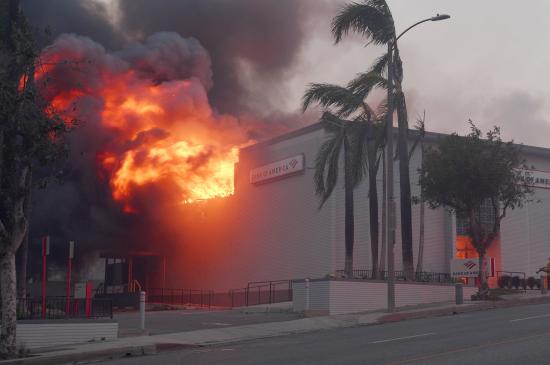
First we hear a crackling sound, then a diffuse orange light glows in the darkness. A siren growing louder and the sound of a helicopter instantly mark the scene as a place of danger. There is a fire. First in the distance, a moment later everywhere. Trees and palms go up in flames. The fire’s power is immense. The firefighters and everyone else who is fighting the wildfires around Los Angeles act with remarkable calm. Nobody is running, the communication chain is working smoothly, TV reporters are broadcasting live, helpers are setting up emergency shelters, taking care of injured animals, cutting fire lines in front of neighbours’ homes. A tried-and-tested routine, efficiency and a great willingness to help. The crisis seems to bring out the best in the people. This uncommented observation is also a tribute to their commitment. But the longer it goes on, the more the question arises why solidarity and sustainable action seem to work in emergencies, while it seems impossible to tackle the crisis before it becomes an inferno. The film’s cinematic meditation on pyropolitics takes a look at our age of multiple crises. The permanent global fire management makes it easy to forget that behind those fires lie geopolitical causes that must be dealt with – not with water, but with political decisions.
Luc-Carolin Ziemann
Trailer
Screenings & Tickets
Credits
Contact
lukasmarxt@gmail.com
A Song Without Home
„My life is a prison“, Adelina says. The young woman is smoking and looking into the camera, her parents sitting on the sofa to her right and left. In black and white and the narrow 4:3 ratio, this family scene feels oppressive: Adeline spent eleven years under house arrest here, with a father who refuses to accept her identity and a mother who seems loving but powerless. In Georgia, there is neither freedom nor security for trans persons like Adelina. Anti-queer attacks happen in broad daylight; the legal situation of the LGBTQ community has recently deteriorated further. When the protagonist at last leaves her parents’ village to go to Vienna, the style of Rati Tsiteladze’s debut film also changes. The lipstick glows red, the lights of the big city neon yellow. A different, freer life seems possible. But the freedom brings new challenges: financial and health problems, communicating in a foreign language – and loneliness. “A Song Without Home” is the intimate, impressionistic long-term portrait of a person who wants to define herself and clings to an unshakeable conviction: “No law can erase who we are.”
Jan-Philipp Kohlmann
Contains mentions of discrimination against LGBTQIA2S+ persons
Contains depictions of discrimination against LGBTQIA2S+ persons
Screenings & Tickets
Free entry
Credits
Contact
olyaslusareva@gmail.com
Apocalypse Yesterday, Today, Tomorrow, and the Day After Tomorrow
Marie Ketzscher
Contains mentions of war scenes
Trailer
Screenings & Tickets
Credits
Contact
anastasiabonadyga@gmail.com
Atlas of Disappearance
Seggen Mikael
Contains mentions of murder, death
Trailer
Screenings & Tickets
Credits
Contact
internacional@agenciafreak.com
Chile lebt
The Europe-wide protests against Chile’s military dictatorship were expressed not only by political activism, but by a host of artistic actions. The colourful aesthetics of the Unidad Popular’s street art, popularised by the Ramona Parra Brigades, became a visual trademark. Based on this model, the Brigada Pablo Neruda, for example, whose members included well-known Chilean artists exiled in Paris like José Balmes, Gracia Barrios and Guillermo Núñez, realised a 60-metre-long mural on the fringes of documenta 6 in Kassel in 1977. Its creation was documented in Franz Lehmkuhl’s film “Chilenische Wandmalerei” (1977–80), screened in Leipzig in 1980. In his agitation film “Chile lebt”, co-produced with Michael Börner, the Chilean journalist and filmmaker Juan Forch uses pictures of the Brigada Pablo Neruda to express what keeps hope in his homeland alive: international solidarity. In 1979, Forch returned to Chile from exile in the GDR.
Florian Wüst
Screenings & Tickets
Credits
Contact
defa-filmverleih@deutsche-kinemathek.de
Eine chilenische Hochzeit
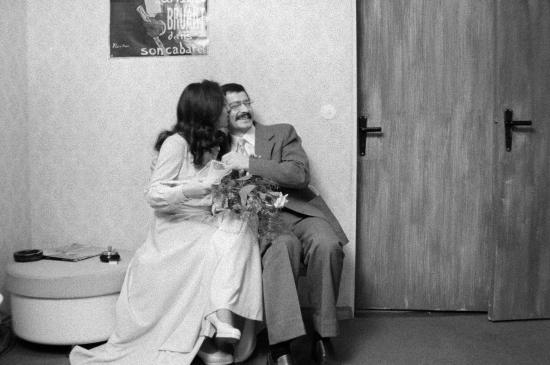
In 1977, Valentin Milanow, a Bulgarian student at the GDR Academy of Film and Television, sat in at the DEFA Studio for Documentary Films. Director Rainer Ackermann was assigned as his mentor. Milanow came up with the idea of portraying the reality of life of exiled Chileans in the GDR. He was friends with a young couple, Alejandra Holzapfel and José Fuica, who lived in the same prefabricated housing estate in Potsdam-Babelsberg. She studied veterinary medicine, he was training to be a teacher of Marxism-Leninism. Milanow was allowed to film their wedding. On the fringes of the seemingly happy celebration, conversations turn to memories of interrogations and torture by the military junta and worries about relatives who were left behind. What the bride herself did not reveal at the time: As a leftist underground fighter she had been exposed to the worst abuse in the “Venda Sexy” prisoners’ camp and others. Today, this place is the memorial site Asociación de Memoria y Derechos Humanos Irán 3030. It is run by Alejandra Holzapfel.
Florian Wüst
Screenings & Tickets
Credits
Contact
defa-filmverleih@deutsche-kinemathek.de
El tigre saltó y mató, pero morirá... morirá...
Five days after the coup, Chile’s most famous singer-songwriter, Víctor Jara, was brutally murdered. In recognition of his oeuvre, his political stance and also of the “victims of the fascist sadism perpetrated by the military and the CIA in Chile after 11 September 1973”, Santiago Álvarez immediately created a cinematic “report in four songs”. The musical and rhythmic structure and the simultaneous reportage style arising from found news footage and recordings of Jara reflect the agitprop language that is so typical of Álvarez. The title of the film is taken from the poem “Nuestra América” (1891) by Cuban poet José Martí. The end, too, alludes to the continuity of the anti-colonial struggle: A collage of international examples of state repression against insurgents from Puerto Rico to Vietnam and Indonesia is followed by depictions of legendary battles of liberation in 19th century South America.
Florian Wüst
Contains depictions of physical violence
Screenings & Tickets
Credits
Contact
For Life
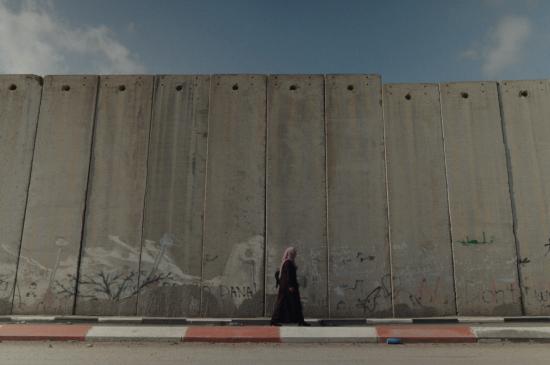
A Palestinian woman, Hind Mashahra, longs for motherhood, but this seems hardly possible as her husband is serving a life sentence in an Israeli prison and is barred from marital visits. Smuggling her husband’s sperm out of prison may be the only chance for her to become a mother again. The documentary follows Hind as she sets out on a risky mission to obtain and deliver her husband’s sample to a fertility clinic. Her repeated attempts are hampered by the traffic, checkpoints, and the short life of semen, perishing within just hours. Unadorned in its language, the film stays close to Hind’s inner experience in the throes of drama, shaped by the reality in the West Bank and East Jerusalem, as well as in quieter moments of waiting that are no less charged. Weaving in accounts of other prisoners’ wives, the documentary chronicles a Palestinian woman’s journey as she pursues motherhood at an extraordinary cost.
Sevara Pan
Contains mentions of death, physical violence
Contains depictions of physical violence, death
Screenings & Tickets
Credits
Contact
benahmetseven@gmail.com
Fracture
James Lattimer
Screenings & Tickets
Credits
Contact
philippe.cotte@cvb.be
Free Zone
Abtin, a young anarchist from Iran, now lives in Greece after fleeing his own country. Back home he managed an underground library of banned books and was reportedly arrested, detained and tortured because he took part in protests. He continues his political struggle in Athen’s Exarchia district – a place of left-wing utopias and a fiercely contested site of gentrification: He joins the movement for refugees, squats in houses, protests against illegal pushbacks and fights for alternative ways of living, though his own situation is highly precarious, because every contact with the state can jeopardise his residence status. Director Jasmine Alakari follows Abtin over the course of a year, experiences his rage, hope and powerlessness, but also euphoria and solidarity. Time and again, the film returns to the question of how much political activism should be allowed to shape one’s life and what role violence plays in this. Meanwhile, the conflict with the police comes to a head in the street and Abtin finds himself in the crosshairs of the state. Alakari keeps filming but realises that she must also examine her own role. What does it mean to be an observer? How far can a film visualise the fears and hopes of a person who does not have the freedom to escape this situation? “Free Zone” has no easy answer to this question but passes it on. To us – the audience.
Luc-Carolin Ziemann
Contains depictions of physical violence
Screenings & Tickets
Credits
Contact
jasmine.alakari@gmail.com
Herminda de la Victoria
In a large-scale operation, a group of homeless families occupy some wasteland on the outskirts of Santiago in March 1967. When the police attempt to evict them, a little girl, Herminda, dies in her mother’s arms. The eviction is called off, the people are allowed to stay and, without any existing infrastructure, build the settlement that exists to this day: Herminda de la Victoria. “Full of errors and mistakes, [the film] is my first approach to cinema, albeit to a ‘new cinema’, a Latin American cinema marked by underdevelopment. Nonetheless, the cinematic process, editing and sound represent a fully valid experience to me. ‘Herminda de la Victoria’ champions the interests of the homeless in Chile, suffers with them, is both testimony and a ‘document’ that forces you to take sides.” (Douglas Hübner)
Florian Wüst
Screenings & Tickets
Credits
Contact
Hope Is a Word
Thick smoke clouds rise at the horizon. Oil bubbles from the ground. The gills of a dead fish are black. A sonorous voice recites a poem about blood, anger and the oil-contaminated landscape of the Niger Delta. A crowd of people join in for the refrain. Writer and activist Nnimmo Bassey has been protesting for decades again the oil extraction in the south of Nigeria and its consequences for humans, nature and agriculture. The Ogoni, an ethnic minority from the region, are particularly affected, with their whole basis for life under existential threat as a result. In the 1990s, they organised a powerful political movement, which was violently put down by the military government – also in the interest of Western oil concerns. How is it possible to put up political resistance in such circumstances? “Hope Is a Word” is the portrait of a man who believes in the power of poetic language. With his workshops, Nnimmo Bassey manages to mobilise a new generation of rhetorically and literarily gifted activists. When they read, rap or recite, the film puts their words into the frame in demonstrative fashion. Poetry becomes a political tool here. For a call can come from a verse, a call that others then follow.
Jan-Philipp Kohlmann
Screenings & Tickets
Credits
Contact
anita@smau.no