Topic
- Activism
- Animated Documentary
- Archival Footage
- Arts/Culture
- Coming of Age
- Digital Culture
- Eastern German
- Environment
- Experimental
- Family
- Gender
- History
- Human Rights
- Humour
- Labour/Economy
- LGBTQIA2S+
- Music
- Politics/Current Affairs
- Portrait/Biography
- Psyche/Mind
- Religion/Spirituality
- Science/Technology
- Social Issues
- Sports
- Underrepresented Communities
- War/Conflict
- Youth
Filmtype
Accessibility
Custom type
Topic
- Activism
- Animated Documentary
- Archival Footage
- Arts/Culture
- Coming of Age
- Digital Culture
- Eastern German
- Environment
- Experimental
- Family
- Gender
- History
- Human Rights
- Humour
- Labour/Economy
- LGBTQIA2S+
- Music
- Politics/Current Affairs
- Portrait/Biography
- Psyche/Mind
- Religion/Spirituality
- Science/Technology
- Social Issues
- Sports
- Underrepresented Communities
- War/Conflict
- Youth
Accessibility
>1,5°C Pyropolitics and the New World
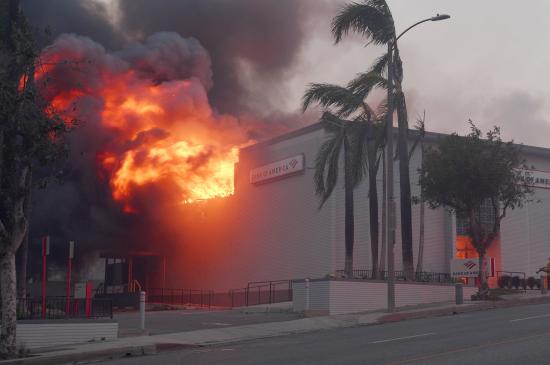
First we hear a crackling sound, then a diffuse orange light glows in the darkness. A siren growing louder and the sound of a helicopter instantly mark the scene as a place of danger. There is a fire. First in the distance, a moment later everywhere. Trees and palms go up in flames. The fire’s power is immense. The firefighters and everyone else who is fighting the wildfires around Los Angeles act with remarkable calm. Nobody is running, the communication chain is working smoothly, TV reporters are broadcasting live, helpers are setting up emergency shelters, taking care of injured animals, cutting fire lines in front of neighbours’ homes. A tried-and-tested routine, efficiency and a great willingness to help. The crisis seems to bring out the best in the people. This uncommented observation is also a tribute to their commitment. But the longer it goes on, the more the question arises why solidarity and sustainable action seem to work in emergencies, while it seems impossible to tackle the crisis before it becomes an inferno. The film’s cinematic meditation on pyropolitics takes a look at our age of multiple crises. The permanent global fire management makes it easy to forget that behind those fires lie geopolitical causes that must be dealt with – not with water, but with political decisions.
Luc-Carolin Ziemann
Trailer
Screenings & Tickets
Credits
Contact
lukasmarxt@gmail.com
Chile lebt
The Europe-wide protests against Chile’s military dictatorship were expressed not only by political activism, but by a host of artistic actions. The colourful aesthetics of the Unidad Popular’s street art, popularised by the Ramona Parra Brigades, became a visual trademark. Based on this model, the Brigada Pablo Neruda, for example, whose members included well-known Chilean artists exiled in Paris like José Balmes, Gracia Barrios and Guillermo Núñez, realised a 60-metre-long mural on the fringes of documenta 6 in Kassel in 1977. Its creation was documented in Franz Lehmkuhl’s film “Chilenische Wandmalerei” (1977–80), screened in Leipzig in 1980. In his agitation film “Chile lebt”, co-produced with Michael Börner, the Chilean journalist and filmmaker Juan Forch uses pictures of the Brigada Pablo Neruda to express what keeps hope in his homeland alive: international solidarity. In 1979, Forch returned to Chile from exile in the GDR.
Florian Wüst
Screenings & Tickets
Credits
Contact
defa-filmverleih@deutsche-kinemathek.de
Cold River: I Am in Leipzig
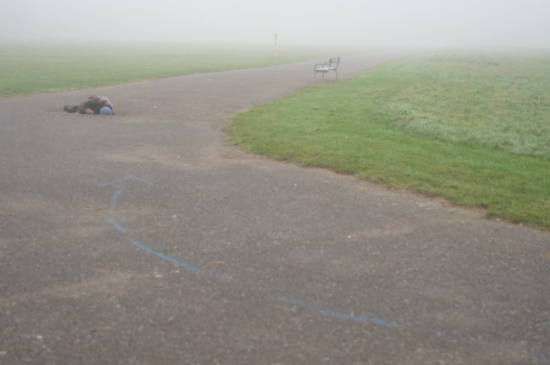
Haiguang dreams. Of his dead grandmother, his birthplace Lěng Shuǐ Jiāng in China, his performances and art projects and his job at a wholesale warehouse in Leipzig. But Haiguang not only dreams, he also films. Himself and his surroundings. Persistent, stoical, sometimes with a handheld camera, sometimes using a tripod – knowing that there is another layer under one’s everyday life that can only be perceived if one dares to search for meaning beyond the visible. If you dare to lie down on a crossing in the park and wait for what happens. If you dare to address the pressure to perform in Chinese society through a performance dragging a car tyre through Beijing. If you dare acknowledge your own fears and doubts and reveal them. Stylistically confident and constantly shifting between places and levels of meaning, Haiguang interlaces his life and dream in eight vignettes in which emotions condense and take on a form that goes beyond the personal. He interweaves the elements of his everyday life between the art academy and his parents’ coal shop in Changsha with equally precise and poetic descriptions. Thus, a puddle by the roadside can become the very place that connects him with his granny across space and time.
Luc-Carolin Ziemann
Trailer
Screenings & Tickets
Credits
Contact
lihaiguang02@gmail.com
Concrete Land
James Lattimer
Contains mentions of physical violence, racism, death, war scenes
Photosensitivity warning: Contains flashes of light that may trigger seizures for people with visual sensitivities.
Screenings & Tickets
Credits
Contact
bk.asmahan@gmail.com
Daughter of the Sun
The stories, myths and reality of the Sámi people are always closely linked to reindeer: travelling with them, keeping them as livestock. Where does this close tie come from? Anita Killi takes up – or imagines – a creation myth: Alits, who roams the land and enjoys his idleness, is gifted the close tie to the reindeers in the shape of Joik (yodelling) by the daughter of the sun when she has to leave him again. The singing magically attracts the animals. Killi captures the yearning in these sounds with poetic imagery and in Sámi language: In the embraces of Alits and the daughter of the sun, but also in the moments when they roam the meadows. Everything is interconnected in this sensual and haptic concept of nature.
Marie Ketzscher
Screenings & Tickets
Credits
Contact
claus@trollfilm.no
Eine chilenische Hochzeit
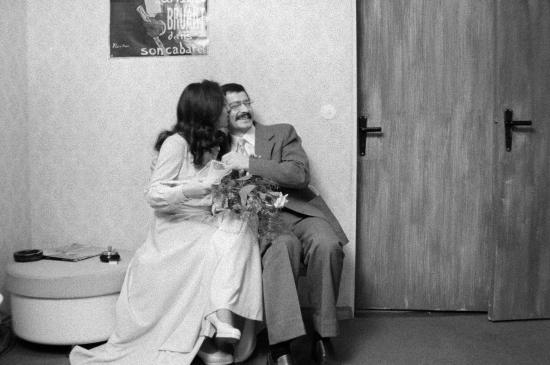
In 1977, Valentin Milanow, a Bulgarian student at the GDR Academy of Film and Television, sat in at the DEFA Studio for Documentary Films. Director Rainer Ackermann was assigned as his mentor. Milanow came up with the idea of portraying the reality of life of exiled Chileans in the GDR. He was friends with a young couple, Alejandra Holzapfel and José Fuica, who lived in the same prefabricated housing estate in Potsdam-Babelsberg. She studied veterinary medicine, he was training to be a teacher of Marxism-Leninism. Milanow was allowed to film their wedding. On the fringes of the seemingly happy celebration, conversations turn to memories of interrogations and torture by the military junta and worries about relatives who were left behind. What the bride herself did not reveal at the time: As a leftist underground fighter she had been exposed to the worst abuse in the “Venda Sexy” prisoners’ camp and others. Today, this place is the memorial site Asociación de Memoria y Derechos Humanos Irán 3030. It is run by Alejandra Holzapfel.
Florian Wüst
Screenings & Tickets
Credits
Contact
defa-filmverleih@deutsche-kinemathek.de
El tigre saltó y mató, pero morirá... morirá...
Five days after the coup, Chile’s most famous singer-songwriter, Víctor Jara, was brutally murdered. In recognition of his oeuvre, his political stance and also of the “victims of the fascist sadism perpetrated by the military and the CIA in Chile after 11 September 1973”, Santiago Álvarez immediately created a cinematic “report in four songs”. The musical and rhythmic structure and the simultaneous reportage style arising from found news footage and recordings of Jara reflect the agitprop language that is so typical of Álvarez. The title of the film is taken from the poem “Nuestra América” (1891) by Cuban poet José Martí. The end, too, alludes to the continuity of the anti-colonial struggle: A collage of international examples of state repression against insurgents from Puerto Rico to Vietnam and Indonesia is followed by depictions of legendary battles of liberation in 19th century South America.
Florian Wüst
Contains depictions of physical violence
Screenings & Tickets
Credits
Contact
Fracture
James Lattimer
Screenings & Tickets
Credits
Contact
philippe.cotte@cvb.be
Free Zone
Abtin, a young anarchist from Iran, now lives in Greece after fleeing his own country. Back home he managed an underground library of banned books and was reportedly arrested, detained and tortured because he took part in protests. He continues his political struggle in Athen’s Exarchia district – a place of left-wing utopias and a fiercely contested site of gentrification: He joins the movement for refugees, squats in houses, protests against illegal pushbacks and fights for alternative ways of living, though his own situation is highly precarious, because every contact with the state can jeopardise his residence status. Director Jasmine Alakari follows Abtin over the course of a year, experiences his rage, hope and powerlessness, but also euphoria and solidarity. Time and again, the film returns to the question of how much political activism should be allowed to shape one’s life and what role violence plays in this. Meanwhile, the conflict with the police comes to a head in the street and Abtin finds himself in the crosshairs of the state. Alakari keeps filming but realises that she must also examine her own role. What does it mean to be an observer? How far can a film visualise the fears and hopes of a person who does not have the freedom to escape this situation? “Free Zone” has no easy answer to this question but passes it on. To us – the audience.
Luc-Carolin Ziemann
Contains depictions of physical violence
Screenings & Tickets
Credits
Contact
jasmine.alakari@gmail.com
Good Evening, Beautiful
„A little flame that lit up and inspired people to tell different stories about the GDR.” This is how a protagonist describes the 1977 book “Guten Morgen, du Schöne” (Good morning, beautiful) by the writer Maxie Wander, a collection of records in which a wide variety of women talk about themselves. One of the most successful books in the GDR and one of the most influential in German literary history: It affected generations of women (and men!) and encouraged them to question their own lives – ample reason for the director to let a few of the women look back on the book and their lives today. It is about equal rights and emancipation, life plans and rebellion, dreams and failure, love and sexuality, mothers and fathers, men and women, happiness and loneliness, death and, above all, the hunger for life. With respect and great tenderness, Susanne Schüle films faces and bodies on which time has left its mark. Age and beauty, fragility and strength. On the visual level, the stories are subtly commented on by amateur footage: bodies marching in step to the ideologies, Hitler salutes and mass rallies. Again and again contrasted with naked bodies, the wild and non-conformist life beyond the dictatorships. War, peeling potatoes, kisses, children. This is how it was. This is how it is. In the end, the monologues of the past lead up to a contemporary dialogue between the sexes and generations. A flame.
Grit Lemke
Screenings & Tickets
Free entry
Credits
Contact
info@shootfromthehip.de
Heralds of the Monsoon
Marie Ketzscher
Screenings & Tickets
Credits
Contact
k.meera28@gmail.com
Herminda de la Victoria
In a large-scale operation, a group of homeless families occupy some wasteland on the outskirts of Santiago in March 1967. When the police attempt to evict them, a little girl, Herminda, dies in her mother’s arms. The eviction is called off, the people are allowed to stay and, without any existing infrastructure, build the settlement that exists to this day: Herminda de la Victoria. “Full of errors and mistakes, [the film] is my first approach to cinema, albeit to a ‘new cinema’, a Latin American cinema marked by underdevelopment. Nonetheless, the cinematic process, editing and sound represent a fully valid experience to me. ‘Herminda de la Victoria’ champions the interests of the homeless in Chile, suffers with them, is both testimony and a ‘document’ that forces you to take sides.” (Douglas Hübner)
Florian Wüst