Topic
- Activism
- Animated Documentary
- Archival Footage
- Arts/Culture
- Coming of Age
- Digital Culture
- Eastern German
- Environment
- Experimental
- Family
- Gender
- History
- Human Rights
- Humour
- Labour/Economy
- LGBTQIA2S+
- Music
- Politics/Current Affairs
- Portrait/Biography
- Psyche/Mind
- Religion/Spirituality
- Science/Technology
- Social Issues
- Sports
- Underrepresented Communities
- War/Conflict
- Youth
Filmtype
Accessibility
Custom type
Topic
- Activism
- Animated Documentary
- Archival Footage
- Arts/Culture
- Coming of Age
- Digital Culture
- Eastern German
- Environment
- Experimental
- Family
- Gender
- History
- Human Rights
- Humour
- Labour/Economy
- LGBTQIA2S+
- Music
- Politics/Current Affairs
- Portrait/Biography
- Psyche/Mind
- Religion/Spirituality
- Science/Technology
- Social Issues
- Sports
- Underrepresented Communities
- War/Conflict
- Youth
Accessibility
Leave This Room Buried
James Lattimer
Trailer
Screenings & Tickets
Credits
Contact
vanja@bonobostudio.hr
Líber Arce, liberarse
Líber Arce was the name of a communist student who was shot dead by the police at a protest on the university campus of Montevideo. The film documents the events before and after his burial, its title transforming the name of the victim into a call for action: liberarse, to liberate oneself. The fact that the film is silent and the indictment of the social and economic conditions as well as US imperialism is spelled out in intertitles turns the lack of resources for a soundtrack into an aesthetic quality. We look more closely because there is nothing to hear. Mario Handler is a cofounder of the “Cinemateca Tercer del Mundo” (1969-1974) film collective, which sought to build its own cinema of counter-information and published a magazine. Above all, however, it screened the militant films from the other Latin American countries and popularised them far beyond the circles of bourgeois culture in Uruguay.

Florian Wüst
Contains depictions of physical violence
Screenings & Tickets
Credits
Contact
Now!
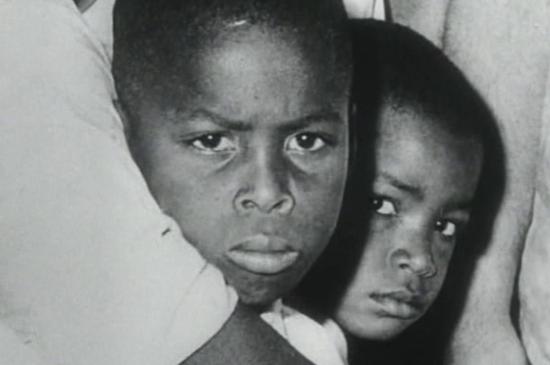
“Still I believe / We are created, free and equal / Now / Now / Now …” US-American singer Lena Horne interpreted the Hebrew song “Hava Nagila” with different lyrics: “Now!” (1963) became an anthem of the civil rights movement in the USA, while Santiago Álvarez’s film of the same name rose to become an agitprop classic. He edited photographs and a few short moving image sequences of racial discrimination, police violence and white terror to the rhythm of Horne’s song. The International Leipzig Documentary and Short Film Week alone screened “Now!” five times in two decades after it had won the Golden Dove in 1965. The presence of Cuban documentary film in Leipzig amounted to a long success story, not least thanks to Álvarez, its best-known exponent. In addition to screenings of his films, he served several times as a member of the International Jury. Even after the controversy surrounding his stance on the Prague Spring 1968, Álvarez continued to be a regular guest.
Florian Wüst
Contains depictions of racism, physical violence
Screenings & Tickets
Credits
Contact
Nuestra voz de tierra, memoria y futuro
Marta Rodríguez and Jorge Silva made their first appearance in Leipzig in 1972, with “Planas, testimonio de un etnocidio” (1971) in the retrospective “Film in the People’s Struggle for Freedom: Latin America” as well as in the television competition and in the cinema competition with “Chircales” (1972). Both films were awarded Golden Doves, Rodríguez and Silva became instant stars of the festival. In 1975, “Campesinos” brought them back to Leipzig. This film marks the beginning of their exploration of the centuries-old oppression of indigenous communities in the Cauca region in southwestern Colombia and their equally long resistance against colonial exploitation and dispossession. Years later, the theme culminated in “Nuestra voz de tierra, memoria y futuro”, in which they used some shots from “Campesinos”. Rodríguez and Silva document the process of political organisation in the Coconuco community during the land reform movement of the 1970s, with extensive critical collaboration by their protagonists. At the same time, it was an attempt to leave the naturalism of the documentary format behind and approach the subconscious mind of the indigenous culture, “to depict its magical world in all its complexity and beauty”, as Silva put it in a conversation with Peter B. Schumann in the information leaflet of the 1982 Berlinale Forum. The film re-celebrated its world premiere in its restored digital version at the 2019 Forum.
Florian Wüst
Screenings & Tickets
Credits
Contact
Otá Layò
The brothers Matheus and José live in Brazil by the rivers of the Kalunga Quilombo, a community of descendants of escaped slaves. The springs and rivers are an important part of their life and they both know how precious and worth protecting these waters are. They love to collect stones there which they use for their artworks. The film follows the brothers on their forays along the water for a bit and tells of their special connection to this place.
Lina Dinkla
Screenings & Tickets
Credits
Contact
contato.acarajefilmes@gmail.com
Pintando con el pueblo
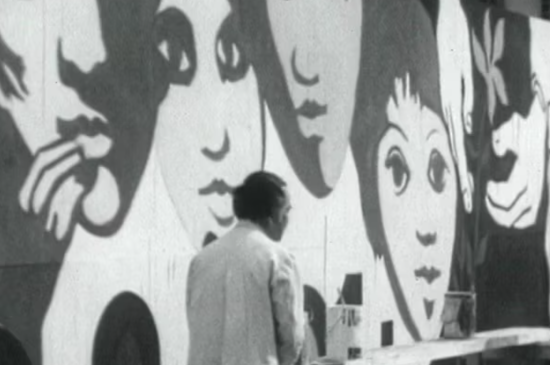
During the Unidad Popular election campaign in 1970, the Ramona Parra Brigades mobilised young activists across the country. They painted political messages on facades and walls using brushes and buckets of paint. In “Brigada Ramona Parra” (1970), Álvaro Ramírez – who continued to work as a filmmaker in exile in the GDR – documents the sometimes daring work of one of these groups. Leonardo Céspedes’ “Pintando con el pueblo” in turn shows the new direction of Chilean cultural politics under Salvador Allende. Artists and art students create a huge mural in front of the presidential palace, La Moneda, in Santiago, under the eyes of passers-by. The site becomes a stage for a rally organized by the Unidad Popular.The film ends with a speech by Allende about art as “an art for all the people”. The 16mm distribution print held by the Arsenal archive is probably the only surviving copy of “Pintando con el pueblo”. It was digitised for this retrospective.
Florian Wüst
Screenings & Tickets
Credits
Contact
Somos +
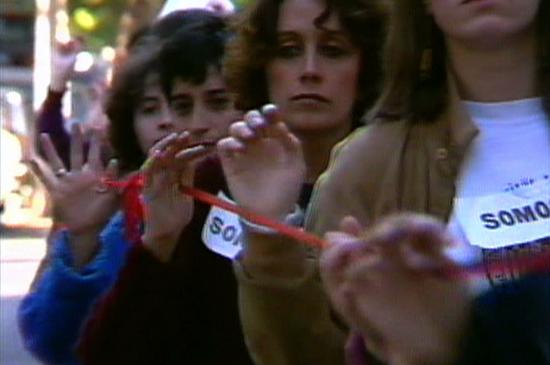
Encouraged by the UN Resolution of 6 November 1974, which condemned the human rights violations of the Chilean military dictatorship, relatives of imprisoned and disappeared persons first began to join forces. Whether in this or other initiatives fighting for a return of democracy to Chile, the resistance was always primarily driven by women. It became more and more visible in the 1980s, not least due to the creativity of their forms of action. One example: On 30 October 1985, the “Mujeres por la vida” organised a protest in the Providencia district of Santiago under the slogan “Somos+” (We are more). The women formed three rows moving towards each other, each holding a ribbon in one of Chile’s national colours. The video documentation of the protest and its violent breakup by the police won multiple awards at the 1986 West German Short Film Festival in Oberhausen.
Florian Wüst
Contains depictions of physical violence
Screenings & Tickets
Credits
Contact
spicher@kurzfilmtage.de
The Maternity Ward
Carolin Weidner
Screenings & Tickets
Credits
Contact
contact@ajimatifilms.com
They’re Here
Carolin Weidner
Contains mentions of racism, murder
Contains depictions of physical violence
Screenings & Tickets
Credits
Contact
Submarine Entertainment
this, too, will be liquid
Marie Ketzscher
Photosensitivity warning: Contains flashes of light that may trigger seizures for people with visual sensitivities.
Screenings & Tickets
Credits
Contact
info@karolinamalwina.net
Tricontinental, Letter to Open in Case Of
French critic and activist Michèle Firk died at the age of 31 and left little behind: several texts in the film magazine Positif, the draft script for a film never made, diary entries and a farewell letter in case of her death. Taking these writings as a starting point, Laura Cazador traces out her short, radical life in the late 1950s and 1960s. A life that is not just closely connected to film history, but also the left-wing discourses and anti-imperialistic movements of that era. Firk politicised during the Algerian War, got involved in Socialist Cuba and later joined the armed struggle in Guatemala. Ben Barka, Salvador Allende, Fidel Castro and Ché Guevara drift eerily through the fascinatingly dense archival material of this film – everything connected by the idea of the Tricontinental. The Havana conference that Firk worked on was supposed to be held in 1966 and call a new, non-aligned alliance between the countries of Asia, Africa and Latin America into being. Having trained as a film director herself in Cuba, Cazador grasps Firk as a point of contention and of reference for her own filmmaking in the present. The film thus reflects on the connection between cinephilia and political engagement not just based on Firk’s texts, but also with the images of the “Third Cinema”.
Jan-Philipp Kohlmann
Trailer
Screenings & Tickets
Credits
Contact
mrkolexa@gmail.com
Un día yo pregunté
“A polemical short film lasting only a few minutes which lines up images of the institution from which the underprivileged expect miracles and liberation from their daily misery: the Catholic Church, which is particularly reactionary in Colombia”, Peter B. Schumann writes about “Un día yo pregunté”. Julia de Álvarez and Carlos Álvarez frequently met with hostility for their political work and, along with other filmmakers, were imprisoned, even tortured, in July 1972. Their release from prison in February 1974 may well have been due, to a not inconsiderable extent, to the joint diplomatic efforts of the Friends of the German Cinematheque (today: Arsenal Filminstitut), the West German Short Film Festival in Oberhausen and others. For Leipzig, too, the couple represented an important voice – and an example of how close the German-German connections were regarding safeguarding, copying and distributing the analogue film material of the revolutionary Latin American cinema.
Florian Wüst
Screenings & Tickets
Credits
Contact
juliasabogal1@hotmail.com