Topic
- Activism
- Animated Documentary
- Archival Footage
- Arts/Culture
- Coming of Age
- Digital Culture
- Eastern German
- Environment
- Experimental
- Family
- Gender
- History
- Human Rights
- Humour
- Labour/Economy
- LGBTQIA2S+
- Music
- Politics/Current Affairs
- Portrait/Biography
- Psyche/Mind
- Religion/Spirituality
- Science/Technology
- Social Issues
- Sports
- Underrepresented Communities
- War/Conflict
- Youth
Filmtype
Accessibility
Custom type
Topic
- Activism
- Animated Documentary
- Archival Footage
- Arts/Culture
- Coming of Age
- Digital Culture
- Eastern German
- Environment
- Experimental
- Family
- Gender
- History
- Human Rights
- Humour
- Labour/Economy
- LGBTQIA2S+
- Music
- Politics/Current Affairs
- Portrait/Biography
- Psyche/Mind
- Religion/Spirituality
- Science/Technology
- Social Issues
- Sports
- Underrepresented Communities
- War/Conflict
- Youth
Accessibility
Bára – Diary of a Rockstar
Carolin Weidner
Screenings & Tickets
Credits
Contact
barbora.lochmanova@gmail.com
Broken Glass
Franka Sachse
Screenings & Tickets
Credits
Contact
kate.voznytsia@gmail.com
Decay
André Eckardt
Contains mentions of mental health conditions, murder
Photosensitivity warning: Contains flashes of light that may trigger seizures for people with visual sensitivities.
Screenings & Tickets
Credits
Contact
j.gonzalezj@uniandes.edu.co
Dysphasia
André Eckardt
Photosensitivity warning: Contains flashes of light that may trigger seizures for people with visual sensitivities.
Screenings & Tickets
Credits
Contact
antoncla.contact@gmail.com
Heralds of the Monsoon
Marie Ketzscher
Screenings & Tickets
Credits
Contact
k.meera28@gmail.com
I’m Painting a Self-Portrait, but All I See Is My Sister’s Face
Carolin Weidner
Trailer
Screenings & Tickets
Free entry
Credits
Contact
hela.stanczyk@gmail.com
Illapu – Lied von Freiheit und Liebe
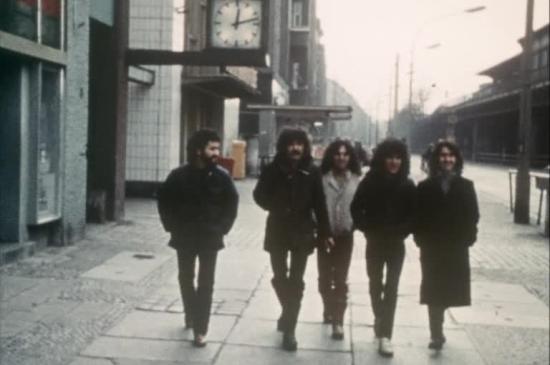
The Chilean folk group Illapu only really became famous under the military dictatorship. The five musicians were allowed to work, but had to “keep a low profile”. When they gradually joined the cultural resistance against the Pinochet regime, they were expelled in 1981. From their French exile, they toured Europe, including East Berlin. This is where Carlos Puccio’s film begins: The Chilean directing student observed Illapu’s rehearsals and concerts for his diploma film project at the Film and Television Academy of the GDR. They talk about their enduring bond with Chile and about what would happen if individual members of the band were given entry permits and Illapu would consequently break up. In 1986, they moved to Mexico together and returned to Chile two years later because of the changing political climate.
Florian Wüst
Screenings & Tickets
Credits
Contact
cristina.marx@filmuniversitaet.de
Is Heaven Blue? #2
The collaborative artistic work of Menno de Noojer (son), Paul de Noojer (father) and Françoise de Noojer (mother), which oscillated between photography and experimental film, spanned almost fifty years. Rather than allowing posterity to label, categorise and, as the case may be, mothball their work, the three realised a final film together just before Paul de Noojer died, when he was already seriously ill. A last joint film as an exuberant self-homage, in which they combine experimental-documentary storytelling, performance, pixilation and stop motion, funny and sad moments, pathos and trash, a joy of putting on costumes and vulnerable nudity. With “Heaven is Blue? #2”, the Noojers celebrate life as a total work of art in which all processes of becoming human and all symptoms of decline have their place and death is a natural part of the whole.
Marie Ketzscher
Screenings & Tickets
Credits
Contact
claus@trollfilm.no
Kurtág Fragments
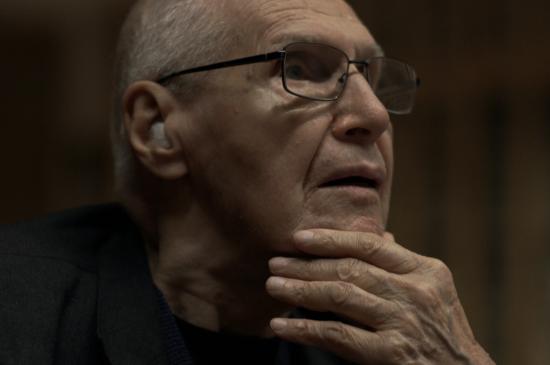
György Kurtág is a renowned Hungarian composer and a major figure of the post-war avant-garde. Born in 1926, he has now reached the age of 100, yet his mind remains wonderfully active. Living in an attic flat of the Budapest Music Center, he continues to work tirelessly with some of the world’s finest musicians who open their creations up to the humbling process of collaboration. Traversing geographies, the film takes us from his birth town of Lugoj to the different places that shaped him, from Transylvania to Budapest to Paris. It traces his early steps into the world of music, which began with dance and four‑hand piano sessions with his mother — something he later continued with his wife and pianist Márta. It then follows his life and many artistic collaborations, including with Icelandic pianist Víkingur Ólafsson and British cellist Steven Isserlis. The film also weaves in the work on his magnum opus “Fin de Partie”. “The map is not the territory; the notes are not music…” To pianists Halla Oddný Magnúsdottir and Ólafsson, Kurtág has “found a way of writing music that is impossible to play without going beyond the notes”. It’s a sentiment shared by Kurtág, who remarks that it’s not about his ideas but about whether the piece, played by a musician, truly “happens” to them. A portrait of a man who lives and breathes music, composing entire worlds brimming with emotion.
Sevara Pan
Trailer
Screenings & Tickets
Credits
Contact
kati.vajda@nfi.hu
Letters from the Silenced Country
Carolin Weidner
Contains mentions of death
Contains depictions of physical violence
Trailer
Screenings & Tickets
Credits
Contact
mirek@studioeverest.pl
Light
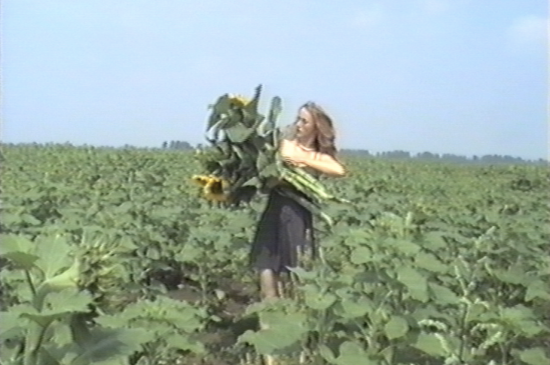
1995. It is the sixth summer since the fall of the Berlin Wall. Artists live, love and work on a farm in East Germany. They film each other with a video camera. They have seen the world, have wondered and learned, became homesick and returned. To where there was space. Fruit hangs from the trees, sparrows chirp, sculptures in the garden. Time and again the camera captures a young woman, her open gaze, her focus. The material which has become fragile today vibrates, gets stuck, freezes. Unperturbed, the narrative evokes the paean of summer, which will not be followed by a seventh for one of them. A white light shines into the present.
Jan Künemund
Contains mentions of death
Screenings & Tickets
Credits
Contact
juliane.ebner@gmx.de
Mum’s Hair
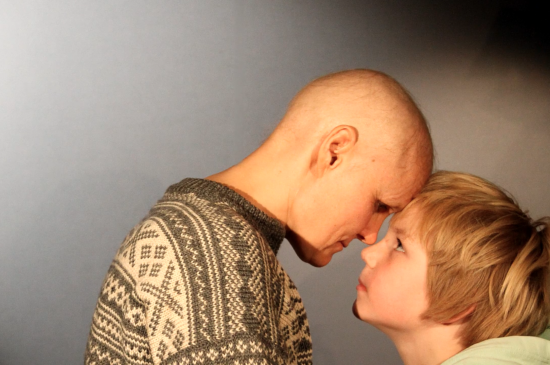
Losing your hair through chemotherapy is a painful experience for many people, not least because a bald head displays one’s new vulnerability so blatantly. But Maja Arnekleiv, the daughter of Norwegian animation director Anita Killi, turns the steps of the transformation – the original mum’s hair, the near-baldness, the new growth which is so different from the pre-chemo hair – into a tribute to resilience, love and family solidarity even in difficult times of illness. In a pixilation documentary produced over a period of two years, she captures in 755 single frames (selected from more than 3,000) how she and her siblings comb, blow-dry, style, braid and spray Anita Killi’s hair, while Killi always has her eyes firmly on the viewers. Sometimes laughing, sometimes serious, always loving. In 2017, Marja Arnekleiv won the Golden Dove for this tender, very touching film which celebrates the mother of four, whatever she looks like.
Marie Ketzscher
Screenings & Tickets
Credits
Contact
claus@trollfilm.no