Topic
- Activism
- Animated Documentary
- Archival Footage
- Arts/Culture
- Coming of Age
- Digital Culture
- Eastern German
- Environment
- Experimental
- Family
- Gender
- History
- Human Rights
- Humour
- Labour/Economy
- LGBTQIA2S+
- Music
- Politics/Current Affairs
- Portrait/Biography
- Psyche/Mind
- Religion/Spirituality
- Science/Technology
- Social Issues
- Sports
- Underrepresented Communities
- War/Conflict
- Youth
Filmtype
Accessibility
Section
Custom type
Topic
- Activism
- Animated Documentary
- Archival Footage
- Arts/Culture
- Coming of Age
- Digital Culture
- Eastern German
- Environment
- Experimental
- Family
- Gender
- History
- Human Rights
- Humour
- Labour/Economy
- LGBTQIA2S+
- Music
- Politics/Current Affairs
- Portrait/Biography
- Psyche/Mind
- Religion/Spirituality
- Science/Technology
- Social Issues
- Sports
- Underrepresented Communities
- War/Conflict
- Youth
Accessibility
Section
A Marriage Story
Carolin Weidner, DOK Leipzig Catalogue 2017
Screenings & Tickets
Credits
Contact
A Song Without Home
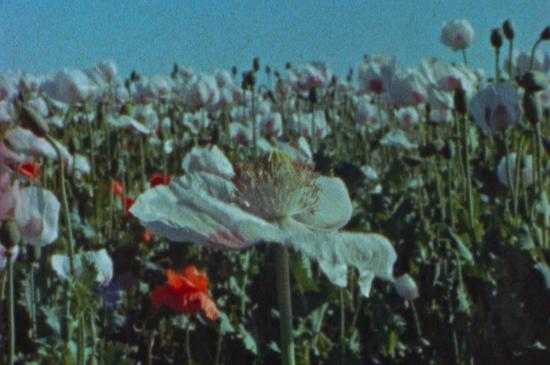
“My life is a prison”, Adelina says. The young woman is smoking and looking into the camera, her parents sitting on the sofa to her right and left. In black and white and the narrow 4:3 ratio, this family scene feels oppressive: Adeline spent eleven years under house arrest here, with a father who refuses to accept her identity and a mother who seems loving but powerless. In Georgia, there is neither freedom nor security for trans persons like Adelina. Anti-queer attacks happen in broad daylight; the legal situation of the LGBTQ community has recently deteriorated further. When the protagonist at last leaves her parents’ village to go to Vienna, the style of Rati Tsiteladze’s debut film also changes. The lipstick glows red, the lights of the big city neon yellow. A different, freer life seems possible. But the freedom brings new challenges: financial and health problems, communicating in a foreign language – and loneliness. “A Song Without Home” is the intimate, impressionistic long-term portrait of a person who wants to define herself and clings to an unshakeable conviction: “No law can erase who we are.”
Jan-Philipp Kohlmann
Contains mentions of discrimination against LGBTQIA2S+ persons
Contains depictions of discrimination against LGBTQIA2S+ persons
Screenings & Tickets
Free entry
Credits
Contact
olyaslusareva@gmail.com
Afterlives
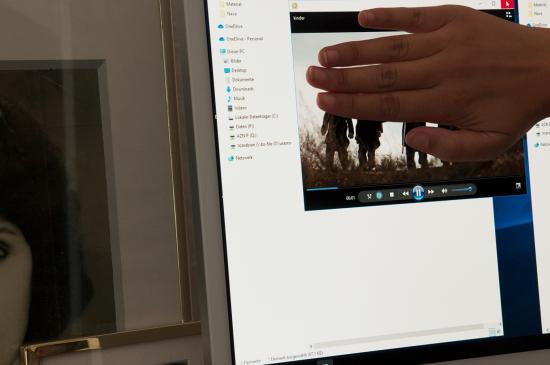
Through numerous video essays in film and media theory, Kevin B. Lee has played a key role in developing the form of the so-called desktop film. The elegant meta-staging reflects the fact that his digital desktop is research tool, media archive and distribution channel at the same time. Lee’s first feature-length film in this style dissects a historical work of propaganda: In 2014, the “Islamic State” terror militia, then at the height of its territorial power, published an elaborately produced film entitled “Flames of War”, which many media outlets compared to the aesthetics of Hollywood blockbusters. Lee manages to abstract and defamiliarize the extreme violence of those images, but comes to the realisation that their ideological power cannot be decoded by the tools of film analysis alone. “Afterlives” broadens the perspective and looks for alternative models in dialogue with experts from the arts, political education and terrorism studies: They reconstruct destroyed cultural assets, develop strategies against extremist radicalisation and study what motivates people to leave terrorist groups. In all this, Lee’s intelligent essay never loses sight of the colonialist western image of the Middle East.
Jan-Philipp Kohlmann
Contains mentions of torture
Contains depictions of war scenes, torture
Trailer
Screenings & Tickets
Credits
Contact
Apocalypse Yesterday, Today, Tomorrow, and the Day After Tomorrow
Marie Ketzscher
Contains mentions of war scenes
Trailer
Screenings & Tickets
Credits
Contact
anastasiabonadyga@gmail.com
Atlas of Disappearance
Seggen Mikael
Contains mentions of murder, death
Trailer
Screenings & Tickets
Credits
Contact
internacional@agenciafreak.com
Auber 89
Anca Păunescu
Screenings & Tickets
Credits
Contact
raluca@lightdox.com
Bára – Diary of a Rockstar
Carolin Weidner
Screenings & Tickets
Credits
Contact
barbora.lochmanova@gmail.com
Black Box
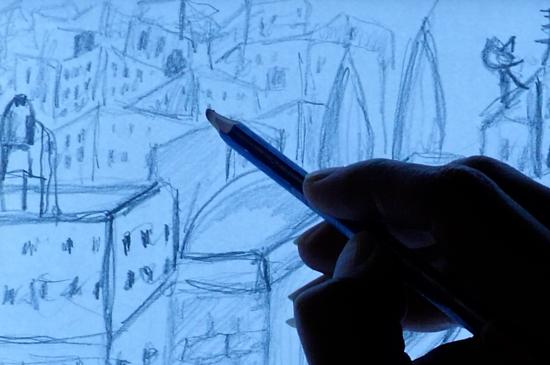
What is left when everything fades away? An old photographer tries to reconstruct people and events by means of old photographs, but they keep slipping away from him, vanishing in the dark, washed away by the waves. In his 2D animated film, rendered in black and white, Anton Dyakov not only shows how memories are lost, but also how they sometimes haunt and overwhelm us – for example in the shape of a disturbing archive fragment of blurred war photos. “Black Box” deals with loss and grief from a personal, yet universal perspective, while referencing the culture of remembrance in the digital age which is increasingly managing – or seeking to manage – without the haptic assurance of a printed photo.
Marie Ketzscher
Screenings & Tickets
Credits
Contact
claus@trollfilm.no
For Life
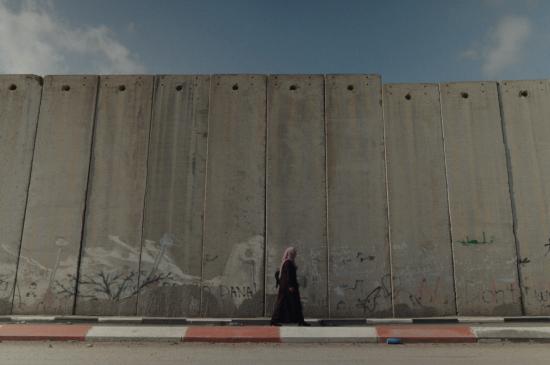
A Palestinian woman, Hind Mashahra, longs for motherhood, but this seems hardly possible as her husband is serving a life sentence in an Israeli prison and is barred from marital visits. Smuggling her husband’s sperm out of prison may be the only chance for her to become a mother again. The documentary follows Hind as she sets out on a risky mission to obtain and deliver her husband’s sample to a fertility clinic. Her repeated attempts are hampered by the traffic, checkpoints, and the short life of semen, perishing within just hours. Unadorned in its language, the film stays close to Hind’s inner experience in the throes of drama, shaped by the reality in the West Bank and East Jerusalem, as well as in quieter moments of waiting that are no less charged. Weaving in accounts of other prisoners’ wives, the documentary chronicles a Palestinian woman’s journey as she pursues motherhood at an extraordinary cost.
Sevara Pan
Contains mentions of death, physical violence
Contains depictions of physical violence, death
Screenings & Tickets
Credits
Contact
benahmetseven@gmail.com
Hope Is a Word
Thick smoke clouds rise at the horizon. Oil bubbles from the ground. The gills of a dead fish are black. A sonorous voice recites a poem about blood, anger and the oil-contaminated landscape of the Niger Delta. A crowd of people join in for the refrain. Writer and activist Nnimmo Bassey has been protesting for decades again the oil extraction in the south of Nigeria and its consequences for humans, nature and agriculture. The Ogoni, an ethnic minority from the region, are particularly affected, with their whole basis for life under existential threat as a result. In the 1990s, they organised a powerful political movement, which was violently put down by the military government – also in the interest of Western oil concerns. How is it possible to put up political resistance in such circumstances? “Hope Is a Word” is the portrait of a man who believes in the power of poetic language. With his workshops, Nnimmo Bassey manages to mobilise a new generation of rhetorically and literarily gifted activists. When they read, rap or recite, the film puts their words into the frame in demonstrative fashion. Poetry becomes a political tool here. For a call can come from a verse, a call that others then follow.
Jan-Philipp Kohlmann
Screenings & Tickets
Credits
Contact
anita@smau.no
in memory of
Carolin Weidner
Screenings & Tickets
Credits
Contact
ciucioflorinda@gmail.com
Kreislauf
Meike Weimann