Topic
- Activism
- Animated Documentary
- Archival Footage
- Arts/Culture
- Coming of Age
- Digital Culture
- Eastern German
- Environment
- Experimental
- Family
- Gender
- History
- Human Rights
- Humour
- Labour/Economy
- LGBTQIA2S+
- Music
- Politics/Current Affairs
- Portrait/Biography
- Psyche/Mind
- Religion/Spirituality
- Science/Technology
- Social Issues
- Sports
- Underrepresented Communities
- War/Conflict
- Youth
Filmtype
Accessibility
Custom type
Topic
- Activism
- Animated Documentary
- Archival Footage
- Arts/Culture
- Coming of Age
- Digital Culture
- Eastern German
- Environment
- Experimental
- Family
- Gender
- History
- Human Rights
- Humour
- Labour/Economy
- LGBTQIA2S+
- Music
- Politics/Current Affairs
- Portrait/Biography
- Psyche/Mind
- Religion/Spirituality
- Science/Technology
- Social Issues
- Sports
- Underrepresented Communities
- War/Conflict
- Youth
Accessibility
Awaken, My Children
Marie Ketzscher
Screenings & Tickets
Credits
Contact
lyza.jarvis@artun.ee
Chile lebt
The Europe-wide protests against Chile’s military dictatorship were expressed not only by political activism, but by a host of artistic actions. The colourful aesthetics of the Unidad Popular’s street art, popularised by the Ramona Parra Brigades, became a visual trademark. Based on this model, the Brigada Pablo Neruda, for example, whose members included well-known Chilean artists exiled in Paris like José Balmes, Gracia Barrios and Guillermo Núñez, realised a 60-metre-long mural on the fringes of documenta 6 in Kassel in 1977. Its creation was documented in Franz Lehmkuhl’s film “Chilenische Wandmalerei” (1977–80), screened in Leipzig in 1980. In his agitation film “Chile lebt”, co-produced with Michael Börner, the Chilean journalist and filmmaker Juan Forch uses pictures of the Brigada Pablo Neruda to express what keeps hope in his homeland alive: international solidarity. In 1979, Forch returned to Chile from exile in the GDR.
Florian Wüst
Screenings & Tickets
Credits
Contact
defa-filmverleih@deutsche-kinemathek.de
Far Far Away
Romantic, mystical, folkloristic: Theodor Kittelsen's (1857–1914) oeuvre as a painter is not just dedicated to nature but also to legends and trolls – and has influenced artists to the present day. Natasha Nikitina for example, whose film takes up Kittelsen's twelve-part series of pictures "Soria Moria Palace" and his eponymous book: The young hero Askeladden sees the golden palace of Soria Moria in the distance and sets out to reach it; an allegory of the golden future that can be earned with a lot of hard work and dedication. In her film, however, Nikitina focuses more on the atmospheric element, letting a troll in a rock wake up and fall asleep again, letting geese and other birds take flight, letting fog and dusk turn into night and back into a glowing morning. A tribute to the artist, but also to the myth-enshrouded Norwegian landscape in general.
Marie Ketzscher
Screenings & Tickets
Credits
Contact
claus@trollfilm.no
Glaube Sitte Heimat
André Eckardt
Contains depictions of drug-use, nudity, physical violence
Screenings & Tickets
Credits
Contact
fidelsievering@gmail.com
I’m Painting a Self-Portrait, but All I See Is My Sister’s Face
Carolin Weidner
Trailer
Screenings & Tickets
Free entry
Free entry
Credits
Contact
hela.stanczyk@gmail.com
Illapu – Lied von Freiheit und Liebe
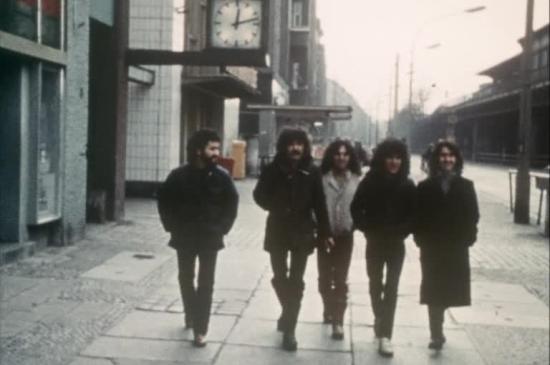
The Chilean folk group Illapu only really became famous under the military dictatorship. The five musicians were allowed to work, but had to “keep a low profile”. When they gradually joined the cultural resistance against the Pinochet regime, they were expelled in 1981. From their French exile, they toured Europe, including East Berlin. This is where Carlos Puccio’s film begins: The Chilean directing student observed Illapu’s rehearsals and concerts for his diploma film project at the Film and Television Academy of the GDR. They talk about their enduring bond with Chile and about what would happen if individual members of the band were given entry permits and Illapu would consequently break up. In 1986, they moved to Mexico together and returned to Chile two years later because of the changing political climate.
Florian Wüst
Screenings & Tickets
Credits
Contact
cristina.marx@filmuniversitaet.de
in memory of
Carolin Weidner
Screenings & Tickets
Free entry
Credits
Contact
ciucioflorinda@gmail.com
Kurtág Fragments
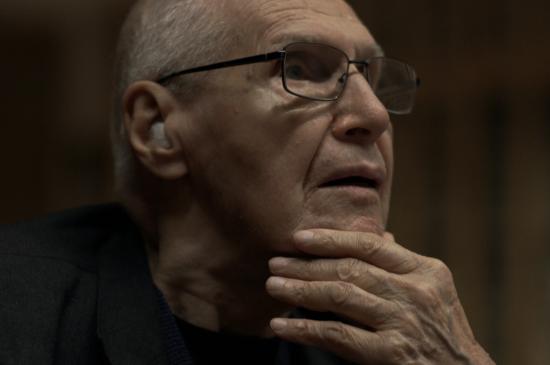
György Kurtág is a renowned Hungarian composer and a major figure of the post-war avant-garde. Born in 1926, he has now reached the age of 100, yet his mind remains wonderfully active. Living in an attic flat of the Budapest Music Center, he continues to work tirelessly with some of the world’s finest musicians who open their creations up to the humbling process of collaboration. Traversing geographies, the film takes us from his birth town of Lugoj to the different places that shaped him, from Transylvania to Budapest to Paris. It traces his early steps into the world of music, which began with dance and four‑hand piano sessions with his mother — something he later continued with his wife and pianist Márta. It then follows his life and many artistic collaborations, including with Icelandic pianist Víkingur Ólafsson and British cellist Steven Isserlis. The film also weaves in the work on his magnum opus “Fin de Partie”. “The map is not the territory; the notes are not music…” To pianists Halla Oddný Magnúsdottir and Ólafsson, Kurtág has “found a way of writing music that is impossible to play without going beyond the notes”. It’s a sentiment shared by Kurtág, who remarks that it’s not about his ideas but about whether the piece, played by a musician, truly “happens” to them. A portrait of a man who lives and breathes music, composing entire worlds brimming with emotion.
Sevara Pan
Trailer
Screenings & Tickets
Credits
Contact
kati.vajda@nfi.hu
Magic Atlas
Marie Ketzscher
Contains depictions of physical violence, drug-use, child abuse
Screenings & Tickets
Credits
Contact
g362005@163.com
Maro’s Photo
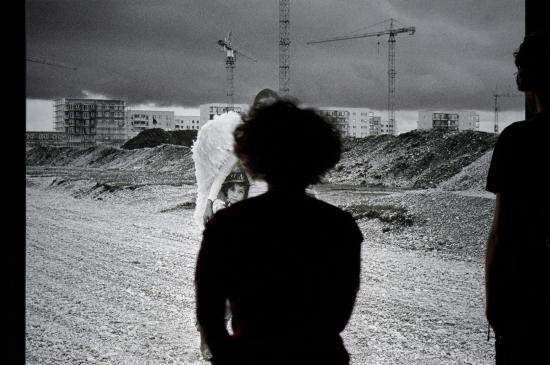
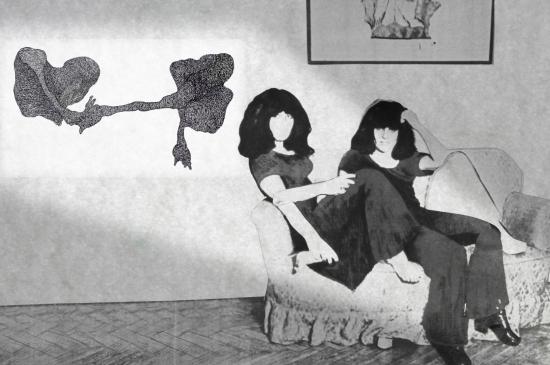
In the early 2000s, Maria Nikolaidou took a photo on Munich’s “Panzerwiese” (tank meadow): Her son Alexandros and another little boy playing war. A woman with angel’s wings wraps her arms protectively around the two of them. Twenty-three years later, mother and son return to the spot where the black and white photo was taken. Alexandros now uses the same camera to make a photo film about the image and also meets with his former playmate. Their voice-over memories and associations reveal different perspectives and moods. The history and stories behind a photograph are being reconstructed: What was overlooked at the time? Why were Alexandros’ grandparents not allowed to give him a gun? Who is the person on the hill in the background? In the end, a new image emerges.
Anke Leweke
Trailer
Screenings & Tickets
Free entry
Credits
Contact
a.murboeck@posteo.de
Moon Flight
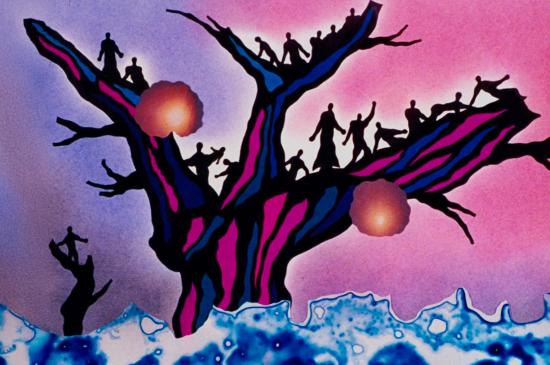
A Slavic legend whose essence can also be found in Tibetan records inspired the two Soviet scientists Mikhail Vasin and Alexander Shcherbakov to formulate their “Hollow Moon” hypothesis in 1970. In this hypnotic film, the Hungarian director, autodidact and graphic designer Sándor Reisenbüchler probes the theory in a highly poetical manner, sending us across the centuries from an imagined past to a distant future. His unmistakeable collages, which he brought to life with meticulous precision working alone at the animation table, combined with experimental moving image material, recall memories of analogue projections and the liquid light shows of the 1960s. Organic shapes and colourful patterns generate a fascinating pull which carries us through a magical portal into a hypothetical space ship inside the moon.
Franka Sachse
Photosensitivity warning: Contains flashes of light that may trigger seizures for people with visual sensitivities.
Screenings & Tickets
Credits
Contact
My Brilliant Father
When the writer Jan Christ talks about himself and his work, the words take on a life of their own. “The asshole in which I exist”, he says, referring to his progressive dementia, which causes not only the loss of memory, but also of language and authority. He is working on his last great oeuvre, a “Buch vom Grunde” (Book from the Depth). He struggles for lofty words. As an artist, he supports the artistic work of his daughter, who accompanies him with her camera during his final eight years. He directs himself or allows himself to be directed, while the filmmaker insists and does care work at the same time. In between, we see a vixen roaming the nocturnal streets of Berlin. Tete Hoffmann’s portrait of her father is at once a tribute, a confrontation, a crafty game and a helpless observation of the disintegration of a beloved person. Who has the right here to get attention, and when? Is it still permissible to continue exploring when the father and the writer have drifted apart? Clinging to language is contrasted with the letting go of images. “You are a vixen”, the brilliant father tells his brilliant daughter.
Jan Künemund
Contains depictions of mental health conditions
Trailer
Screenings & Tickets
Credits
Contact
tetehoffmann@web.de