Topic
- Activism
- Animated Documentary
- Archival Footage
- Arts/Culture
- Coming of Age
- Digital Culture
- Eastern German
- Environment
- Experimental
- Family
- Gender
- History
- Human Rights
- Humour
- Labour/Economy
- LGBTQIA2S+
- Music
- Politics/Current Affairs
- Portrait/Biography
- Psyche/Mind
- Religion/Spirituality
- Science/Technology
- Social Issues
- Sports
- Underrepresented Communities
- War/Conflict
- Youth
Filmtype
Accessibility
Custom type
Topic
- Activism
- Animated Documentary
- Archival Footage
- Arts/Culture
- Coming of Age
- Digital Culture
- Eastern German
- Environment
- Experimental
- Family
- Gender
- History
- Human Rights
- Humour
- Labour/Economy
- LGBTQIA2S+
- Music
- Politics/Current Affairs
- Portrait/Biography
- Psyche/Mind
- Religion/Spirituality
- Science/Technology
- Social Issues
- Sports
- Underrepresented Communities
- War/Conflict
- Youth
Accessibility
Atlas of Disappearance
Seggen Mikael
Contains mentions of murder, death
Trailer
Screenings & Tickets
Credits
Contact
internacional@agenciafreak.com
Auber 89
Anca Păunescu
Screenings & Tickets
Credits
Contact
raluca@lightdox.com
Awaken, My Children
Marie Ketzscher
Screenings & Tickets
Credits
Contact
lyza.jarvis@artun.ee
El primer año
“El primer año” documents the first year of the Unidad Popular: the rude awakening of the ruling classes of Chile as they are faced with the democratically elected socialist government. From the immediate economic sabotage of the right wing through celebrating workers, the situation of the Mapuche, the agrarian reform, the nationalisation of coal and copper mining and Fidel Castro’s visit, up to the “March of the Pots” by bourgeois women crying for bread, of which they have plenty, the cycle of achievements and difficulties is complete. Besides their journalistic interest, Patricio Guzmán and his collaborators sought to capture the atmospheric aspect of the departure towards a fairer society under Salvador Allende, which is what makes “El primer año” such a moving document of its time. Chris Marker offered to produce a French version with the help of the SLON film collective, which is preceded by photographs by Raymond Depardon, accompanied by a foreword on the history of Chile. Guzmán continued his work on the chronicle of events until he was forced to leave the country after the military coup of 11 September 1973. It was only in Cuban exile that he was able to successively finish his masterpiece “La Batalla de Chile” (1975-79) together with Pedro Chaskel. Each of its three parts was acclaimed at the International Leipzig Documentary and Short Film Week and the Berlinale Forum.
Florian Wüst
Screenings & Tickets
Credits
Contact
alexandra@bfdistribution.cl
Extinction Story
André Eckardt
Screenings & Tickets
Credits
Contact
Far Far Away
Romantic, mystical, folkloristic: Theodor Kittelsen's (1857–1914) oeuvre as a painter is not just dedicated to nature but also to legends and trolls – and has influenced artists to the present day. Natasha Nikitina for example, whose film takes up Kittelsen's twelve-part series of pictures "Soria Moria Palace" and his eponymous book: The young hero Askeladden sees the golden palace of Soria Moria in the distance and sets out to reach it; an allegory of the golden future that can be earned with a lot of hard work and dedication. In her film, however, Nikitina focuses more on the atmospheric element, letting a troll in a rock wake up and fall asleep again, letting geese and other birds take flight, letting fog and dusk turn into night and back into a glowing morning. A tribute to the artist, but also to the myth-enshrouded Norwegian landscape in general.
Marie Ketzscher
Screenings & Tickets
Credits
Contact
claus@trollfilm.no
Inside – Outside
Philip Zengel
Screenings & Tickets
Credits
Contact
Private Universe
Lars Meyer, DOK Leipzig Catalogue 2012
Screenings & Tickets
Credits
Contact
Staßfurt – Windhoek
Philip Zengel
Screenings & Tickets
Credits
Contact
defa-filmverleih@deutsche-kinemathek.de
Sumo: Spirit Weighs Nothing
Carolin Weidner
Screenings & Tickets
Credits
Contact
ESPN
Ten to Twenty Spoil Heaps
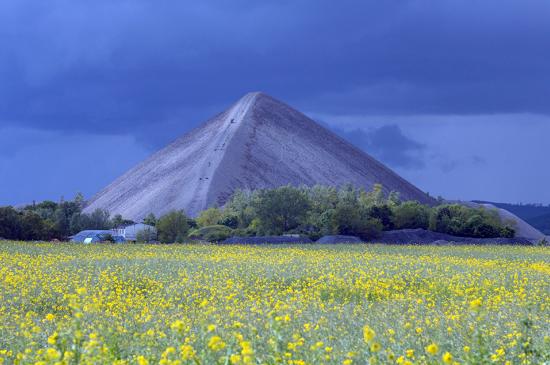
Mansfeld, an East German mining region: The land is gone, but the slag heaps are still there. As a mighty colossus on a barren plain, as the top of a pyramid behind a terraced house, as a dark line on the horizon. These piles of former mining waste have become imposing landmarks. Emerson Culurgioni views them as sediments of history. The carefully framed tableaus of an empty, post-industrial landscape, crossed only occasionally by a Simson moped gang whizzing by, recall James Benning’s exploration of a human-made environment. In contrast to the stillness of the images, a stream of far-reaching reflections about soil and resources, war and crises, labour and destruction, East and West, origin and identity, home and belonging meanders on the soundtrack. Layer by layer, long-dumped memories are uncovered. At the end is the question: What value do we attach to them.
Grit Lemke
Screenings & Tickets
Credits
Contact
emerson@posteo.de
The Class of 1990
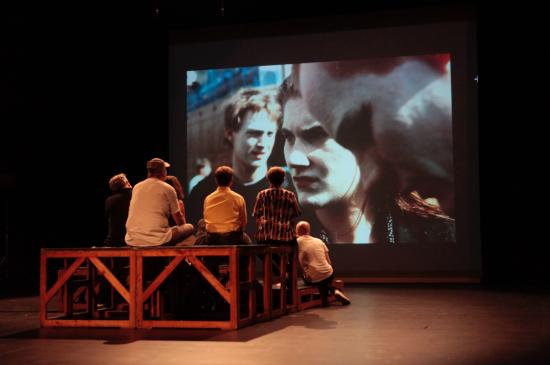
A theatre stage, Hamlet: the "call for freedom": The ones who declaim it have learned their craft. Right here, in Rostock, they had begun their studies a month before the German reunification. 35 years later, they remember. 1990: They come from different backgrounds, from East and West. They are strangers, live in prefabricated homes. And they quickly find themselves in a maelstrom sweeping across the whole of the East: Like the factories around them, the theatre school is to be "phased out". At the same time, the "Sonnenblumenhaus" is burning in Rostock-Lichtenhagen. They must learn to organise themselves. Like pieces of a jigsaw, individual tales, supplemented by archive images and historical rehearsal videos, come together to form a picture of those times. Embodied by today’s students, who re-enact scenes from the past, the past is reflected in the present. The story of the East German student movement of the early 1990s has been almost completely erased from the collective memory today. As in Rostock, nothing at Leipzig University reminds us that the existence of a number of scientific or artistic institutes and institutions is owed solely to their commitment. "Die Klasse von 1990" is an urgently needed corrective to a Western-dominated historiography, and a lesson in self-empowerment and democracy.
Grit Lemke
Screenings & Tickets
Credits
Contact
office@poison-berlin.com