Topic
- Activism
- Animated Documentary
- Archival Footage
- Arts/Culture
- Coming of Age
- Digital Culture
- Eastern German
- Environment
- Experimental
- Family
- Gender
- History
- Human Rights
- Humour
- Labour/Economy
- LGBTQIA2S+
- Music
- Politics/Current Affairs
- Portrait/Biography
- Psyche/Mind
- Religion/Spirituality
- Science/Technology
- Social Issues
- Sports
- Underrepresented Communities
- War/Conflict
- Youth
Filmtype
Accessibility
Custom type
Topic
- Activism
- Animated Documentary
- Archival Footage
- Arts/Culture
- Coming of Age
- Digital Culture
- Eastern German
- Environment
- Experimental
- Family
- Gender
- History
- Human Rights
- Humour
- Labour/Economy
- LGBTQIA2S+
- Music
- Politics/Current Affairs
- Portrait/Biography
- Psyche/Mind
- Religion/Spirituality
- Science/Technology
- Social Issues
- Sports
- Underrepresented Communities
- War/Conflict
- Youth
Accessibility
Lederwarenfertiger – Ein Beruf für Dich [excerpt]
Meike Weimann
Screenings & Tickets
Credits
Contact
Light
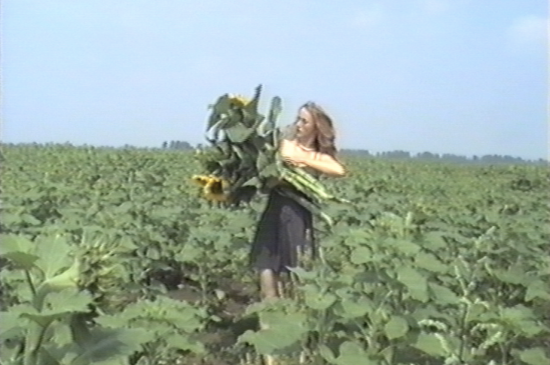
1995. It is the sixth summer since the fall of the Berlin Wall. Artists live, love and work on a farm in East Germany. They film each other with a video camera. They have seen the world, have wondered and learned, became homesick and returned. To where there was space. Fruit hangs from the trees, sparrows chirp, sculptures in the garden. Time and again the camera captures a young woman, her open gaze, her focus. The material which has become fragile today vibrates, gets stuck, freezes. Unperturbed, the narrative evokes the paean of summer, which will not be followed by a seventh for one of them. A white light shines into the present.
Jan Künemund
Contains mentions of death
Screenings & Tickets
Free entry
Credits
Contact
juliane.ebner@gmx.de
Mein Leipzig – lobt das keiner mehr?
Meike Weimann
Screenings & Tickets
Credits
Contact
Neighborhood Autobahn
A cinematic observation of a landscape shaped and still marked by borders. Even 35 years after reunification, borders are still present in Marienborn. There is the memorial recalling the violence of the SED regime. Just a stone’s throw away, new borders have been added. Refugees now live in the former NVA barracks, which have been converted into a collective accommodation centre. To get here, they, too, had to cross borders, often clandestinely and at the risk of their lives. Now another border separates them from the outside world: a combination of wall and fence that inevitably brings to mind the former border security facilities of the GDR. In long tracking shots whose wide-angle view makes them seem almost otherworldly, the film observes this coexistence of opening and delineation. While the images make continuities visible, the sound brings out the subtle differences between the various locations.
Luc-Carolin Ziemann
Contains mentions of racism
Trailer
Screenings & Tickets
Free entry
Credits
Contact
luci.schwingen@gmail.com
Silicon Saxony
Cranes on flat country. A Taiwanese chip giant is building Europe’s biggest semiconductor factory north of Dresden. The “building blocks of modern economy” play a central role against China, the USA, the rest of the world … Yet it is precisely in this place, where the new is grandly heralded, that a “forgotten future” lies buried. This was the centre of GDR semiconductor research, which strove to realise a social utopia by means of microelectronics. Some see the chip as a “weapon” in the fight for economic dominance and profit, others saw it as a political programme on the path to the “new human”. Jonas Meschede mixes neon-coloured images of a futuristic setting from the cleanrooms of the present with GDR science fiction and archive footage, unearthing what was buried. Once more, the promises of a golden future appear at the end. And the certainty that in the ground on which its gleaming factories are built what was declared dead only lies dormant.
Grit Lemke
Trailer
Screenings & Tickets
Credits
Contact
meschedeleon@gmail.com
Staßfurt – Windhoek
Philip Zengel
Screenings & Tickets
Credits
Contact
defa-filmverleih@deutsche-kinemathek.de
Ten to Twenty Spoil Heaps
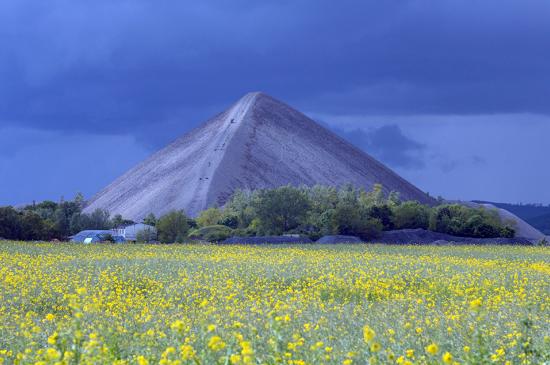
Mansfeld, an East German mining region: The land is gone, but the slag heaps are still there. As a mighty colossus on a barren plain, as the top of a pyramid behind a terraced house, as a dark line on the horizon. These piles of former mining waste have become imposing landmarks. Emerson Culurgioni views them as sediments of history. The carefully framed tableaus of an empty, post-industrial landscape, crossed only occasionally by a Simson moped gang whizzing by, recall James Benning’s exploration of a human-made environment. In contrast to the stillness of the images, a stream of far-reaching reflections about soil and resources, war and crises, labour and destruction, East and West, origin and identity, home and belonging meanders on the soundtrack. Layer by layer, long-dumped memories are uncovered. At the end is the question: What value do we attach to them.
Grit Lemke
Screenings & Tickets
Credits
Contact
emerson@posteo.de
The Class of 1990
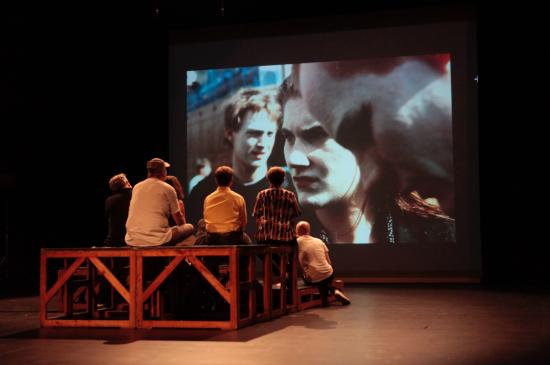
A theatre stage, Hamlet: the "call for freedom": The ones who declaim it have learned their craft. Right here, in Rostock, they had begun their studies a month before the German reunification. 35 years later, they remember. 1990: They come from different backgrounds, from East and West. They are strangers, live in prefabricated homes. And they quickly find themselves in a maelstrom sweeping across the whole of the East: Like the factories around them, the theatre school is to be "phased out". At the same time, the "Sonnenblumenhaus" is burning in Rostock-Lichtenhagen. They must learn to organise themselves. Like pieces of a jigsaw, individual tales, supplemented by archive images and historical rehearsal videos, come together to form a picture of those times. Embodied by today’s students, who re-enact scenes from the past, the past is reflected in the present. The story of the East German student movement of the early 1990s has been almost completely erased from the collective memory today. As in Rostock, nothing at Leipzig University reminds us that the existence of a number of scientific or artistic institutes and institutions is owed solely to their commitment. "Die Klasse von 1990" is an urgently needed corrective to a Western-dominated historiography, and a lesson in self-empowerment and democracy.
Grit Lemke
Screenings & Tickets
Credits
Contact
office@poison-berlin.com
Transition
On New Year's Eve 2023, Thomas Heise begins to shoot his new film. It is to be called “Übergang”. His idea: A film in the “Heimatfilm” tradition revolving around Berlin’s Schönhauser Allee, where he has lived for decades. The author is to be a character in the film. A few months later, Heise falls seriously ill and dies. The small team continues to work on the film, unearthing unpublished texts and images from Heise’s estate and archives. “Images are […] encompassing”, Heiner Müller is quoted, but dreams curdle quickly. As soon as the personal story becomes a false image, it is gently but persistently put into perspective. A touching email exchange Heise had with a female high-school graduate in Karlsruhe who is searching for truth contains a whole primer for documentary filmmaking: “See what you would not otherwise see. Stay patient. […] Never expect financial security. Be happy about that. Because it won’t change.” Peter Badel and Chris Wright have not produced a hermetic artist tribute, but have, utterly in the spirit of Heise, pieced together fragments of lived history.
Jan Künemund
Contains mentions of death
Screenings & Tickets
Free entry
Credits
Contact
Uncle Thuận
He is „always sad“, says Uncle Thuận. Connected via mobile phone with his family who are scattered across the world he sings sentimental songs about spring in Hanoi. Meanwhile, his wife Thúy tirelessly looks after the restaurant that the two have been managing in North Rhine-Westphalia for twenty years. They came to the GDR as contract workers at the age of 19. In conversations with their daughters, life stories unfold in which they were rarely expected to decide anything but always to work hard and to function. A role they accept without complaint and justify even today. But the protective shell accumulated over decades increasingly begins to show cracks. And somewhere in the endless routines and tasks of a restaurant kitchen which also structure the film, a question quietly emerges: the question of happiness. In Minh Anh Nguyễn, a post-migrant generation speaks up who regard contract work and racism in the GDR not as a closed chapter but as part of their history. Casual and very close to her protagonists, she tells of colonial legacies that have inscribed themselves into biographies and across generations. At the same time, she shows how this cycle can be broken: By the daughters asking questions which – even outside the Vietnamese community and above all in the East – are long overdue.
Grit Lemke
Trailer
Screenings & Tickets
Credits
Contact
nguyen.minh-anh@web.de
VEB Edelpelz Schkeuditz [excerpt]
Disclaimer: This documentary film contains neither images of fur farms nor of the slaughter, skinning or killing of animals.
Meike Weimann