Film Archive

Sections (Film Archive)

Retrospective 2024
Filmstill [Opening speech for the retrospective “Cuban Documentary Film”] [excerpt]
[Opening speech for the retrospective “Cuban Documentary Film”] [excerpt]
Santiago Álvarez
Cuban documentarist Santiago Álvarez speaks to GDR cultural officials and the “fighting” youth of Leipzig: about documentary film as a weapon against imperialism and colonialism.
Filmstill [Opening speech for the retrospective “Cuban Documentary Film”] [excerpt]

[Opening speech for the retrospective “Cuban Documentary Film”] [excerpt]

[Eröffnungsrede zur Retrospektive „Kubanischer Dokumentarfilm“] [Ausschnitt]
Santiago Álvarez
Retrospective 2024
Acoustical Film
GDR
1974
15 minutes
German,
Spanish
Subtitles: 
German (Overvoice)

In 1974, the GDR and the Leipzig festival celebrated the 25th anniversary of the Cuban Revolution with the “Cuban Documentary Film” retrospective. Santiago Álvarez, vigorous propagandist of documentary film as an art of war against imperialist cinema entertainment, spoke at soporific length at the opening.
One wonders whether, in addition to the invited officials, the “fighting” youth of Leipzig addressed by Álvarez were present at the event. The speech has survived only as an audio document, the images must be imagined. The recording was commissioned by the State Film Documentation, a government agency that was to preserve GDR reality for the future. In 1974, no one in the room could have imagined that this future would one day take place without the GDR.

Sylvia Görke

Credits DOK Leipzig Logo

Director
Santiago Álvarez
Producer
Staatliche Filmdokumentation
Retrospective 2024
Filmstill 15.000 Volt
15.000 Volt
Karlheinz Mund
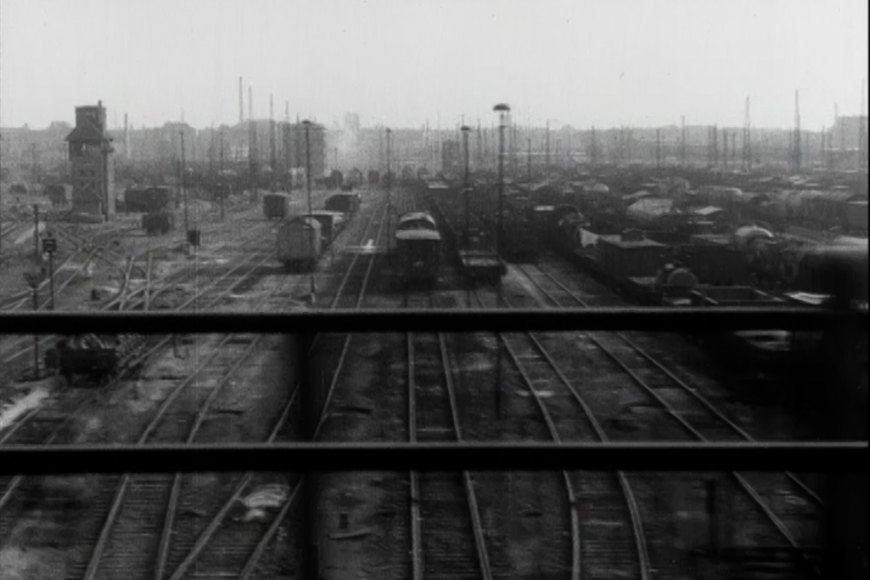
On the overhead wire 15,000 volts, underneath everyday working life on an electric locomotive. On the soundtrack a passenger who the GDR will throw overboard in 1976: Wolf Biermann.
Filmstill 15.000 Volt

15.000 Volt

15.000 Volt
Karlheinz Mund
Retrospective 2024
Documentary Film
GDR
1963
18 minutes
German
Subtitles: 
None

This graduation film by future DEFA documentarian Karlheinz Mund presents a piece of GDR working worlds in the best poetic and earthy Babelsberg school tradition: the everyday life of railway workers – with two women in the electric locomotive driver’s cab.
In 1963, Leipzig audiences were able to get to know Mund’s study in the festival’s university film presentation. At the end, the “Spring Song of the Railwaywoman” can be heard off-screen, sung by Wolf Biermann. The GDR still tolerated the rebellious tormentor. Those who heard him in this film at the time probably only found out later that the authorities had long had him in their sights. In 1963, East Berlin’s Humboldt University refused to grant him a degree in philosophy despite passing his exams. Listening to Biermann’s song today, the words become charged: spring storm, great rain, a land waiting …

Sylvia Görke

Credits DOK Leipzig Logo

Director
Karlheinz Mund
Cinematographer
Hans-Jürgen Reinecke, Gerhard Gläser, Werner Kohlert, Eberhard Teich-Grüber
Editor
Gisela Hoffmann
Producer
Roland Paul
Sound
Günter Grossmann
Score
Gerhard Rosenfeld
Narrator
Dorothea Richter
Retrospective 2022
Filmstill Ablinga
Ablinga
Dagnija Osite-Krüger
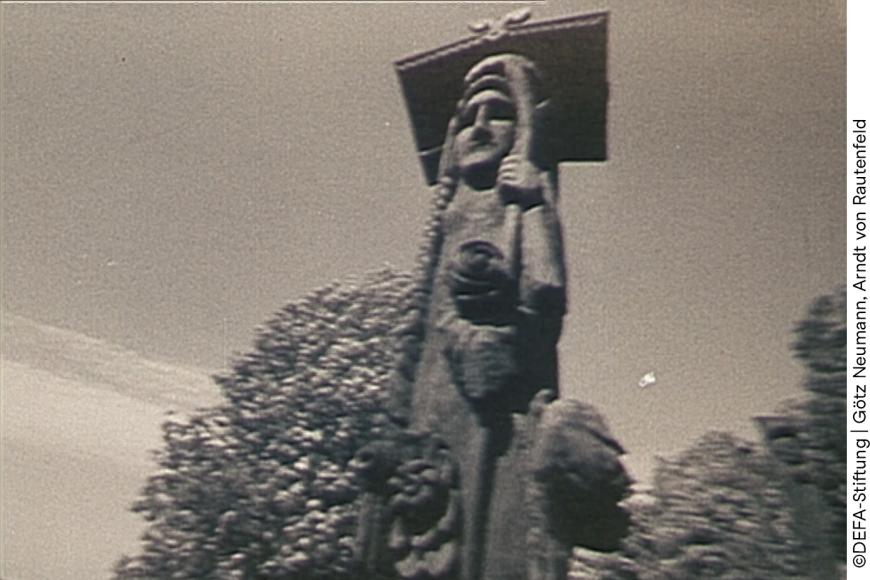
A Lithuanian village destroyed by the Wehrmacht is reborn as a forest of sculptures. This film poem commemorates the murdered ones and calls for peace.
Filmstill Ablinga

Ablinga

Ablinga
Dagnija Osite-Krüger
Retrospective 2022
Documentary Film
GDR
1977
13 minutes
German
Subtitles: 
None

Nothing is left of the Lithuanian village of Ablinga. Destroyed by Wehrmacht soldiers in 1941, a forest of sculptures was erected in 1972 to commemorate those who once lived here. Larger than life, the carved wooden monuments rise to the sky. In national poet Justinas Marcinkevičius’s poem they wake up again, share some last secrets and become connecting links on a timeline that knows violence and dreams of peace. Dagnija Osite-Krüger’s montage is bold, playful and sometimes brutal, her concern credible and strong. Within a few minutes, “Ablinga” puts a spell on us, becoming a monument to German guilt and the memory of the murdered ones.

Carolin Weidner

Credits DOK Leipzig Logo

Director
Dagnija Osite-Krüger
Script
Dagnija Osite-Krüger
Cinematographer
Leonid Krainenkow
Editor
Werner Wendt
Producer
DEFA-Studio für Dokumentarfilme
Sound Design
Peter Gotthardt
Retrospective 2024
Filmstill Aida
Aida
Marwan Salamah
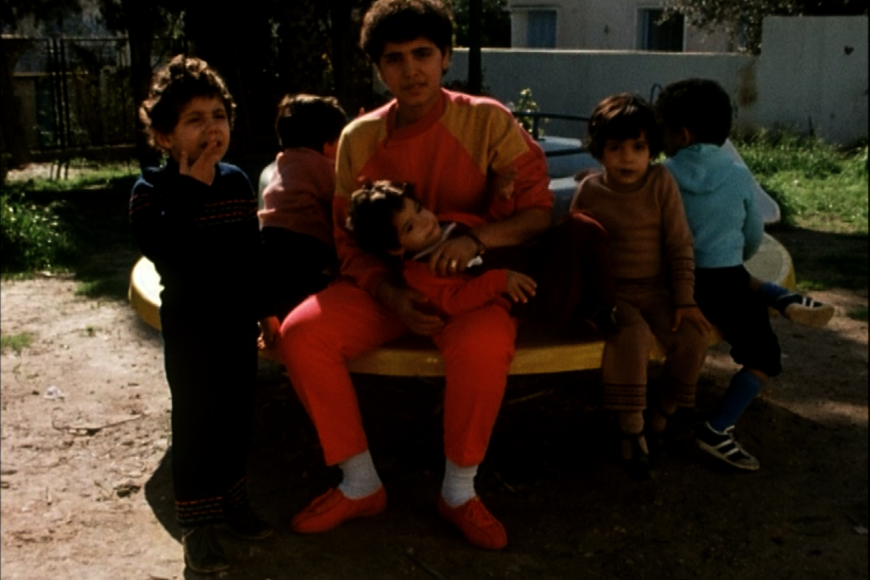
Marwan Salamah was delegated by the Palestine Liberation Organization to study in Babelsberg. As a one-man team, he realised this portrait of a young educator in a PLO orphanage in Tunis.
Filmstill Aida

Aida

Aida
Marwan Salamah
Retrospective 2024
Documentary Film
GDR
1985
22 minutes
Arabic
Subtitles: 
German (Overvoice)

Words of the poet Mahmoud Darwish float through this film: “Tell me. Perhaps I will remember my home whose perfume is only on my lips.” A 17-year-old Palestinian introduces herself: Aida, the returning one. When her father was killed in battle, her mother was already dead, killed by a bomb. When she was eight, she was sent to a PLO orphanage in Beirut, then to an orphanage in Damascus, then to an orphanage in Tunis. Here she takes care of new orphans. The portrait of a girl expands: countless children who will forget their homeland and origin. There is nothing but war left in their drawings. The PLO had assigned its collaborator Marwan Salamah to study cinematography at Babelsberg. Here, he is also the director. In 1985, “Aida” won the Prize of the World Federation of Democratic Youth in Leipzig.

Sylvia Görke

Credits DOK Leipzig Logo

Director
Marwan Salamah
Script
Marwan Salamah, Elke Schieber
Editor
Karin Geiß
Producer
Hochschule für Film und Fernsehen der DDR
Retrospective 2021
Media Name: 3b2d1331-941c-4092-9b29-c1ab7865ad61.png
Operation J
Walter Heynowski
A polemical biographical research of Adenauer’s Chief of Staff of the Chancellery Globke: Nazi administrative lawyer, Eichmann confidant, accomplice to the racist declassification of Jews.
Media Name: 3b2d1331-941c-4092-9b29-c1ab7865ad61.png

Operation J

Aktion J
Walter Heynowski
Retrospective 2021
Documentary Film
GDR
1961
103 minutes
German
Subtitles: 
None

Heynowski’s biographical research in the guise of an exposé film was part of a campaign coordinated by SED functionary Albert Norden to unmask the FRG as a fascist state. Documents and commentaries trace the career of Adenauer’s Chief of Staff of the Chancellery, Hans Globke, who had collaborated in the systematic marking and racist declassification of Jews as a Nazi administrative lawyer and Eichmann confidant. The facts had been on the table for some time, but acquired new propaganda value in view of the impending Eichmann trial. In 1961, “Operation J” was awarded a main prize at the International Leipzig Documentary and Short Film Week.

Sylvia Görke

Credits DOK Leipzig Logo

Director
Walter Heynowski
Script
Walter Heynowski
Cinematographer
Rolf Sperling
Editor
Bert Schultz
Producer
Deutscher Fernsehfunk (DFF)
Retrospective 2024
Filmstill Associations
Associations
John Smith
Nail polish, a general, a mule. John Smith recites from a text by the linguist Herbert H. Clark. The words evoke appropriate images, but mean something different.
Filmstill Associations

Associations

Associations
John Smith
Retrospective 2024
Documentary Film
UK
1975
7 minutes
English
Subtitles: 
None

It was only long after the end of the GDR that the Leipzig audiences had an opportunity to get to know the work of John Smith, the British master of the trenchant, short artist film that continues to expand enormously in the mind. The ideas of conceptual art and structural minimalism prevalent in the 1970s have influenced his works, which he sees as documentary films according to John Grierson’s definition, as “creative treatment of actuality.” In his view of the world details are highlighted which then cease to be taken for granted. In “Associations”, he recites a text by the linguist Herbert H. Clark. Words conjure up matching images, but mean something different. An experience that could also be had in the “actually existing socialism” of the GDR.

Sylvia Görke

Credits DOK Leipzig Logo

Director
John Smith
Retrospective 2021
Media Name: 5c49c505-581b-4547-bea9-bb15af694625.jpg
Respite
Harun Farocki
Material from the Nazi Jewish transit camp Westerbork. Every road from here lead to death, including for the cameraman. Farocki analyzes the silent sequences: surgery on the narrative.
Media Name: 5c49c505-581b-4547-bea9-bb15af694625.jpg

Respite

Aufschub
Harun Farocki
Retrospective 2021
Documentary Film
Germany,
South Korea
2007
40 minutes
German captions
Subtitles: 
None

Anyone interned in the Nazi Jewish transit and collection camp Westerbork in the occupied Netherlands faced death: The trains left to Auschwitz from here, to Sobibór. In 1944, the camp commander ordered the prisoner and cameraman Rudolf Breslauer, who was murdered shortly afterwards, to film the camp, presumably as visual evidence of his own “work performance”. Harun Farocki, West German doyen of essayistic image criticism, used the surviving silent material to compose an equally silent sequence analysis commented only in title cards. It is surgery on the hidden narrative, not open heart surgery.

Sylvia Görke

Credits DOK Leipzig Logo

Director
Harun Farocki
Script
Harun Farocki
Cinematographer
Rudolf Breslauer
Editor
Lars Pienkoß, Harun Farocki
Producer
Harun Farocki
Retrospective 2023
Filmstill Uprisings in the Soviet Sphere of Influence
Uprisings in the Soviet Sphere of Influence
Ralph Giordano, Hans-Ulrich Barth
Communism as a history of crises: The authors examine the various uprisings in the Soviet sphere of influence and search for similarities and differences.
Filmstill Uprisings in the Soviet Sphere of Influence

Uprisings in the Soviet Sphere of Influence

Aufstände im sowjetischen Machtbereich
Ralph Giordano, Hans-Ulrich Barth
Retrospective 2023
Documentary Film
FRG
1961
24 minutes
German
Subtitles: 
None

The history of communism as the story of its crises: The two authors Ralph Giordano and Hans-Ulrich Barth take up various uprisings and protests to demonstrate the discrepancy between the claim to power and the reality in “socialist imperialism.” A more nuanced light is shed on individual uprisings, while at the same time feeding into stereotypical Cold War images of the enemy.

Katharina Franck, Andreas Kötzing

Credits DOK Leipzig Logo

Director
Ralph Giordano, Hans-Ulrich Barth
Producer
NDR Norddeutscher Rundfunk / German TV ARD Network
Retrospective 2021
Media Name: 2f55af86-cd4d-441f-b4ef-1e3e390d2af5.jpg
Berlin-Totale XIV. 2. d) Almstadtstraße
Karl-Heinz Wegner
A production of the State Film Documentation, which was set up to preserve uncensored GDR reality: Long-term residents look back on the German-Jewish history of “their” street.
Media Name: 2f55af86-cd4d-441f-b4ef-1e3e390d2af5.jpg

Berlin-Totale XIV. 2. d) Almstadtstraße

Berlin-Totale XIV. 2. d) Almstadtstraße
Karl-Heinz Wegner
Retrospective 2021
Documentary Film
GDR
1979
35 minutes
German
Subtitles: 
None

Why this film document about a street in East Berlin is the way it is, why it conveys an almost touching, basically unformed honesty and perplexity, is due to the specific institution it was made for. The State Film Documentation was founded to provide the GDR with uncensored testimonies of its own reality. Three long-time residents look, through notoriously draughty windows, at the notoriously chilly German-Jewish history: Herr Miegel, former pub owner, Frau Kramp, former cinema employee, Mischket Liebermann, writer and GDR cultural politician. They have been neighbours in their district forever. They will probably remain strangers to each other forever.

Sylvia Görke

Credits DOK Leipzig Logo

Director
Karl-Heinz Wegner
Cinematographer
Roland Worel, Dieter Schönberg
Sound
Dieter Harms
Commissioning Editor
Veronika Otten
Retrospective 2021
Media Name: 102687fc-8c0a-405a-bfbc-eed0678dcd4f.jpg
Educational Attainment of West German Pupils in the 1950s
Jürgen Neven du Mont
Hitler sold badges to come to power? And really six million murdered Jews? A knowledge test among FRG secondary school pupils where it’s actually the parents that fail.
Media Name: 102687fc-8c0a-405a-bfbc-eed0678dcd4f.jpg

Educational Attainment of West German Pupils in the 1950s

Bildungsstand westdeutscher Schüler in den 50er Jahren
Jürgen Neven du Mont
Retrospective 2021
Documentary Film
FRG
1959
44 minutes
German
Subtitles: 
None

On 29 April 1959, Hessian Broadcasting transmitted an alarming survey of the Federal German school system. The first of three parts of the report “Focus on Our Youth” investigates the question of what has stuck in the minds of higher form students about Hitler’s and Ulbricht’s Germanies. Hesse under Polish administration? Hitler sold badges to come to power? At least they are about right concerning the number of murdered Jews – that is, the third who could think of anything to say about this at all. One television critic rightly pointed out that this represented the sum total of all parental table talk. But were these parents watching television on 29 April 1959?

Sylvia Görke

Credits DOK Leipzig Logo

Director
Jürgen Neven du Mont
Cinematographer
Willy Sedler, Bernhard Weber, Günter Seuss
Editor
Hilde Grabow
Producer
HR Hessischer Rundfunk
Sound
Horst Eiteljörge
Retrospective 2023
Filmstill Birth of Solidarity
Birth of Solidarity
Bohdan Kosiński
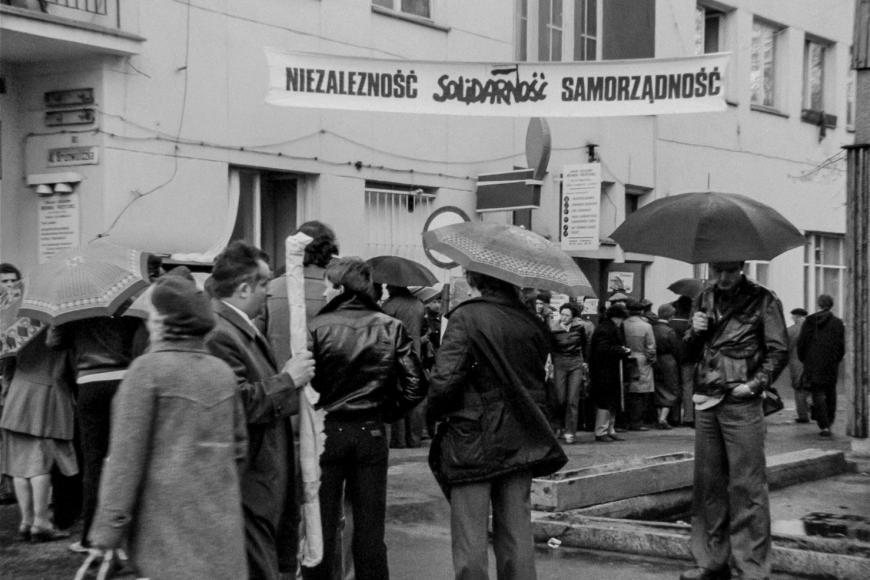
The authorities decide on the future of Solidarność, the masses protest in the streets. A general strike is in the air. For a moment, political change seems possible.
Filmstill Birth of Solidarity

Birth of Solidarity

Narodziny Solidarności
Bohdan Kosiński
Retrospective 2023
Documentary Film
Poland
1981
29 minutes
Polish
Subtitles: 
English

While the communist authorities decide the conditions for an official registration of the Solidarność movement inside, the masses demonstrate in front of the court outside. A contemporary document of the moment when the power of the people seemed to make a lasting cultural opening no longer just a promise but a possibility. At the time, “undesirable” at the Leipzig festival.

Katharina Franck, Andreas Kötzing

Credits DOK Leipzig Logo

Director
Bohdan Kosiński
Script
Bohdan Kosiński
Cinematographer
Michał Bukojemski
Editor
Lidia Zonn
Producer
Wytwórnia Filmów Dokumentalnych
Sound
Małgorzata Rok, Jan Kalisz
Retrospective 2023
Filmstill Black Days
Black Days
Ladislav Kudelka, Milan Černák, Ctibor Kováč, Štefan Kamenický
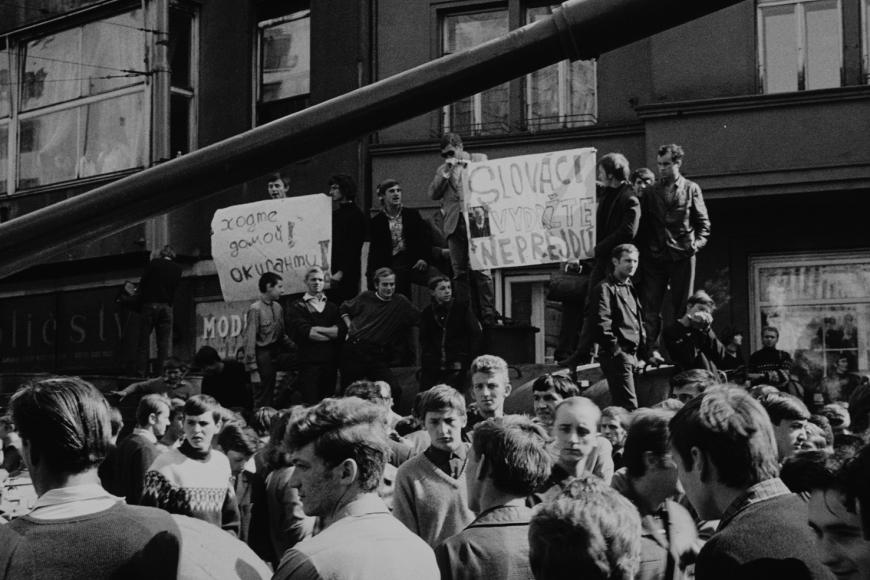
The invasion of Warsaw Pact troops in August 1968 from a Slovak perspective. Politicians and the population search for an appropriate attitude between caution and determination.
Filmstill Black Days

Black Days

Čierne dni
Ladislav Kudelka, Milan Černák, Ctibor Kováč, Štefan Kamenický
Retrospective 2023
Documentary Film
Czechoslovakia
1968
30 minutes
Slovak
Subtitles: 
English

“Stay calm and level-headed!” Endless armoured convoys, radio stations broadcasting their potentially last announcements and the Slovak Communist Party meeting Czech party representatives. Shaky images and wailing sirens testify to the tension as Warsaw Pact troops march into Bratislava, too, to suppress the Prague Spring.

Katharina Franck, Andreas Kötzing

Credits DOK Leipzig Logo

Director
Ladislav Kudelka, Milan Černák, Ctibor Kováč, Štefan Kamenický
Cinematographer
Vladimír Holloš, Leopold Bródy, Pavel Čilek, Oskar Šághy, Mikuláš Fodor, Rudolf Ferko
Editor
Juraj Lexmann, Anna Forischová
Producer
Československý film Bratislava
Sound
Jozef Kováčik, Jaroslav Kopernický, Alexander Pallós, Ján Fabián
Retrospective 2024
Filmstill Black Film
Black Film
Želimir Žilnik
One night, the filmmaker roams through Novi Sad, picks up homeless people and takes them home. A self-experimentation with a camera, somewhere between social reportage and activism.
Filmstill Black Film

Black Film

Crni film
Želimir Žilnik
Retrospective 2024
Documentary Film
Yugoslavia
1971
17 minutes
Serbian
Subtitles: 
English

1971, Novi Sad, a winter’s night. The filmmaker meets six homeless men, is outraged by the negligent state and takes matters into his own hand. As shelter cannot be found at short notice, he invites the men to his apartment, turning his wife into the involuntary accomplice of his relief operation. The experiment fails, but the film is in the can.
Želimir Žilnik is one of those representatives of the Yugoslavian Black Wave who won the hearts of the West. It is true that at home he found state-funded production opportunities for self- and bureaucracy-critical films like this one. He was even allowed to present them at domestic festivals. But he still experienced Yugoslavian censorship. Strangely enough, however, not with “Black Film“.

Sylvia Görke

Credits DOK Leipzig Logo

Director
Želimir Žilnik
Cinematographer
Karpo Aćimović Godina
Editor
Kaća Stefanović
Producer
Neoplanta film
Sound
Dušan Ninkov
Retrospective 2021
Media Name: fcc9300e-e989-4e86-a1c4-b950c44da978.jpg
Buchenwald
Günter Weschke
The Buchenwald Memorial was the first national memorial of the GDR. From 1961 to 1975, every memorial tour began with this introductory film, in which the Jewish victims are barely mentioned.
Media Name: fcc9300e-e989-4e86-a1c4-b950c44da978.jpg

Buchenwald

Buchenwald
Günter Weschke
Retrospective 2021
Documentary Film
GDR
1961
26 minutes
German
Subtitles: 
None

The inauguration of the “National Buchenwald Memorial”, the first national memorial of the GDR, took place in 1958. The monumental site was also meant to demonstrate the state-supporting importance of a selective culture of remembrance, commemorating the communist resistance fighters – and omitting the fact that the graves were mainly filled with Jewish victims. In 1961, DEFA completed this “introductory film”, commissioned by the Buchenwald committee, which talks about Goethe, Schiller, Thälmann, but only very marginally about Jews. Every visitor’s memorial tour started with this until 1975. Its scriptwriter and production manager was the playwright Heiner Müller, a fact that was not known until 2004.

Sylvia Görke

Credits DOK Leipzig Logo

Director
Günter Weschke
Script
Günter Weschke, Heiner Müller
Cinematographer
Günter Weschke
Producer
DEFA-Studio für Wochenschau und Dokumentarfilme
Sound
Heinz Reusch, Kurt Wolfram
Narrator
Sergio Günther, Ekkehard Schall, Wolfgang Heinz
Retrospective 2024
Filmstill Chile
Chile
Juan Forch, Jörg Herrmann
Exiled Chilean Juan Forch and Dresden-based silhouette film specialist Jörg Herrmann call for battle against Pinochet and his imperialist allies: with singing and organ music.
Filmstill Chile
Filmstill Chile

Chile

Chile
Juan Forch, Jörg Herrmann
Retrospective 2024
Animated Film
GDR
1975
2 minutes
German,
Spanish
Subtitles: 
English

In 1973, General Pinochet, with the support of the US secret service, staged a coup against the democratically elected Marxist-Socialist President of Chile, Salvador Allende. Pinochet’s military junta murdered and tortured their way across the country. Juan Forch, Santiago-born journalist and filmmaker, managed to escape the terror via Mexico to the GDR and continued his opposition work from here until his return in 1979: as a director at the DEFA Studio for Animation Film in Dresden. With silhouette film specialist Jörg Herrmann he realised this animated agitation miniature, in which the dictator and his allies dance to the caustic artist’s tune – and to organ music.

Sylvia Görke

Credits DOK Leipzig Logo

Director
Juan Forch, Jörg Herrmann
Script
Juan Forch
Cinematographer
Peter Pohler
Editor
Heidrun Sünderhauf
Producer
DEFA-Studio für Trickfilme
Sound
Horst Philipp
Score
Addy Kurth
Animation
Juan Forch
Retrospective 2023
Filmstill Confusion
Confusion
Evald Schorm
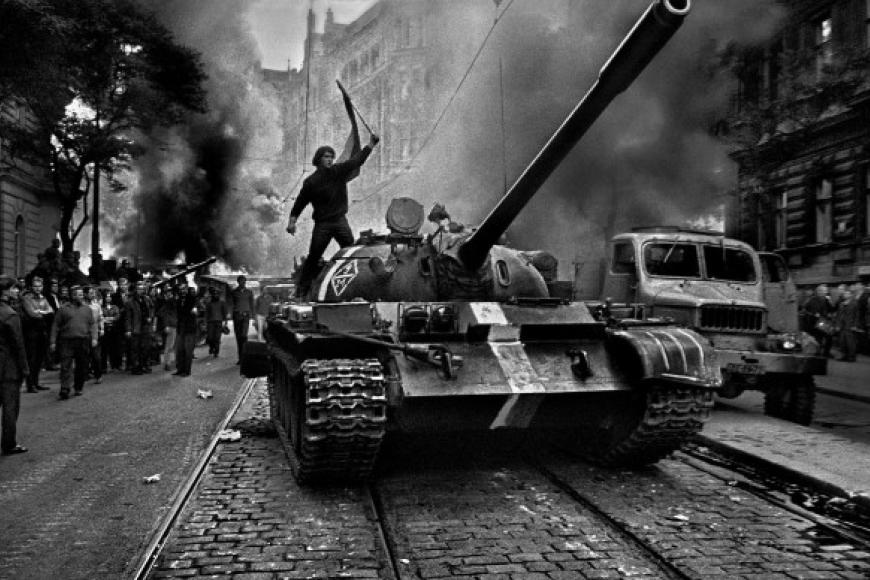
Secretly filmed footage of the suppression of the Prague Spring: hidden in archives for decades and screened 22 years later to the beat of Tchaikovsky.
Filmstill Confusion

Confusion

Zmatek
Evald Schorm
Retrospective 2023
Documentary Film
Czechoslovakia
1969
36 minutes
Czech
Subtitles: 
English

No images of value but “confused material.” For decades, footage secretly filmed in August 1968 in Prague was hidden in archives under this label. Evald Schorm recovered the illegal material and composed it to the beat of Tchaikovsky recordings, in keeping with its expressive nature. The film could finally be publicly shown in 1990.

Katharina Franck, Andreas Kötzing

Credits DOK Leipzig Logo

Director
Evald Schorm
Cinematographer
Stanislav Milota, Jaromír Kallista, Jiří Macák, Ivan Vojnár, Jozef Ort-Šne, Jozef Ort-Šnep
Editor
Vlasta Styblíková
Producer
Krátký Film Praha