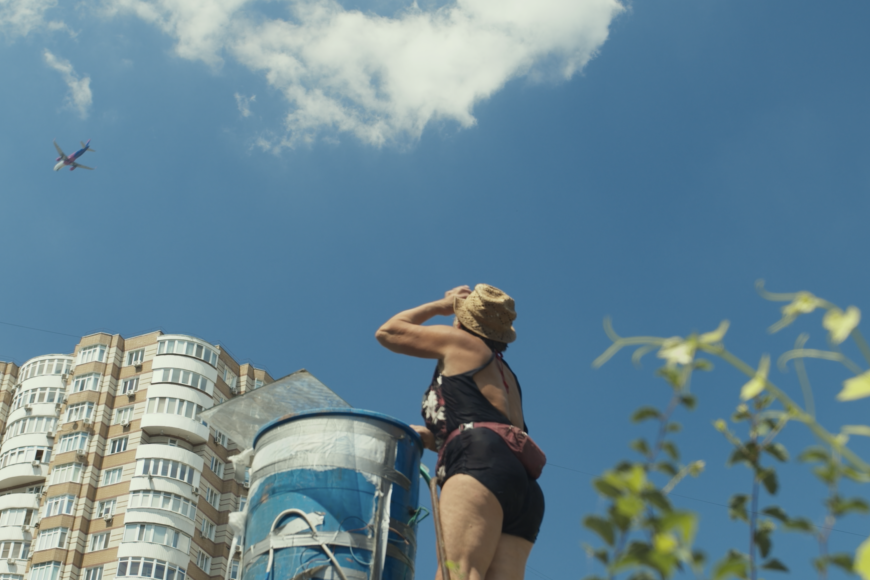
Surrounded by high-rises, Natalia has created her own, not-so-small paradise: Goats roam free, shrubs and fruit trees bloom, the chickens busily lay eggs. Natalia meets repeated attempts to buy the plot with brusque derision. Even when the city and country are attacked by Russia in the wintry February of 2022, she retains her apparent carefree resistance: While all the lights around go out at night, there is a warm and cozy glow from Natalia’s house. Only Kitty, with whom she lives, expresses concern, organises his flight from Ukraine and prophylactically shows the spots that would be safest in an air raid. Adelina Borets’ portrait of an incorruptible woman finds its own unique tone, shows a simple everyday life throughout the seasons that presents itself as self-determined and buoyant despite the worsening situation. Borets adopts Natalia’s manner as natural, gives her space. The dimensions of the war unfold step by step, at Natalia’s own pace and by skilful cuts and pans. “Flowers of Ukraine” is a film about a disaster. But it is also a love song to life – and pickled tomatoes.
A high-rise in Kyiv, an apartment on the 15th floor. A zoom out of a still image. On the telephone, Mariia shares her memories of this place, of coming-of-age and community – before the war.
In 2002, the filmmaker moved into an apartment on the 15th floor of a Kyiv high-rise. She was twelve at the time. Today, from the safe distance of another country, she talks to people who remember the flat and the time spent together. Coming-of-Age, the love of cinema, a sense of community and the erotic charge of individual moments combine to create an image of missing home and intimacy. With every memory, we zoom a little out of the still image on screen: three windows facing southwest, a balcony facing southeast, a rooftop protected from view, a high-rise panorama. The warm and personal gaze at the sky and houses of Kyiv is mirrored in the cold attentiveness of international war reporting.