In 1940, two friends who grow up like brothers rescue horses destined for war in Sardinia. Only one of them will survive. An equally dark and poetic animation.
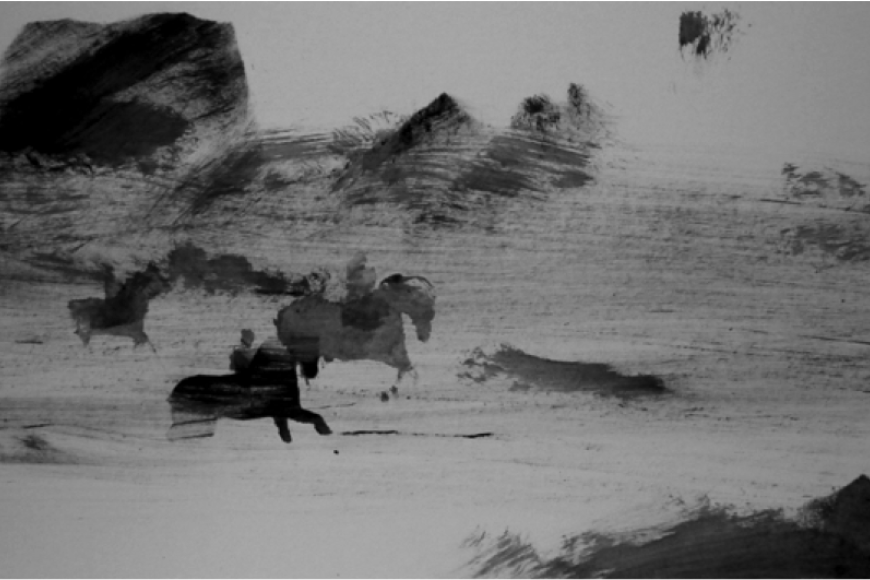
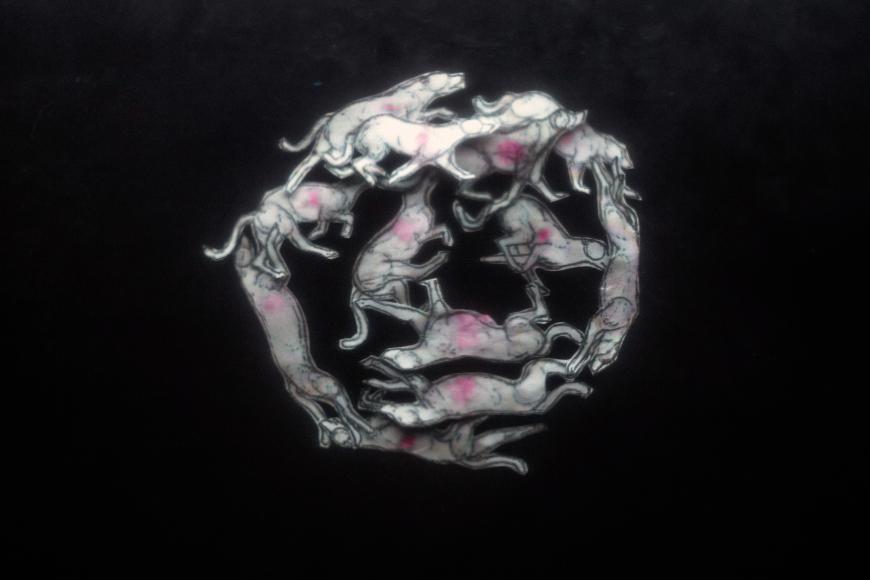
Sardinia, 1940. The harmless term “horsing around” takes on a very serious and ultimately tragic meaning for 14-year-old Michele and his 11-year-old friend Ventura. When they learn that the peasants have sold their best horses for serious money to the state and thus to the military for the approaching war, the two boys take a decision that is as naïve as it is intuitive: They free the herd in a daring nighttime operation. Their happiness is short-lived. Betrayed by a villager, they are caught on the way home and Ventura is shot dead. A senseless death? Or a sign of special bravery, as the ambiguous Sardinian film title suggests? Director Giovanni Columbu, a Sardinian himself, has dedicated his late animation debut to his grandmother who once told him the story. He took the liberty of adapting it with brushstrokes on paper, his style drawing primarily on the charms of historical painting schools, animation techniques and cinema genres. Columbu’s associative visual language, marked by shades of black, white, and grey, is animated by impulsive hatchings, countless dots, and generous elisions. The soundtrack, too, sets rather sparse nuances – subtle illustrations that draw on Sardinian cultural traditions while opening a space for universal metaphors.
Andreas Körner
Credits
Director
Giovanni Columbu
Script
Giovanni Columbu
Editor
Giovanni Columbu
Producer
Giovanni Columbu
Co-Producer
Flavia Oertwig
Score
André Feldhaus, Filippo Ripamonti, Alessandro Olla, Hans Zeller, Pietro Mascagni
A look back at a GDR childhood by the sea, where boundaries and freedoms were always close to each other: a poetic autobiography, condensed in hundreds of watercolours.
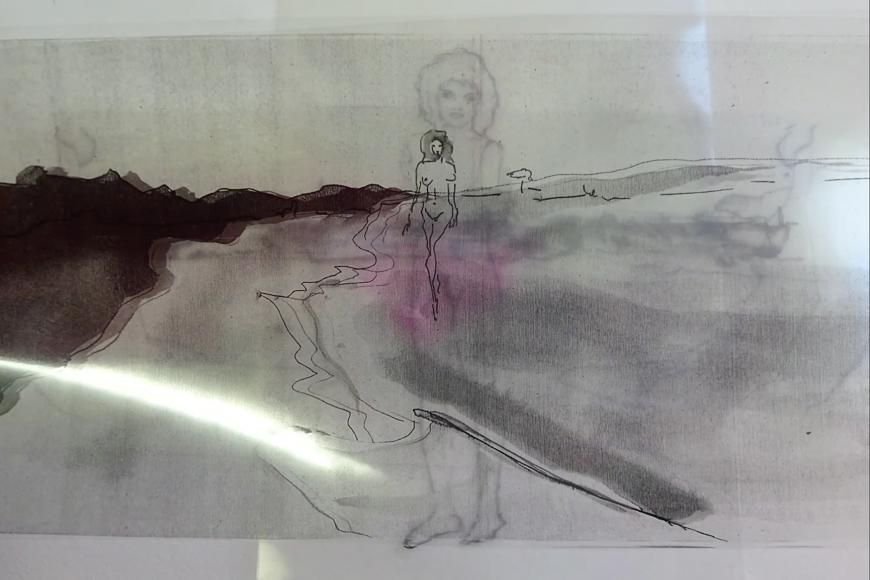
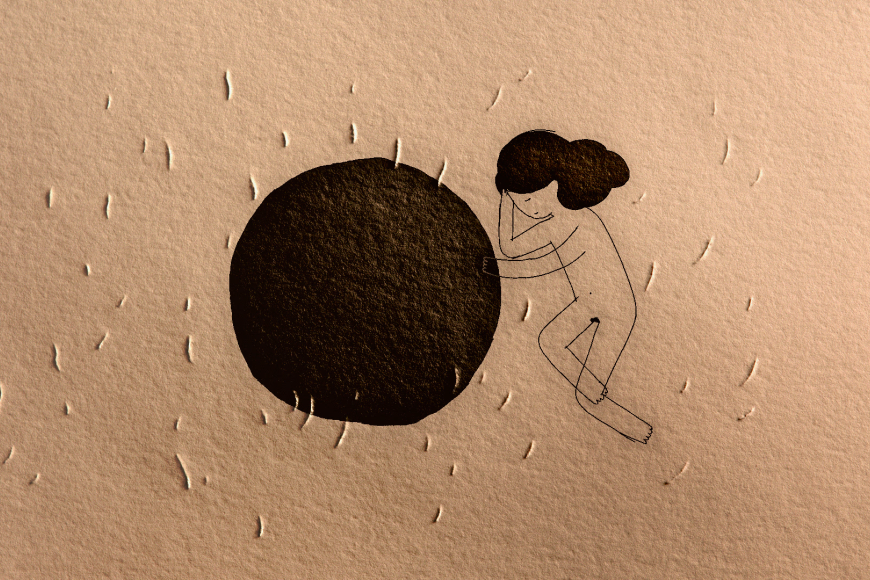
Siren-like singing and rhythmic light reflections segue into a lyrical text and sketched silhouettes of coastlines and waves. Delicate lines and soft shadings on superimposed transparent foils form many-layered networks of shapes and structures. What is offscreen creeps into the frame through reflections and blends in with the visual design of the film. Then and now meet and merge into a poetic narrative about a childhood in Stralsund, at a time when the city was still part of the GDR. A fenced-in, circumscribed childhood, framed by nocturnal floodlights, the bawling of drunk sailors and the crumbling plaster of facades and walls gone grey. The narrator manages to leave this oppressive fortress behind, but she can never escape completely. The memories that have settled like grey dust on her interior will stay with her forever.
An outcry, a free-roaming paper dog and enduring pain: This experimental stop motion animation takes us into the emotional depths of a personal story of loss.
In only ninety seconds Marcus Grysczok tells a touching personal story of loss and takes us to great emotional depths. Tune in: an electronically distorted outcry. The protagonist talks to himself and to someone who no longer lives in this world, but all the more in his heart. He looks for a way out of this state of powerlessness, assuming a stranger’s role, a free-roaming paper dog that runs between real shelves and across tables, races past people on black-and-white photographs and everyday objects, chases himself on a plate rim. The images convey a feeling of home – a home for memory and for life. Tune out? As soon as the dog stops, reality puts an end to this restless racket and brings the awareness of enduring loss. Poetic in language and design, the film formulates a moving but clear-eyed farewell to a brother.
Dark spots eat their way into graphically idealised images of home. With unsparing objectivity, Rubina describes why Russian can no longer be the language of security for her.
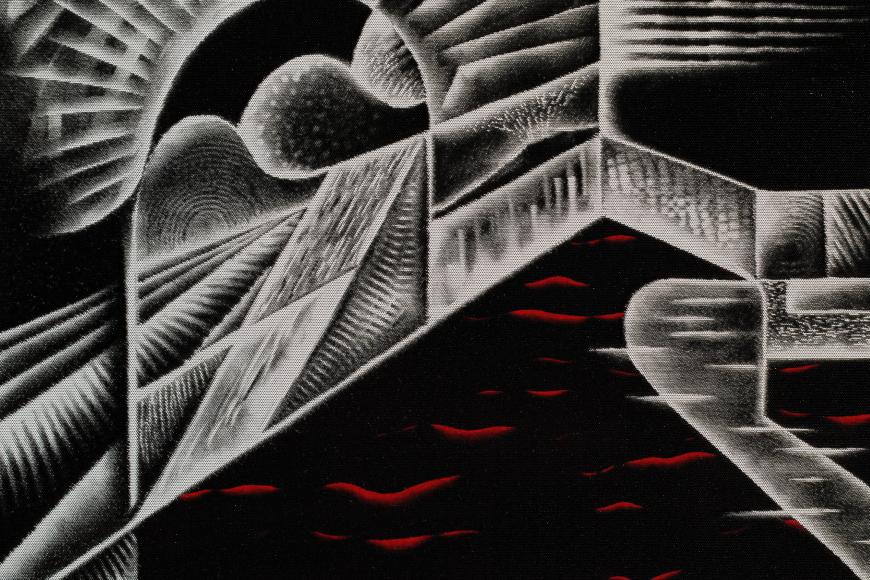
How brutal is it when your own language casts you out of your home because it has been turned into the language of crimes against other people? In her autobiographical animation, Irina Rubina analyses why Russian can no longer be the language of security for her and why German – historically riddled with guilt and therefore insecure – does not offer a new home yet. The stark factuality of the director as narrator is enormously unsettling because it describes the irreversibility of this emotional state precisely. On the visual level, dark spots eat into idealised images of home, until the planes become deadlocked in abstraction. The pictures were created on a so-called pinscreen. Reliefs can be “painted” and animated by the pins’ shadows on this screen on which around 200,000 pins are arranged in lines. The alternation of light and shadow and their immediate proximity lend drastic expression to the inner turmoil and ambivalence.
A father disappears, literally flying away. What to do when a parent suffers from mental illness? A tender father-daughter reconciliation in poetic images.
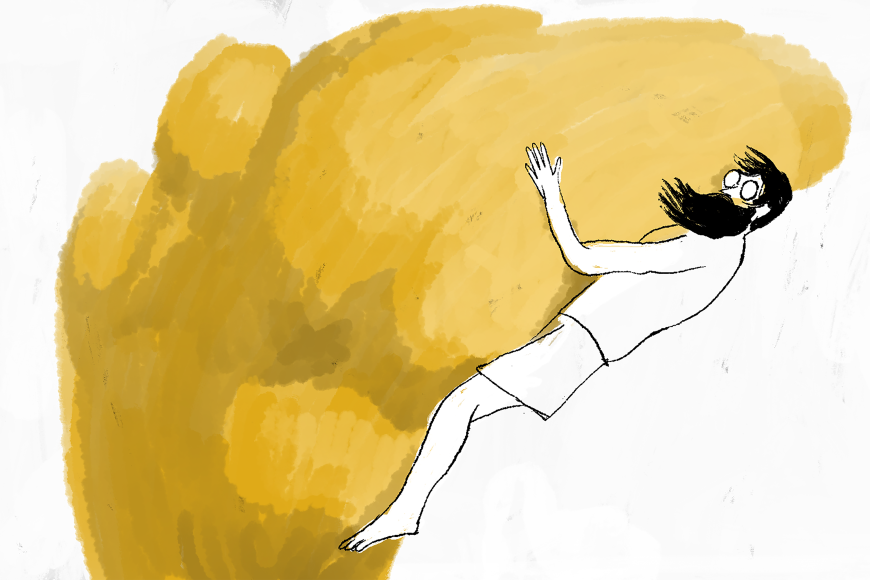
When the woman in curlers opens the door, Papa is blown away: Like a breath of air, a storm or tornado, he is blown in and back out. Even in his own apartment he is ungraspable: He grows and shrinks, becomes fragile or threatening, knocks everything down. And then he literally flies away, hurling eggs at passers-by. Caught in all this is his daughter, who at first can only helplessly stand by and who finds it increasingly difficult to visit him – the steps grow higher, the floor turns into chewing gum. Finally, she looks up at the sky and sees him hover there. What to do when one’s father suffers from mental illness? How to deal with it when the responsibility (of care) switches sides so early in life? Jelena Milunović explores this, using bold, very tender and not always obvious parables. She sets strong colour accents: The depressed episodes are in claustrophobic black and white, the ecstatic highs are colourful free-hand drawings. And the red balloon, which briefly appears in the beginning as a metaphorical vehicle of hope, might point the way to bringing the two of them back together.
Marie Ketzscher
Credits
Director
Jelena Milunović
Script
Jelena Milunović
Producer
Miloš Ivanović
Co-Producer
Draško Ivezić, Jelena Milunović, Filmuniversität Babelsberg KONRAD WOLF
Is living as a mythical creature, mouse or furry not the most radical form of self-realization? In her film, Masłoń moves through VR spaces as an avatar to explore touch.
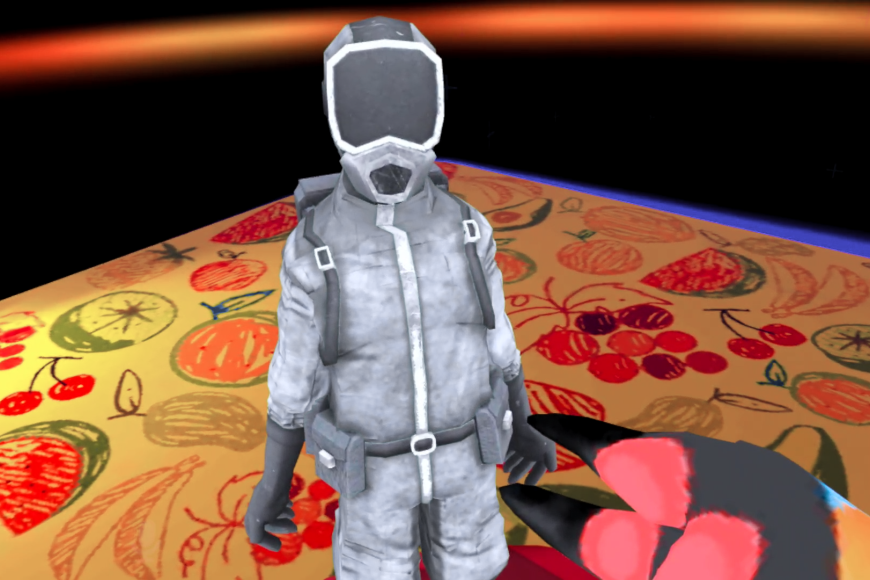
Is it not unlimited freedom, the most radical form of self-realisation, to exist in every conceivable setting as a flying mythical creature, a sad mouse or a furry figure with an extended naked spine as a tail? In her film, Monika Masłoń moves through different spaces as an avatar, exploring the subject of touching and being touched on VR platforms. Anything our phantasy can imagine can be created from pixels here. The limits of existence can be extended infinitely by a click. But what about human – or avatarian – closeness? Can an emotional signal like shaking hands be simulated in this VR world, despite the complete absence of physical bodies? When I see my avatar being touched, can my body memory suggest that I feel this tactile event even though there is no other physical body? Masłoń examines these questions with a delicate sense of humour and in exchanges with other avatars. But then we enter a VR space that feels more intimate: She has taken us on a personal date. How does the impossibility of physical touch in a long-distance relationship differ from that in VR? Can a VR date create more physical presence and still the longing for the beloved person better than other forms of communication?
An unpleasant examination by a meticulous doctor leads to a supposedly inevitable medical intervention that leaves the young patient scarred in body and soul.
In a sterile white examination room, a young woman is asked by a doctor to undress completely. An exhaustive examination of the protagonist’s skin begins during which every centimetre, the palm of her hand, the sole of her foot, the back and also the genital area are closely scrutinised. The doctor meticulously probes every nook and cranny of the young woman’s outer shell until she is able to identify a suspicious birthmark. A timely appointment to remove the mole is made.
Exposed and irritated, the protagonist finds herself confronted with her fears about the surgery and the after-effects of the examination. A tiny birthmark triggers an inner process: an analysis of her own body and the control others are allowed over it. Fragile lines on scarred paper and a tonal design that gives us goosebumps make us participate intensely in her emotions.
Design as a political act? In this animated collage, a contemporary advertising graphic designer explores the uncompromising work of the photomontage pioneer and anti-fascist John Heartfield.
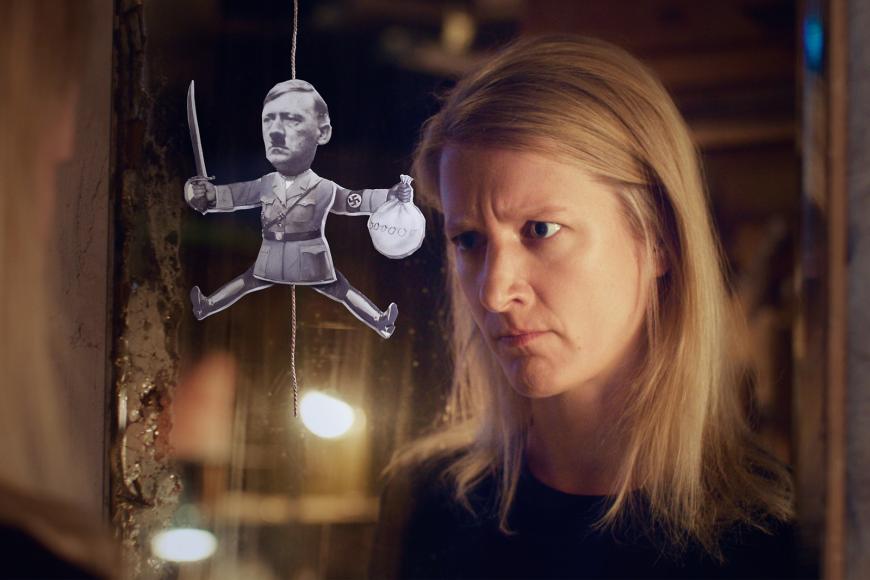
As she visits an exhibition, a graphic designer is mesmerised by the photocollages of the anti-fascist John Heartfield, who became known as the “montage dada.” Stefanie falls through a vortex of paper and photo snippets into an old-fashioned looking studio. A pair of scissors – an analogue tool she herself hardly uses – attracts her attention. She begins to cut a figure out of cardboard, a miniature version of the artist who at once addresses her and explores his life and works with her. The studio turns out to be a living archive that ceaselessly produces documents and information about Johnny. The research gives Stefanie, stressed and disappointed by her job, new motivation, and the courage to choose a different path as a designer.
Both protagonists have the same profession and find themselves facing the same questions about the significance and recognition of their work. Both are struggling in their own way with frustration and fears, caused by the different social and political circumstances of their generations. The different elements of this animated documentary come together in a dialogic collage that reflects on the mission of art, its educative and critical power, and its potential to bring about changes in our society.
Franka Sachse
Credits
Director
Katrin Rothe
Script
Katrin Rothe
Cinematographer
Thomas Eirich-Schneider, Richard Marx, Manon Pichón
Editor
Hannes Starz
Producer
Gunter Hanfgarn, Andrea Ufer, Ralph Wieser, Sereina Gabathuler, Werner Schweizer
Two colour surfaces battle, taking up more and more space in their contest to outdo each other, causing breathlessness. An abstract and yet physically tangible cinematic event – large and loud.
Breathing is vital and needs space. A small blue square appears out of nowhere, vibrating nervously and growing into a narrow line. Its red mirror image follows suit. Both take up more and more room in a contest to outdo the other, while a growing shortness of breath is wedged between them. Martin Schmidt pulls off an astonishing feat: He generates a physically tangible cinematic experience from abstraction. He choreographs smooth surfaces in the cold, technical logic of their skirmish and electronically deconstructs the sounds of gasping. As the battle is getting fiercer, things are visually and acoustically compressed and stretched, twisted and filtered, until a heavy monster of tension emerges. “Lines” is big and loud; it can be read metaphorically, but also understood only in terms of its aesthetic power.
1945. The Red Army are moving into Germany. A child, a Soviet soldier, a Nazi officer and a Hitler Youth have been stuck in a hotel ever since, which binds them together for years in bizarre ways.
In 1945, the Red Army are advancing on German territory, the Second World War is drawing to an end. Families are still trying to escape to America, but many plans fail. Five-year-old Sophie also loses her father and mother during the flight. They are killed by Nazi officer Scharf and a Soviet soldier named Vasily, with Hitler Youth Beckmann as a witness. The gruesome event takes place in an extremely strange hotel which henceforth will bind the four survivors to its premises in bizarre ways, no matter which rooms of the truly scary building they find themselves in. Up in the lounge, where the new customers arrive one by one, down in the kitchen, where the now grown-up Sophie prepares food, or even in an alcove near the elevator shaft, where Beckmann hides with the rats. The involuntary permanent guests age but never tire of courting Sophie. Heinrich Sabl has built an excitingly disturbing dollhouse decorated with quotes from reality for the German-Soviet history of guilt and coping. In his first feature-length animated film, on which the director worked for more than twenty years, he sends extraordinary characters on an equally extraordinary visual and acoustic time journey through the war-damaged suites of the 20th century.
Can a calculated vector line inspire the same feelings as a drawn pixel line? A tongue-in-cheek declaration of love to the technology and aesthetics of the past 60 years.
This film grows somewhere between “forever” and “no longer”, between infinity and constraint, between absoluteness and concreteness. Everything is set in a square format, the original or pixel shape. But this square seems to be like a mirror facing another mirror, a self-referential optical illusion of infinity – with more than a grain of salt. We experience the humorous negotiation of an eternal issue of dispute among visual artists: Can a mathematically calculated vector line, scalable ad infinitum, inspire the same feelings in the beholder as a finite, imperfectly drawn line of pixels? Is the former not the visual equivalent of the neo-liberal illusion of infinite growth – shiny, but sickening? Could the mysterious pixelated moth resolve this eternal dispute? It guards the “Vectorial Superlooper” to ensure that this marvellous invention does not fall into the wrong hands. Jon Frickey spans an arc from our absurd, finite existence to the technological inventions that shape our sense of style, our taste, and thus our life. His film is a tongue-in-cheek declaration of love to the technology and aesthetics of the past 60 years: to pixel art, video games, television series, vector monitors – and, of course, to pixels and vectors themselves.
Inspired by a feminist science fiction story, the Spaniard Inés embarks on a journey of discovery through India. She is looking for Ladyland, the utopian land of women.
Dreamy animated images in detailed henna painting and atmospheric watercolours dominate a young Spanish artist’s moving journey of discovery. In a small bookshop in India, Inés comes across the feminist-utopian science fiction story “Sultana’s Dream.” It is about the terrible revenge on men, the bookseller explains. In the slim volume she wrote in 1905, Rokeya Hossain describes the fantasy realm of Ladyland – a land in which women are self-determined and live in peace, in which they run all government affairs and all forms of education are open to them. And the men? Their place in Ladyland, the bookseller continues, is where they belong: locked up at home.
Fascinated by the literary “painting” of this place and its inventor, Inés sets out in the footsteps of the writer and teacher Hossain, who championed education and equal rights for Indian girls and women as early as the beginning of the 20th century. The trip takes the Spaniard across contemporary India. Her companions are the dreams of Ladyland – and the utterly different realities of the lives of the women she meets on her journey.
Jana Kraft
Credits
Director
Isabel Herguera
Script
Gianmarco Serra, Isabel Herguera
Cinematographer
Eduardo Elosegi
Editor
Gianmarco Serra
Producer
Fabian Driehorst, Chelo Loureiro, Mariano Baratech, Diego Herguera, Iván Miñambres
Sound Design
Simon Bastian, Gianmarco Serra
Score
Gianmarco Serra, Tajdar Junaid
Animation
Izibene Oñederra Aramendi, Ana María Sabater Araújo, Paula Valiño Rivera, Sergio Pereira del Castillo, María José Alfonso Torrescusa
World Sales
Wouter Jansen
German Distributor
Vanessa Ciszewski
Artistic Design
Francisco Muñoz de Gregorio, María Manero Muro, Rajesh Thakare, Nelson Cabrera Curbelo, Upamanyu Bhattacharyya, Bhusan Katkar, Aravind Senan, Begoña Vicario, Troy Vasanth
Film sketches compete for the filmmaker’s attention, scenarios push each other out of the way. Too much distraction, all the time. A feverishly associative animation about a neurodivergent mind.
Grandfather’s hands making pottery, the vertical linearity of a tower, a train crashing into a car – all of these are fragile, newly born film sketches that crowd each other out in a survival game for the filmmaker’s attention. The sceneries fight against each other, intertwine to form new strands, sink into an endless flood of information, shatter in a sea of open browser tabs. With his authentic voice-over and a mesmerising collection of moving images, director Konstantin von Sichart’s alter ego offers us a deep insight into his creative process. Marked by his neurodivergence, he learns before our eyes to cope with his inability to concentrate on one thing – and to weave meaning from these strands, remain true to his film idea. But how can this ever result in a film? Toxically coloured images, naively drawn and finely crafted, AI-generated, filmed from a monitor, collaged, worked-on – a wealth of tools and aesthetic approaches translates the described mental overload into the language of design. The film thus becomes more than a self-reflection of modern filmmaking: It is the portrait of a new generation – caught between the compulsion to take everything in and have a position on everything and the urge to stand still or even run away.
A story inspired by Bach’s timeless music, narrated on the editing table and painted on six rolls of toilet paper. A multicoloured and at the same time profound pleasure.
Something is wrong. Something is completely wrong. With the sound and with the image. The notes are crooked, the piano lid squeaks, the movement falters. Corrections are needed to bring everything together in harmony and in tune with Johann Sebastian Bach’s beautiful music. Six roles of painted toilet paper are worked on by human hands on an editing table, one after the other. The editing device consists of coloured building blocks and a few wooden sticks. It is a game, a trick, it’s entertainment. At the same time, the simple images on the film strip take us deep into the current events of our time. But the material resists sharply delineated representation. It soaks up the paint and blurs the boundaries. It tears. It is limited. Before the story can pick up speed, the roll is unspooled. Narrative is difficult in view of this situation. And yet animation artist Anna Samo manages, with a very light touch, to transform ambivalent feelings, confusion, rigidity and speechlessness into a work of hope and courage.
A Palestinian neighbourhood in southern Damascus. The memory of a lost home is patched together from pictures of a life between the debris of war, constant threats, youth and jasmine.
A dimly lit, scarcely furnished flat, the hissing and buzzing of an open microphone. What follows is an argument in Arabic between mother and son. She complains about his lethargy. He sees no point in school while the country is at war. At last, the boy sets out through the busy streets of his neighbourhood which is a chaotic patchwork of everyday life and the debris of war. Using 3D graphics software, Husein Bastouni reconstructs from his personal memories the situation in the Palestinian refugee camp of Yarmouk in the south of Damascus when the area found itself between the frontlines in the Syrian war. Visually and acoustically – indeed, almost olfactorily – his film draws you into this world from the first second with terrifying immediacy, and yet poetically. In a moment of shock, the rhythm slows down, the images become sparser, but the protagonist’s reflections become crystal clear. In the silence of thought, the eye glides like a deep-sea diver through a sunken city and a lost home.
In 2043, humanity launches the spaceship Zoopticon to send a greeting to distant galaxies. An extraterrestrial opera with cheering colours and radiant pop charm in the darkness of space.
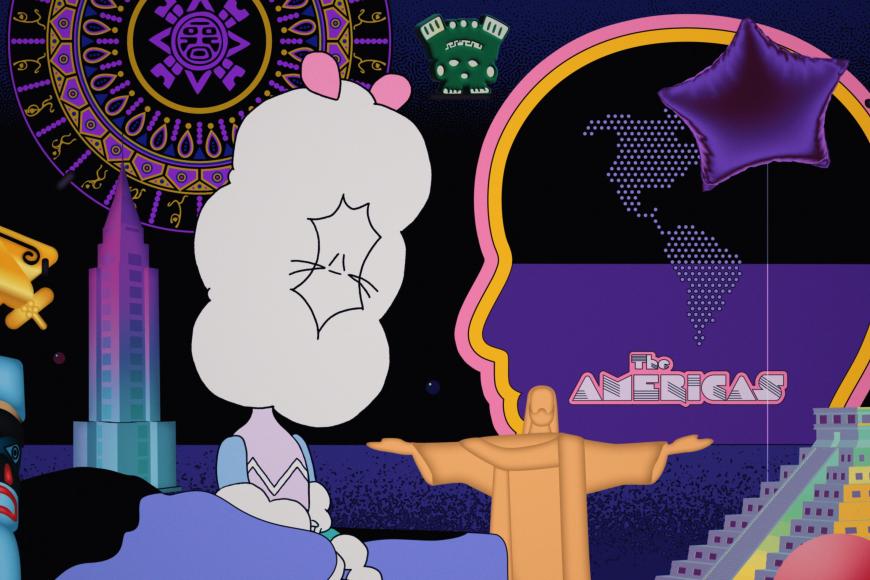
In 2043, humanity launches a spaceship called Zoopticon to send a greeting to distant galaxies. Lightyears later, the once proud – loaded with valuable cultural artefacts and lots of hope, after all – ambassador’s spirits sink in the infinite expanse. Loneliness leads to a blundering suicide attempt which jolts the spaceship’s body awake, whereupon the genetic material of five animals from five continents stored in petri dishes unexpectedly comes to life.
Jon Frickey, Sandra Trostel and Thies Mynther brush the science fiction classic “2001” against the grain. Their Zoopticon, a benevolent relative of Stanley Kubrick’s supercomputer HAL 9000, takes a surprising route on its odyssey through space. Their extraordinarily stylish animation starts with a moving monologue of the sensitive protagonist and finds its perfect orbit as a grandiose opera gradually begins to unfold – complete with soulful drama, brightly coloured radiant pop charm and tongue-in-cheek cathartic confidence.
André Eckardt
Credits
Director
Jon Frickey, Thies Mynther, Sandra Trostel
Script
Jon Frickey, Thies Mynther, Sandra Trostel, Christoph Mathieu