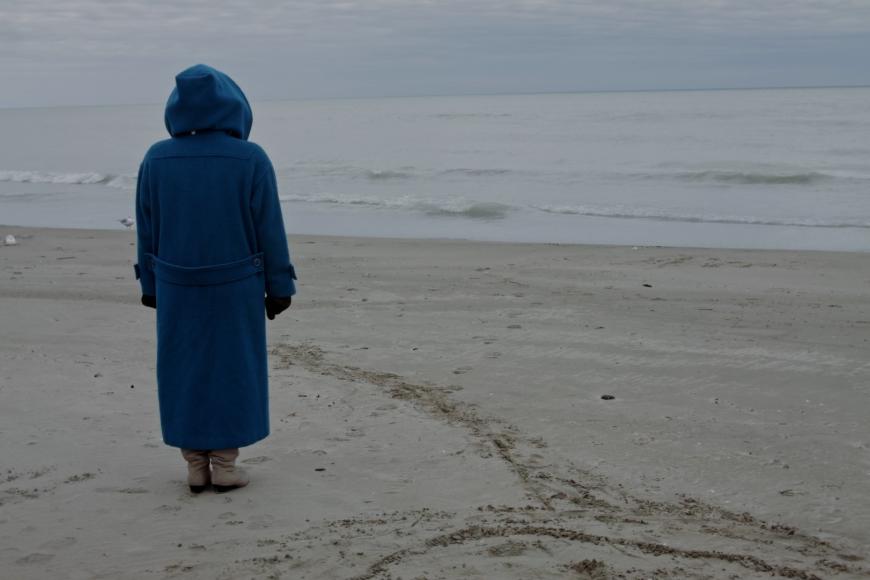
Valentyna and her bed-ridden mother live on a small farm surrounded by the evergreen, lush flora of the rain forest. The works and thoughts of the poet and the artist, though, are filled with the landscapes of their old home, Ukraine. Memories of snow and birch trees, thistles and orchids, vegetable gardens and their animal residents come to life in Tamara’s poems and Valentyna’s drawings.
Life flows quietly in the small house in the middle of nowhere. Valentyna takes care of the few animals, milks the cows, makes cheese, cares for her mother. The photos on the chest of drawers, the allusions to the Chernobyl disaster only hint at why the two left Ukraine a long time ago. But what they left behind still lives in exile. One wonders whether she, the celebrated poet, still remembers her writings? Mother and daughter are as gentle with each other as the film’s gaze on the two women, their animals and surroundings. Without a trace of nostalgia, cinematographer Mariano Maximovicz’s images let us see not only the beauty of the landscapes we live in but also of those that live on in our minds.
Marie Kloos
Credits
Director
Hernán Fernández
Script
Constanza Sandoval, Hernán Fernández
Cinematographer
Mariano Maximovicz
Editor
José Goyeneche
Producer
Maca Herrera Bravo
Sound
Julián Caparrós
Score
Serguéi Rajmáninov
Nominated for:
FIPRESCI Prize,
Prize of the Interreligious Jury
The life of an official of the Canadian Immigration Service. What sounds prosaic means an up and down lifestyle constantly on one’s toes for daughter Sofía and her family.
For thirty years, Sofía Brockenshire’s father travelled the world as an official of the Canadian Immigration Service, his family always by his side. Diaries and other contemporary documents show the numerous relocations, the destinations in South Korea, India, in South and Central American countries. The result is a detailed mosaic of memories and audiovisual snippets that tries to take not only the civil servant’s perspective, but also that of his wife and children.
When asked where they originally came from, the Brockenshire kids answer cleverly: from the suitcases. Because they travel with them year after year, always prepared to have to leave a place they just moved to. The life of the family is determined by the Canadian authorities, they seem to have practically no say in the matter. Neil Brockenshire’s views on his professional career are ambivalent: full of gratitude and certain to have helped people, but also thoughtful and occasionally resentful. In her film, Sofía Brockenshire re-assembles what was scattered across the globe over the decades: photos, thoughts, desires. “The Dependents” is a personal portrait and something of a reflection about the existence as a professional expat in a world that has no borders for some and nothing but obstacles for others.
Carolin Weidner
Credits
Director
Sofía Brockenshire
Cinematographer
Sofía Brockenshire
Editor
Sofía Brockenshire
Producer
Sofía Brockenshire
Sound
Julian Flavin
Sound Design
Julian Flavin
Nominated for:
Leipziger Ring,
Prize of the Interreligious Jury,
FIPRESCI Prize
When the poet Juana Bignozzi dies, she bequeaths the intellectual property of her work to the young author Mercedes, along with prosaic but even more poetic duties.
English, German Subtitles for deaf and hard-of-hearing
A poet’s life ends and a film begins to carry on her legacy, prosaically at first. When Juana Bignozzi dies in 2015, the intellectual property rights to her work pass to the young author Mercedes Halfon – as the aged lady had decreed. But Mercedes also inherits a refrigerator and a lot of junk that must be cleared out of the orphaned apartment in Buenos Aires. Together with young filmmakers, she transforms the duty into a poetically fulfilling project.
The result is not only an unusual but actually a non-portrait of a poet – and perhaps not even a result. Rather, it is a continuously growing equation of superimposed faces, texts and images that refuses to simply work out. They look at each other as if in rear-view mirrors: Juana Bignozzi, who speaks to the young from her writings full of humble reverence, and her young female admirers who, reading, filming and browsing through Bignozzi’s legacy, feel almost embarrassed by these declarations of love. What confidence the deceased had in them! What tremendous expectations she had of those whose mother or grandmother she could have been! Their own poetic achievements seem too half-hearted to Mercedes and Laura to ever live up to such advance praise. But even as they doubt, they are already deep into it.
Sylvia Görke
Credits
Director
Laura Citarella, Mercedes Halfon
Cinematographer
Inés Duacastella, Agustín Mendilaharzu
Editor
Miguel de Zuviría, Alejo Moguillansky
Producer
Ingrid Pokropek
Sound
Valeria Fernández, Marcos Canosa
Winner of:
Silver Dove (International Competition)
Plasticine figures re-enact the story of an imposition: the severely handicapped 16-year-old Laura is raped. The Argentinian state wants to force her to have the child.
A human tragedy on the backdrop of a legal and medical scandal which in 2007 lead to legal action against the Argentinean state before the UN Human Rights Commission and a verdict of guilty in 2011. The mentally and physically handicapped 16-year-old girl Laura had been raped by her uncle in 2006. But a legal abortion which had already been officially granted at the request of her mother, Vicenta, was opposed by lawyers and doctors.
“Vicenta” conveys the details of this truly incredible imposition in the form of a fable in which plasticine figures seem rooted to the spot in a Kafkaesque nightmare. Only the camera moves through this scenery, usually in travellings across the set-up. Very occasionally excerpts of newscasts, broadcast from small monitors on the stage of this “puppet show”, authenticate the narrative. And yet the whole spectrum of conceivable feelings between being openly paralysed with shock and proud self-empowerment of the mother who stubbornly fights for justice for herself and her daughter is conveyed and made comprehensible. In the above-mentioned UN ruling, the Argentinean state was accused of having fundamentally disregarded the recognised right to freedom from inhuman, cruel and degrading treatment in the case of Laura and her mother Vicenta.