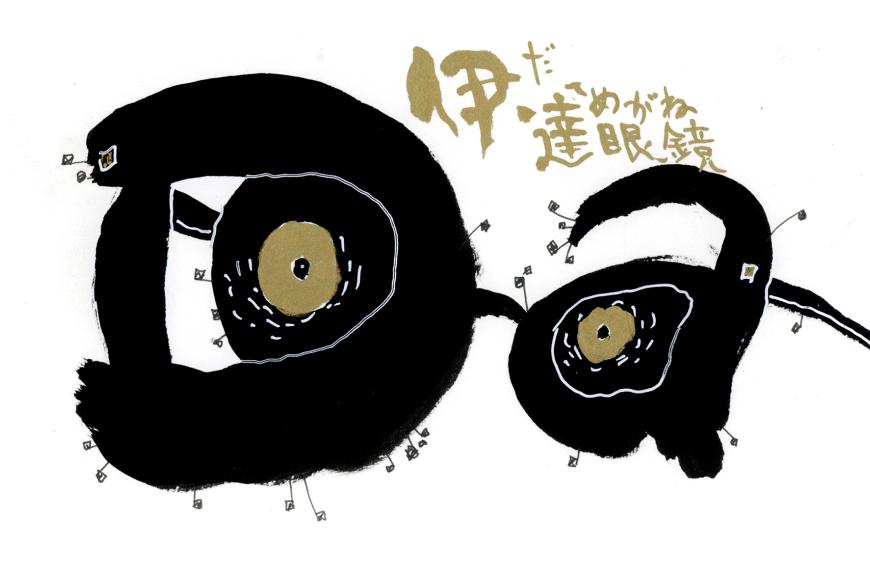
The last syllable on the lips of a dying man is “da”. Koji Yamamura translates a short story by author Hideo Furukawa into a thrilling and highly dynamic film.
Life is short, extremely short. The time between birth and death seems to fly by. Snip your finger – and it’s all over. The last seconds are just long enough to pronounce the syllable “da”. It is precisely this syllable, spoken with someone’s last dying breath, that is picked up by a man who looks for the shortest of all things in the streets of Tokyo. The syllable whirls through his thoughts, triggering a torrent of reflections on the Japanese language that he gets more and more worked up about. In a dadaist manner, the “da” words hurtle at us like notes in jazz. Bold ink drawings move across the white background, sometimes fluidly, sometimes explosively. A last “da” completes the extemporisation and brings to a standstill all the energetic circling and vibrating that dominated the image before. The dying man closes his eyes. But the end is followed by a new beginning. “Extremely Short” marks the start of the series “Bungaku Bideo” – literature videos – which, commissioned by the Yanai Initiative, makes innovative accomplices of contemporary Japanese literature and international animation. In this case, Koji Yamamura encounters a piece of prose by Hideo Furukawa, listens to the monologue recited by the author himself and translates his linguistic furor into an exciting visual form.
Having a crush – what a beautiful but equally fleeting, sobering moment. The senses go on their first physical explorations, breathtaking, deviant or repulsive.
Biology lesson. On one side the teacher in the light of the entomology projection, on the other the classroom in semi-darkness. Attention is slackening. Adolescent daydreaming: The boy at the desk in front is actually quite cute. The fingers want to run off. Still, rather touch only oneself at first. But then there is a spark …
Having a crush, what a beautiful and intense, but equally fleeting and sobering moment. Eyes, nose, ear, mouth and hands go on their first physical explorations, breathtaking, deviant or repulsive. Zhen Li observes with microscopic precision and magnificently captures this exceptional state of mind with different animation techniques. Charcoal drawings with smeared marks, furry waves of mould, intricately animated bodies and buzzing, sticky sounds circumscribe the sensual surge.
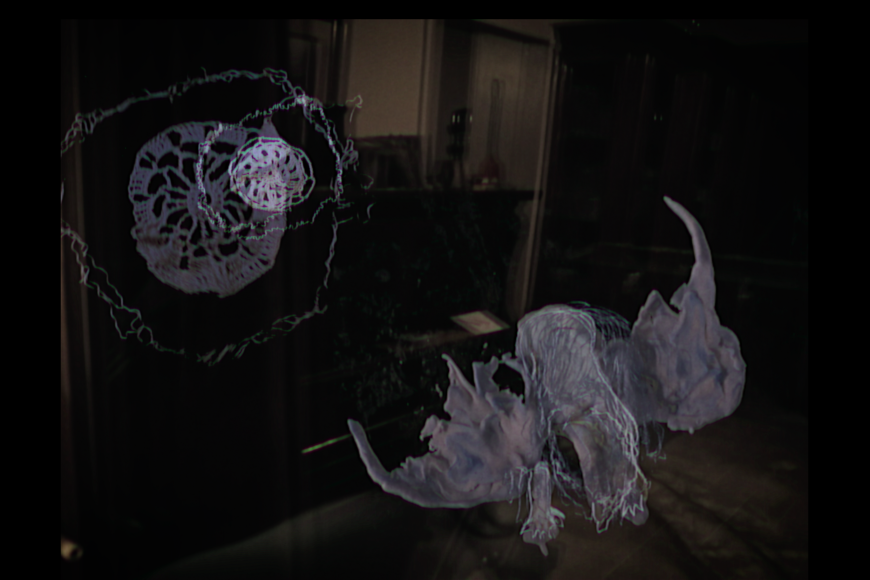
The dark confines of a flat, light still burning in the kitchen. Ghostlike apparitions mingle with old video recordings. This was the home of a loved one who lived in two worlds.
Memories of a loved one: The camera explores the dark confines of a flat. Light is still burning in the kitchen; objects are scattered haphazardly on the living room tables. The eyes follow into the labyrinthine self, now turned into space, of a once familiar and now absent person. The narrator’s voice begins by asserting that everything in this place is true. It “shows” the places where the remembered person learned to crochet and where she shelled peas. The narrative remains factual, but a gap begins to open. Ghost-like apparitions intrude in the old video images, phantom voices populate the noise-like echo sounds. Just like the crocheting and the peas, a naked murderer and other unpleasant shadows are part of the house inspected here. As things progress, individual threads are spun together to form the symbolic crocheted doily of a home. Incredibly poetic and very personal, Ayden Lamb’s “Haunted House” brings to life on film a person who during their lifetime was present – had to be present – in two worlds.
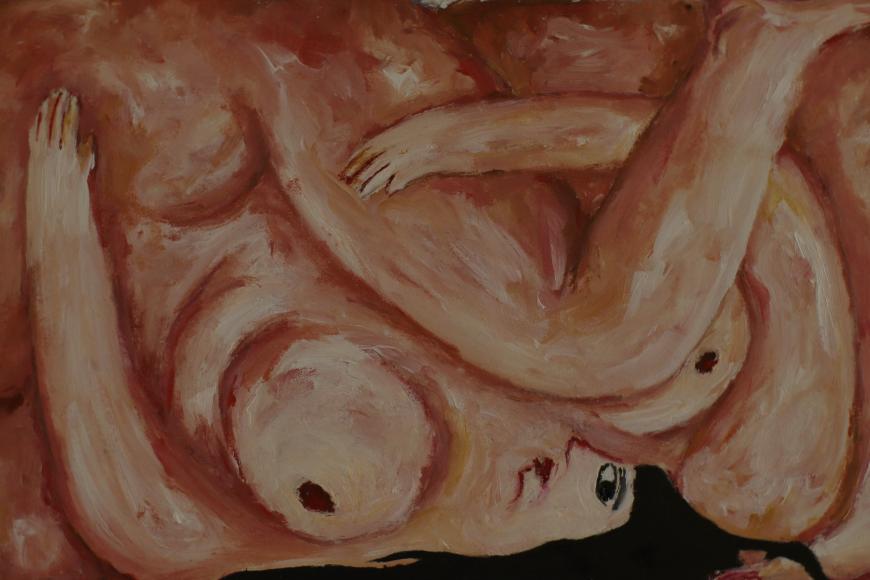
This alien body that does not seem to be yours. It is too conspicuous, too tall, and then again too insignificant. A cinematic reconciliation with being different.
“There was a body that didn’t want to be human. It didn’t know it belonged to someone. To me.” María Cristina Pérez González opens her film with these poetic and cryptic words, diving deep into the visually powerful, hand-painted animation. Associative rather than narrative, the sad voice pulls us into a maelstrom of remembered fragments that all revolve around the protagonist’s body: A voluminous shape that sometimes eats itself with loathing, stretches until it fills the frame or cowers like a pea – in the blackness of the fluid, generous brushstrokes, but above all in its own fleshy self. There is the estranged sister who once called the feet of this body ugly. The good friend who disappeared without a farewell. The father who once said that all unhappy women grow fat. And most of all there is this nameless figure that lives in her belly and feeds her depression with a cute grin. As so often in life, the only path to contentment is reconciliation. With the sister, of course, but above all with her own body which does not fit into narrow social norms – but is the only one she has. And with which she can dance, jump, and even laugh quite splendidly once she understands that it is not a monster to be fought.
Marie Ketzscher
Credits
Director
María Cristina Pérez
Script
María Cristina Pérez
Editor
Mauricio Cuervo Rincón
Producer
Mauricio Cuervo Rincón
Co-Producer
Mireia Vilanova, James Belfer, Adam Belfer
Score
Daniel Gwilym Jones Cozzarelli
Animation
Laura Alcina, Natalia Rojas Noy, Megumi Cardona, Gizenth Barreto, Fabián Llantén, Anamaría Sáenz Peñas, Julián Arias Garzón, Juan Pablo Figueroa, Daniel Bonza
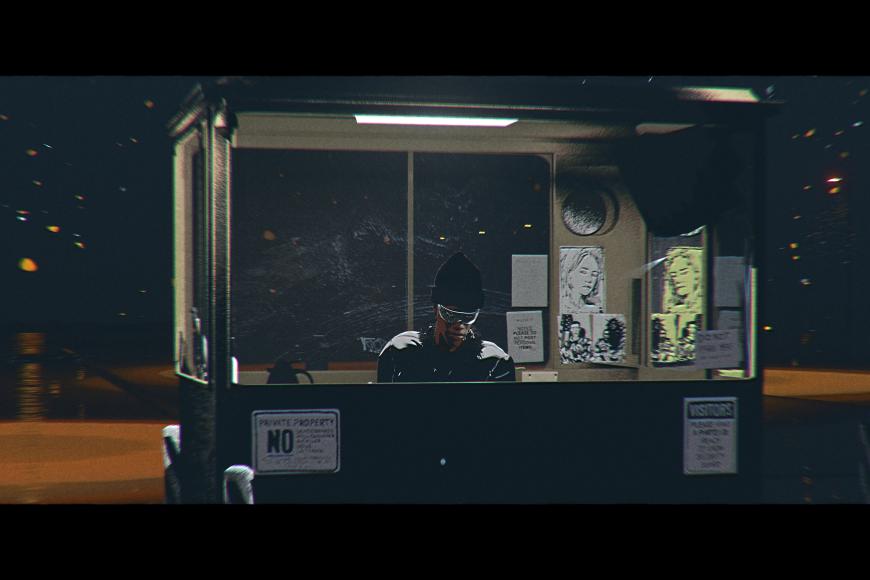
A cold winter’s night. Armoured in coolness, Nobody makes his lonely security guard rounds in the square, engrossed in his meandering reflections of life – melancholy of the streets.
The winter’s night draws its last breaths in the milky amber glow of the street lights. Snowflakes trickle down, the camera slowly circles a small guardroom in a driveway. Night after night, this lonely island is occupied by: Nobody. As a security guard in the cold, he guarantees the safety of the warm homes and their owners. He passes the time with a recalcitrant oil radiator, a calendar girl on a green meadow and his meandering thoughts. His security logs serve as a seismograph of reflections on life and nightly rounds of the square. Nobody is wrapped in a shell of coolness grown over a long time, which makes it hard for him to react to a rare smile the way he would like to in his heart. Nadia Hallgren and Jamie-James Medina condense an autobiographical short story by artist and musician Willis Earl Beal aka “Nobody”. The actor Michael K. Williams, who died in 2021, lent his voice to this inner monologue and gives it a sleepy, melodious sound. In this very cinematic, melancholy piece in a state of limbo, casual observations open a philosophical cosmos. But every time the journey of the mind crashes on the tarmac of the carpark in front of the block of flats.
André Eckardt
Credits
Director
Nadia Hallgren, Jamie-James Medina
Script
Willis Earl Beal
Editor
Spencer Campbell
Producer
Michael Stirton, Jamie-James Medina, Nadia Hallgren