Icelandic musician Björk composes electronic music from natural sounds. In the video clip for “Hunter”, her head morphs into that of an artificial polar bear.
Icelandic musician Björk has always merged natural and technoid creativeness. She samples and loops environmental sounds and transforms them by means of electronic effects. Paul White translates this approach and aesthetics in the video clip for “Hunter”, morphing the singing Björk’s head and human features into an artificial polar bear that seems to be made of liquid plastic.
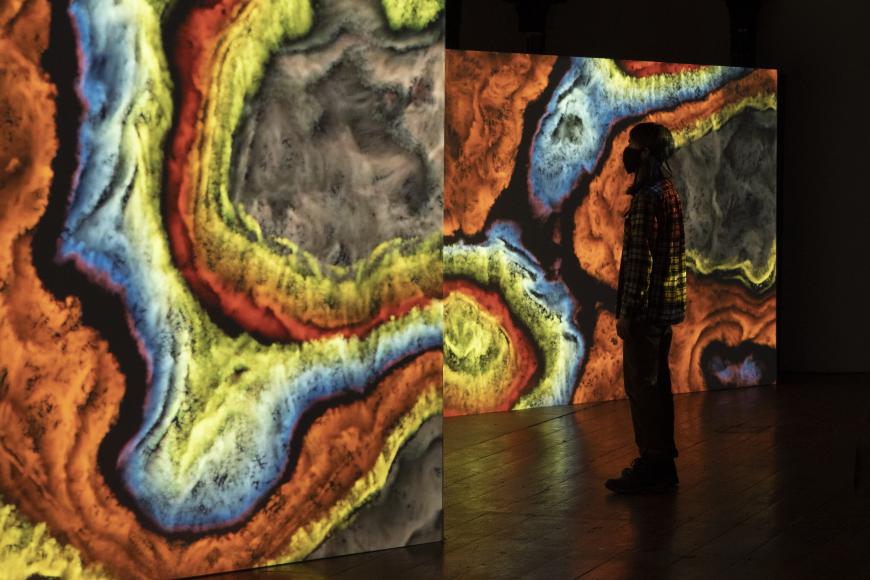
A huge, luminous band of morphing layers of colours and strange sounds captivate the eyes and ears. An installation impressively brings geological history to life.
The earth never sleeps. The duo Semiconductor distils research data on earth movements and animates them in a five-channel installation. In a dark hall, visitors to the Sónar Barcelona 2016 festival are captivated by a huge, luminous band of ceaselessly morphing layers of colours and strange sounds, experiencing a cut through both landscape and time.
Creaking, rumbling and trickling, earth movements leave traces of sound. The duo Semiconductor animates research data and conveys geological processes in a fascinating way.
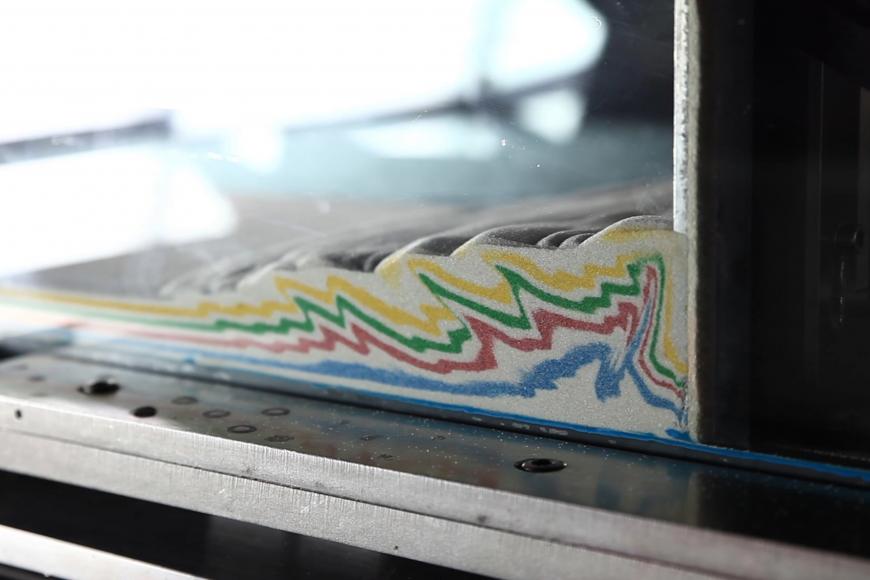
Geologically, layers of earth form over thousands of years. The processes are almost imperceptible to humans. A research project in a Spanish quarry reconstructs earth movements, models them and records them acoustically. Creaking, rumbling and trickling, the layers leave traces of sounds animated in an audiovisual five-channel installation by the duo Semiconductor.
Beatriz Ferreyra enters a room and already stops with excitement in the doorway. The Argentinean pioneer of musique concrète composes with everyday sounds.
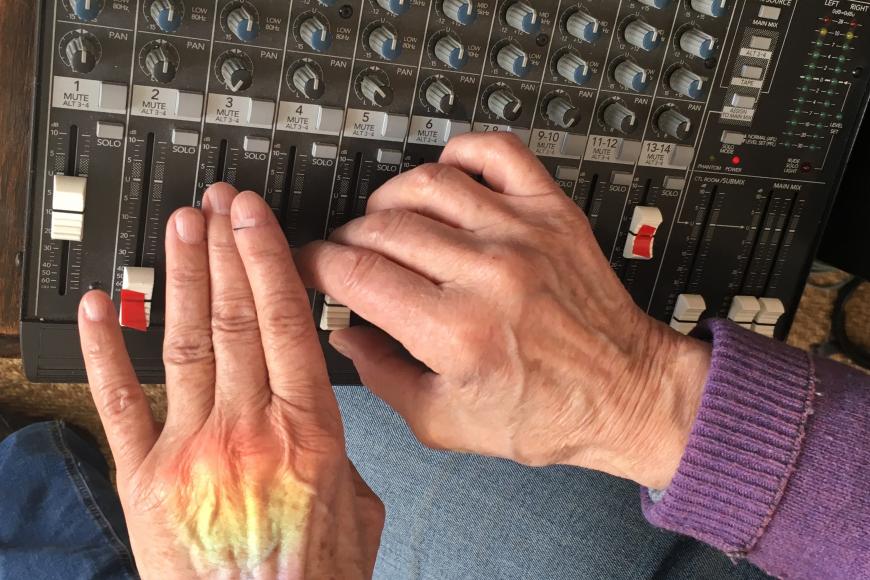
Beatriz Ferreyra enters a room and already stops with excitement in the doorway: “Look at all the sounds it makes, nieaowowowa!” The Argentinean composer and pioneer of musique concrète collects sounds made by everyday objects. Aura Satz’s minimalist portrait follows the sound hunter at work, shows her gestures and her still undiminished joy of discovery when arranging the sounds.
A rhythm fragment becomes a percussion ensemble without a single identical loop. Tiles proliferate into patterns that are never quite the same. Infinity in animated beats.
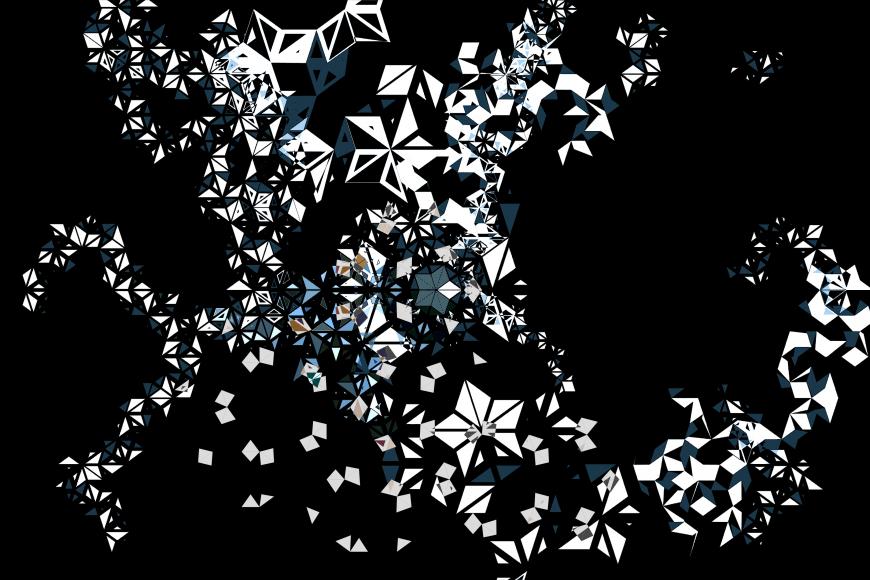
In 1974, the mathematician Penrose discovered pairs of tiles that form an infinite plane without repeating patterns. Inspired by this, Max Cooper uses a rhythm fragment of one instrument to compose a percussion ensemble without a single identical loop. Jessica In contributes animated tile ornaments without symmetries that are reminiscent of a mandala and visualise the idea of infinity.
An app assigns a sound and a graphic element to every letter on the computer keyboard. In a live improvisation, the Leipzig artist CFM uses them to create patterns and breaks.
An app that assigns a sound and a connected graphic element to every letter of the computer keyboard forms the basis of this live improvisation by CFM. The game of patterns and breaks uses different sound-form combinations from Jono Brandel’s kit to create rhythms, loops and music as well as a video to accompany them.