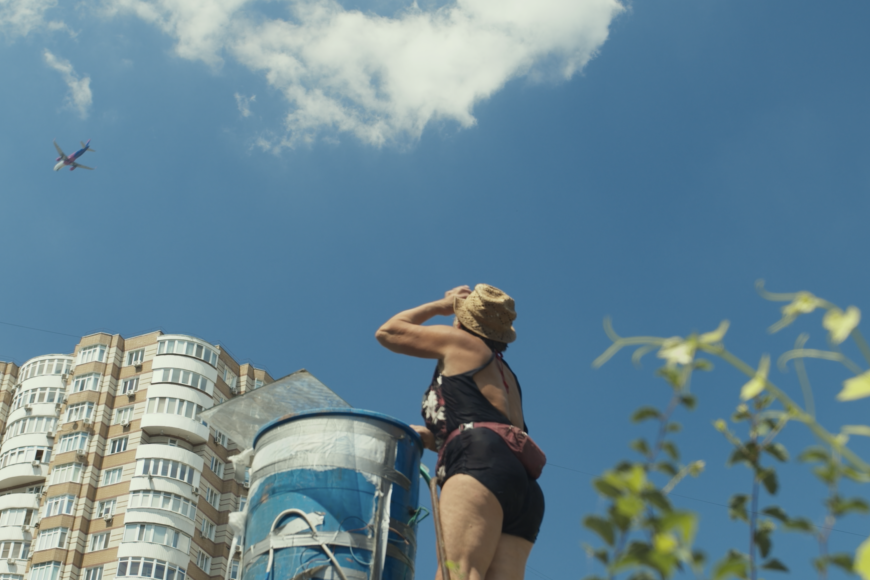
Surrounded by high-rises, Natalia has created her own, not-so-small paradise: Goats roam free, shrubs and fruit trees bloom, the chickens busily lay eggs. Natalia meets repeated attempts to buy the plot with brusque derision. Even when the city and country are attacked by Russia in the wintry February of 2022, she retains her apparent carefree resistance: While all the lights around go out at night, there is a warm and cozy glow from Natalia’s house. Only Kitty, with whom she lives, expresses concern, organises his flight from Ukraine and prophylactically shows the spots that would be safest in an air raid. Adelina Borets’ portrait of an incorruptible woman finds its own unique tone, shows a simple everyday life throughout the seasons that presents itself as self-determined and buoyant despite the worsening situation. Borets adopts Natalia’s manner as natural, gives her space. The dimensions of the war unfold step by step, at Natalia’s own pace and by skilful cuts and pans. “Flowers of Ukraine” is a film about a disaster. But it is also a love song to life – and pickled tomatoes.
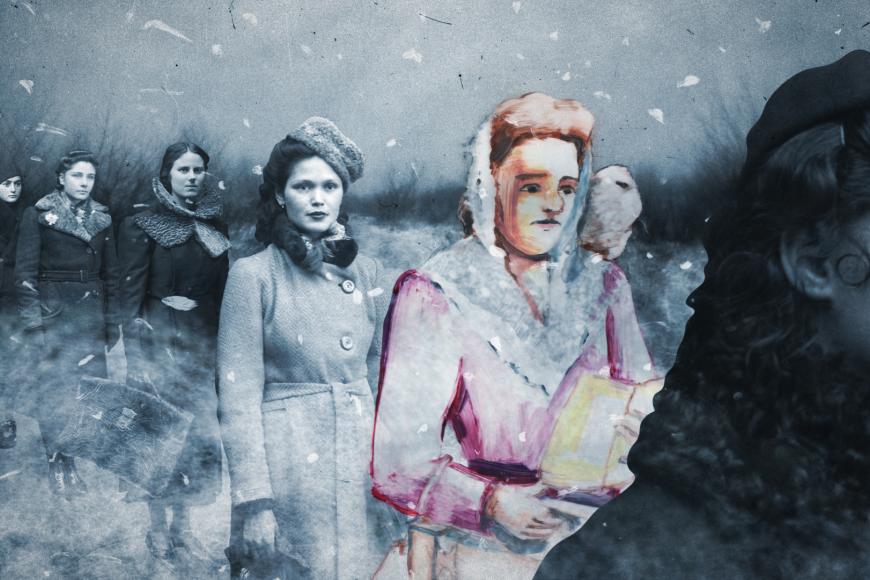
Inspired by the estate of a Romanian photographer in which 5,000 glass plate negatives from the 1930s to the 1950s survived undiscovered for a long time, a touching love story evolves. In 1939, Anna Florea meets the young soldier Jean Mihail in her home village in Bukovina. A moonshine kiss seals their affection. But all too soon, Jean is ordered to the frontline. His passionate letters keep the connection alive. But when Anna must flee the site, the contact breaks off. Their great love is fragile, damaged by war and time – just like the old studio and everyday photographs this animated documentary uses to illustrate optimism and impending loss. Anna Florea herself narrates the film: in retrospect, at the age of 91. Her warm and gentle voice reanimates the memories seemingly stored in these pictures. Those “frozen” on the photographic plates begin to move, are made to glow in oil-on-glass overpaintings, blossom and take us with them into the past.
Franka Sachse
Credits
Director
Mélody Boulissière, Bogdan Stamatin
Editor
Billie Belin, Annabelle Basurko, Nina Gerolt
Producer
Marc Faye
Co-Producer
Mathieu Rolin, Mihai Mitrică
Sound
Yan Volsy
Animation
Mélody Boulissière, Charlotte Arene, Andrei Berculescu, Dorel Mărgărit, Cosmin Tudor Sîrbulescu
Without light, there would be no cinema – and no life. Searching for the origin of images, this film delves into two worlds that explore the magic of light: physics and art.
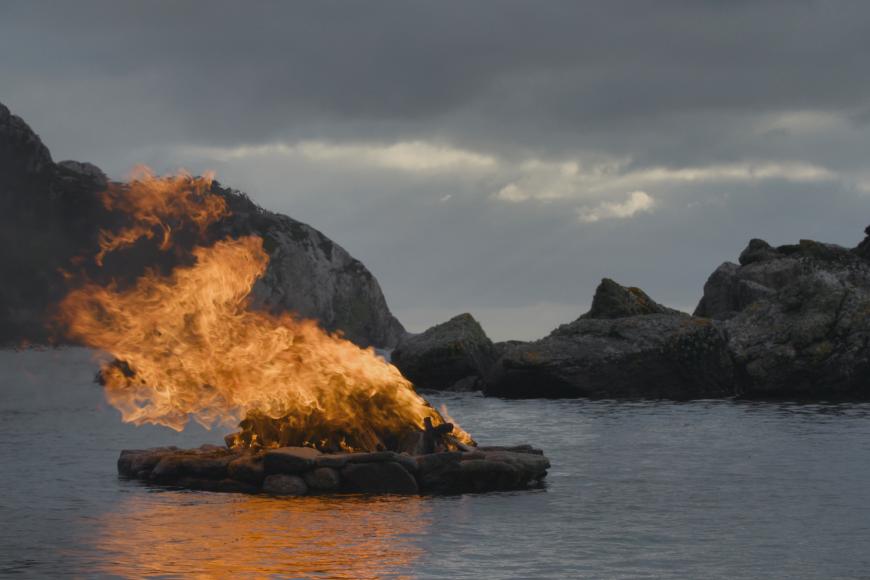
Light is a fascinating phenomenon. Without light, there would be no cinema, no film – and no life. So light is at the origin of everything, and yet it remains invisible to the eye until it hits matter. This moment is – quite literally – the starting point of Thomas Riedelsheimer’s latest work, for the springtime spectacle of rainbow shreds in the cinematographer and documentary filmmaker’s flat became the starting point of a search for the origin of the images we form of this world. For this quest he dived deep into two spheres that seem to follow different laws but always strive to fathom the magical: physics and art. An intellectual and poetic ping pong game evolves between researchers from the Max Planck Institute in Erlangen and the “Extreme Light Group” of the University of Glasgow as well as internationally renowned artists such as Ruth Jarman, Joe Gerhardt, Julie Brook, Johannes Brunner and Raimund Ritz. In its course, the various perspectives on light lead to new insights on all sides that would hardly have been achieved without this methodical cross-over: about laser power and colour pigments, about black holes and floating sculptures. In brief moments, the uninitiated may even get some idea of the laws of quantum physics, generally considered impossible to visualise.
Luc-Carolin Ziemann
Credits
Director
Thomas Riedelsheimer
Cinematographer
Thomas Riedelsheimer
Editor
Thomas Riedelsheimer
Producer
Sonja Henrici, Stefan Tolz, Leslie Hills
Sound
Hubertus Rath
Sound Design
Christoph von Schönburg
Score
Fred Frith, gabby fluke-mogul
World Sales
Elina Kewitz
German Distributor
Piffl Medien GmbH
Broadcaster
3sat
Nominated for:
VER.DI Prize for Solidarity, Humanity and Fairness