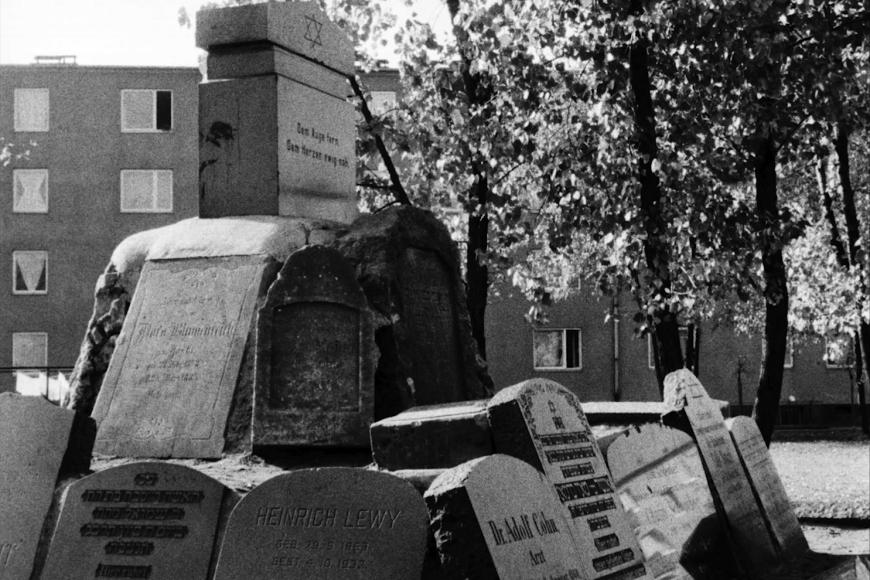
Jewish cemeteries in Berlin commemorate people and all the places where they were exterminated. Anti-Semitic desecrations of the graves in East Berlin were to be erased, too.
After studying at the German Academy of Film Art Potsdam-Babelsberg, Karlheinz Mund made this documentary tour of Jewish cemeteries in Berlin. The gravestones preserve the names of famous and unknown people. They preserve their places of death, where no distinction was made between the famous and the unknown: Auschwitz, Mauthausen. When the West German Short Film Festival invited Mund’s film, the committees in charge enforced one distinction after all: The images of graves defaced with anti-Semitic graffiti taken from the West German press were allowed to remain, footage of the same content filmed in East Berlin had to be removed for the theatrical release in the GDR.
Loneliness and threat, translated into surreal images in which the oppressive Hungarian reality of life under communism in the 1980s allegorically meets the 1956 uprising.
A feeling of fear spreads: In an apartment building, the stairs follow no logic, men get lost with a wardrobe, everyone is lonely. The surreal threat suddenly becomes real when security agents ring the doorbell: “Csengőfrász”, the symbol for the arbitrary arrest of citizens allegedly hostile to the state from the time of the Hungarian Uprising.
Followers of the Hauka cult in Ghana enter the bodies of the colonialists and go mad to European marching music. An ethnofiction that remains disturbing and controversial to this day.
This still controversial ethnofiction is one of Jean Rouch’s most famous films. It stages followers of the Hauka cult in Ghana incorporating their colonial masters to marching music imported from Europe. The disturbing work was released at the same time as the first Leipzig festival year, but would have gone beyond the scope of the “Culture and Documentary Film Week”. This was because the festival did not adopt an international focus until 1960. Nevertheless, Rouch floats through Leipzig’s festival history as an inspiring genius: He is regarded as the founder of Cinéma-Vérité, a documentary concept that was pursued with great interest in Leipzig, and he irritated the colonial gaze by encouraging African filmmakers to determine the images of their continent themselves.