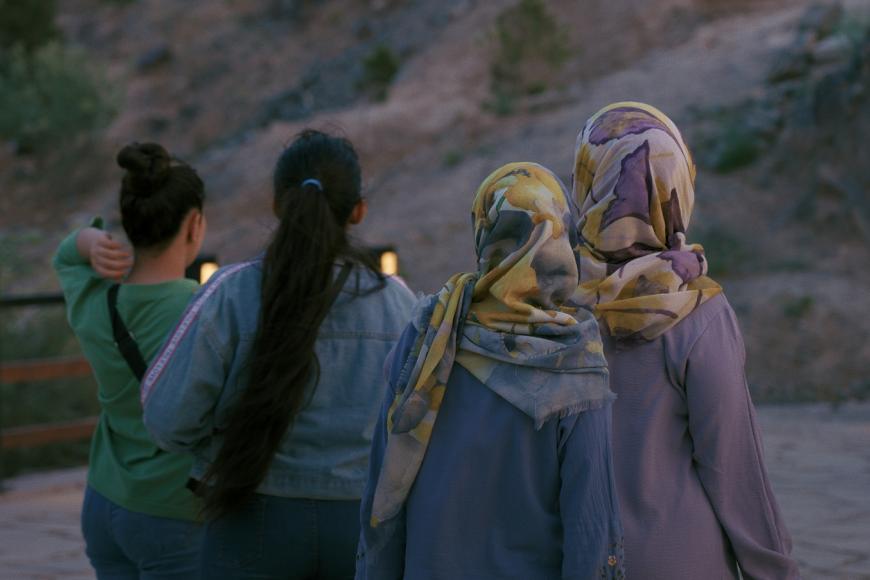
Family discussions flare up against the backdrop of the “Woman, Life, Freedom” protest movement in Iran: Elahe does not want to wear a hijab. An intimate and honest discussion.
Filmmaker Elahe returns to her hometown of Mashhad in Iran to help her parents move house. Boxes must be packed, old stuff must be rummaged through together. Meanwhile everyone involved discusses what Elahe should wear at the upcoming big party, because Mr. Hossein, the respected and devout patriarch of the extended family, has invited his relatives to his garden. Elahe will not wear a headscarf, nor a hat, not even a borrowed baseball cap for this occasion. On previous visits, she was willing to make a lot of compromises in order not to shame anybody at home. But those days are over. The “Woman, Life, Freedom” movement encourages her to force a change. In Hossein’s garden the director has intimate and moving conversations with sisters and cousins. They have all had similar experiences with hijab and chador but found different ways of dealing with it. Elahe boldly confronts her family’s fears and wishes and films the honest discussions.
From ritual dance performances on the Indonesian island of Java, to colonialist film images, to an intervention at the Amsterdam Rijksmuseum: T.A. Kusno settles the score with colonialism.
The powerful interventions of the Indonesian artist, cultural studies scholar and filmmaker Timoteus Anggawan Kusno are internationally renowned. What distinguishes them are the empowering attitude and the breathtaking aesthetics he employs to re-interpret in different media the cultural traditions passed on in his homeland. With “Afterlives”, he delivers another unequivocal reckoning with the representations of history shaped by colonial annexation. The opening sequence is already a declaration: On the soundtrack we hear screaming, in which both pain and its liberating relief are manifest and united. On screen we see an explosion of colours: Jathilan, a ritual Javanese war game, is being performed. Men are dancing on horses made of plaited bamboo until they fall into a trance or the evil spirits are driven away. The impressive precision of the editing to tribal trance music by Setabuhan makes the colonialist archive images expose themselves – and fade. Those of (dance) performances in which the Javan tiger, killed multiple times in historic rituals, is symbolically reanimated come to the fore. In the Rijksmuseum Amsterdam, it now guards – in the shape of a re-interpreted colonial sculpture – the empty frames that once gave (representative) power to the governors-general of the Dutch East Indies.
Borjana Gaković
Credits
Director
Timoteus Anggawan Kusno
Script
Timoteus Anggawan Kusno
Cinematographer
Aditya Kresna, Krisna E. Putranto, Timoteus Anggawan Kusno
A ghostly search for traces, based on the 1965 U.S. embargo against “communist” real hair wigs from Asia. Is every wig inhabited by a ghost from the imperial past?
Narrated by the incarnate ghost of a deceased real hair donor. In the post-war era, the export of real hair wigs contributed to Asia’s economic development, with Hong Kong as a major hub. In its heyday in the 1960s, “Asian real hair” was popular with wealthy U.S. women, but then the USA imposed an embargo on the product, now classified as “communist hair”. This is where the intricate and innovatively realised story begins: Starting with complex economical and sociopolitical contexts, it weaves a thread that runs through various historical and dreamlike staged levels.
Hong Kong was and is a space of in-between-ness – between East and West, between communism and capitalism. Perhaps that is why there are so many spooks in the city, one protagonist speculates. Just like the well-travelled ghost, an eternally wandering entity and contemporary witness of an imperial and colonialist past.
Annina Wettstein
Credits
Director
Bo Wang
Script
Bo Wang
Cinematographer
Yavuz Selim Isler, Fai Wan
Editor
Bo Wang
Producer
Ruoyao Jane Yao, Jia Zhao
Sound
Franco van der Linde
Sound Design
Jeroen Goeijers
Narrator
Jia Zhao, Hamza Junaid, Tommy Tse
Winner of:
Golden Dove Short Film (International Competition Documentary Film)
A journey through places and times that shaped the life of Turkish writer and human rights activist Aslı Erdoğan. She writes against silence, especially in exile.
“Words are the only instruments I have”, says Aslı Erdoğan in this powerful audiovisual collage. The writer, physicist and human rights activist who lives in exile in Berlin writes against the disappearance and loss of her own language. As a former political prisoner in Turkey, she knows only too well what autocratic violence and oppression intend: to silence people.
In this sense, this filmic portrait sets itself vociferously against the silence. Words flicker between fragments of the history of protest in Turkey. Working with text, photography and archive material, the film embarks on a vibrant visual and acoustic journey through places and times that shaped Aslı Erdoğan’s homeless life. Taking inspiration from her autobiographical collection of prose, “Requiem for a Lost City”, individual history becomes collective. A many-voiced choir reminds us that language is the thing that nonetheless holds everything together.
Annina Wettstein
Credits
Director
Davide Minotti, Valeria Miracapillo
Script
Aslı Erdoğan
Editor
Davide Minotti
Producer
AAMOD
Sound
Riccardo Spagnol
Sound Design
Valeria Miracapillo
Narrator
Aslı Erdoğan, Deniz Ozdoğan, Alexandra Genzini, Pauline Saudriès
The most profound memories are sometimes the most deceptive. That’s what Brett Allen Smith finds out as he keeps replaying the funeral of the family dogs. A baffling confrontation.
At first glance, Brett Allen Smith’s memory worlds seem slightly otherworldly but peaceful. There is a little pug – curious, bouncy and, most importantly, alive, a harmless explorer of lawns and living rooms. At the same time, the director is driven by an inner fracture, an irritation to be illuminated by means of phone conversations with family members: How real are the memories that had such a tremendous impact on him? Like the hill towering in front of Smith’s inner eye under which two dogs lie buried. And there are sunflowers, imposing plants that are impossible to pick for his five-year old’s hands because their roots have bored so deeply into the soil.
Today the director is a father and dog owner himself – there are shots of a baby and a pug – and his thought construct, maybe even something that shaped his identity, is blurring. The phone calls with his sisters lead nowhere. On the visual level, “Au Revoir, Pugs” plays with images, animation and nostalgic effects, while melodies can be heard from far away, sweet and melancholy but also a little uncanny. A compact work of less than ten minutes, a soft-toed sneaky jolt.
Carolin Weidner
Credits
Director
Brett Allen Smith
Cinematographer
Brett Allen Smith
Editor
Brett Allen Smith
Producer
Andrea Gatopoulos, Brett Allen Smith, Marco Crispano