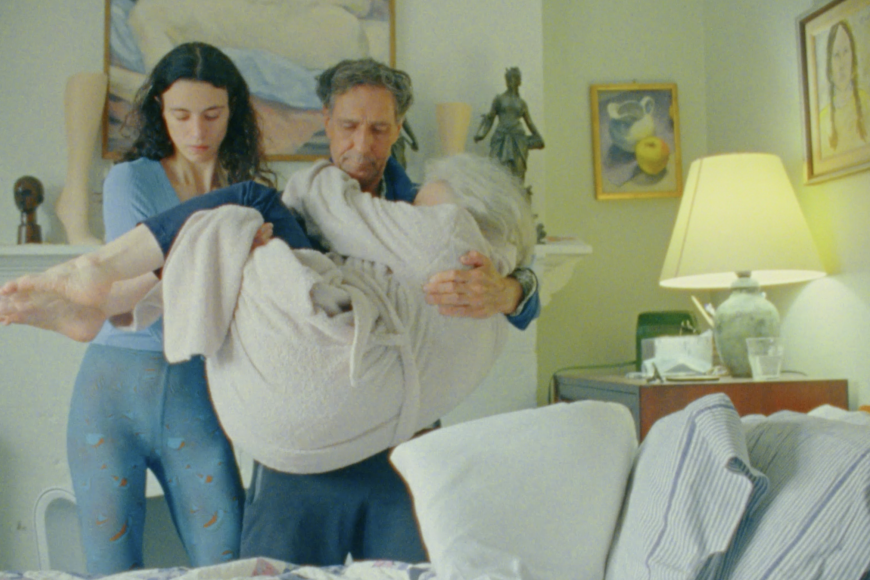
The director stages her parents, dancing, in the family home. A playful approach to family, transience and to illness. Associative, loose and intelligent.
Director Nora Rosenthal brings a very specific focus to this portrait of her parents, Heidi and Alan: She shows them dancing. But these are far from “easy dances.” Rosenthal realises quickly that her own inflated expectations threaten to make her ambitious project fail. She hires two professional dancers – mirror images and, as it were, interaction partners for Heidi and Alan – to spread the enormous pressure on robust shoulders and with whom they can waltz or even do a disco number. Abstractly playful, yet empathetic, “Nine Easy Dances” addresses heavyweight subjects like transience and illness, opens the door to the family archive and tries to tell a story whose end already hangs in the air. A multilayered endeavour, associative, free and intelligent.
The director, a stateless Filipino, returns to his native country. For more than twenty years, he lived without papers in the USA and feels trapped in a world full of borders.
English, German Subtitles for deaf and hard-of-hearing
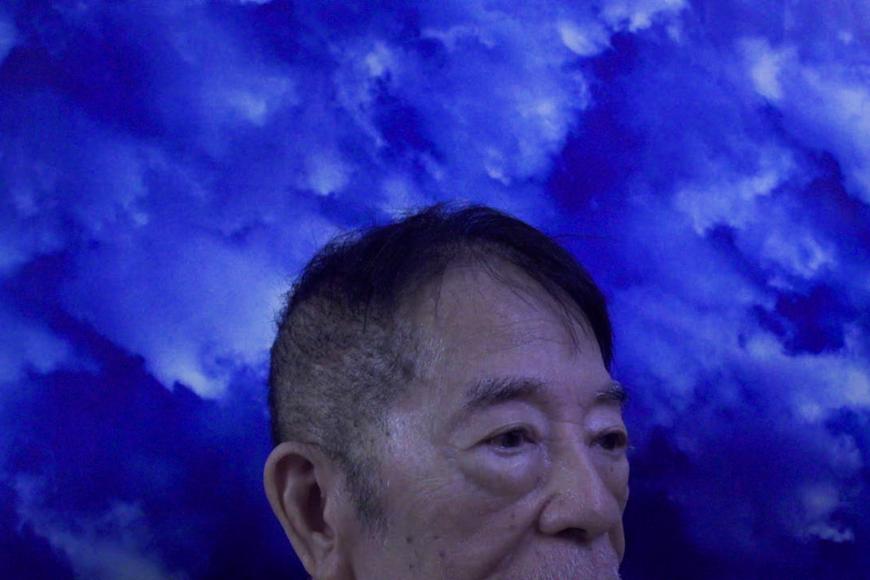
How does an undocumented individual document themself? This is the question the Filipino filmmaker who grew up illegally in Los Angeles asks himself. His extended family live scattered across the USA and the Philippines. Now he embarks on a journey to his estranged native country, driven by the desire to overcome a curse that has profoundly disturbed the family history over generations. The colonial past is a heavy burden even today, even in the diaspora. Filipino itself, the official language with its countless loanwords from Spanish and English, is nothing but a linguistic by-product of the colonial era.
By re-locating Miko Revereza tries to come to terms with the experience of distance and loss of identity with a remarkably idiosyncratic and creative approach. His psychogeographical filmic journey is dense and meandering, the camera sometimes literally destabilised as if by the curse. By means of superimpositions and improvised music a melancholic but never accusing memoir is created that lingers in our minds. The filmmaker, who showed “The Still Side” at DOK Leipzig in 2021, lives in Mexico today.
Annina Wettstein
Credits
Director
Miko Revereza
Script
Miko Revereza
Cinematographer
Miko Revereza
Editor
Miko Revereza
Producer
Shireen Seno
Sound Design
Miko Revereza, Kevin T. Allen
Score
Vincent Yuen Ruiz
Nominated for:
Prize of the Interreligious Jury,
FIPRESCI Prize