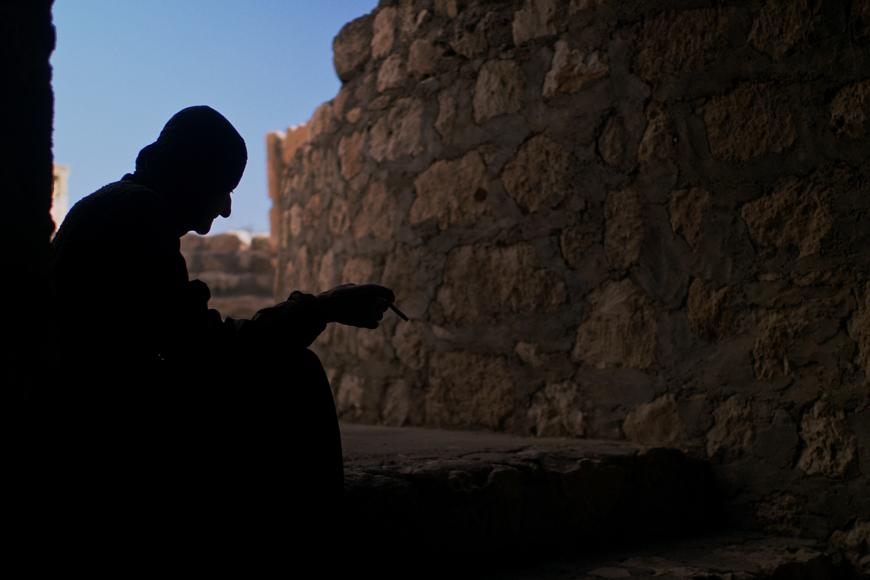
A Syrian Orthodox nun lives in an abandoned estate in south-eastern Turkey. Despite hostilities from the Muslim neighbourhood: she won’t be driven out.
In a dilapidated village in south-eastern Turkey, a Syrian Orthodox nun endures alone with her animals. However strong the hostility of her predominantly Muslim neighbourhood may be: she won’t be driven out, for she has sworn to protect the church and not to leave the sacred place. This quietly filmed observation of everyday life focuses on an isolated woman who carries the pain of a whole community inside her.
The population of the village was tortured and driven away in the 1990s. The nun Dayrayto came here only afterwards. Today she rarely receives visits from passing believers. She usually spends her days doing maintenance work on the church and taking care of the animals. Right now she is worried about her old dog. Has he been poisoned? What to make of the provocations and threats she talks about? Dayrayto is always vigilant, even when she’s resting. From her elevated dwelling she looks far across the landscape, registering every vehicle, however distant. But she is in no way distracted by the presence of the film crew. The unobtrusive camera follows the nun – not at every turn, but as a constant, protective companion as she endures on her “bastion”. Loneliness, worries and fear shape this sparse life. They made her suspicious, but also fearless.
Sarah’s father Eulidio was one of 20,000 contract workers who came to the GDR from Mozambique. The fall of the Wall tears the family apart, but step by step his daughter weaves the ties together again.
Hammer and compass in Mozambique. We see a GDR flag waved at a rally in Maputo, carried by “Madgermanes”, contract workers who once toiled in eastern Germany. Some of them founded families there, like Eulidio. His daughter Sarah grows up with her mother in Berlin. The relationship with her “second home” is slow in growing, partly thanks to Luana, Sarah’s baby, whose father Eduardo is also from Mozambique.
Eulidio still remembers the Lubmin nuclear power plant. Today he fries chips in Springs, South Africa. Meanwhile, Sarah only knew her father from a photo for the longest time: rather cool-looking, wearing a cap. She met him for the first time when she was eleven and felt how comfortable she was surrounded by people whose skin is as dark as hers. As an adult woman she decides to spend some time in Mozambique – and meets Eduardo. On the flight back she’s pregnant. This documentary observation by Brenda Akele Jorde deals with Sarah’s attempt to weave together and spin out threads that were torn by the fall of communism. And it shows the challenges this brings: While Sarah is confronted with racism in Germany, in Africa she’s regarded as a German. While once her father Eulidio was expelled after the fall of the Berlin Wall, now it’s Eduardo who sees his daughter only sporadically.
Carolin Weidner
Credits
Director
Brenda Akele Jorde
Script
Brenda Akele Jorde
Cinematographer
David-Simon Groß
Editor
Laura Espinel
Producer
Florian Schewe, Miriam Henze
Co-Producer
Filmuniversität Babelsberg KONRAD WOLF, RBB Rundfunk Berlin-Brandenburg
Sound
Till Aldinger, Brenda Akele Jorde, André Bahule
Sound Design
Jakob Mäsel
Score
Lenna Bahule
Commissioning Editor
Rolf Bergmann
Funder
Medienboard Berlin-Brandenburg GmbH
Co-Director
Malte Wandel, David-Simon Groß
Nominated for:
Leipziger Ring,
VER.DI Prize for Solidarity, Humanity and Fairness,
DEFA Sponsoring Prize,
Young Eyes Film Award
The director – or more precisely, her alter ego – sets out in search of traces of her family history in Silesia. What she finds are dinosaurs. Including a few made of plastic.
German Subtitles for deaf and hard-of-hearing, English
Silesia: a contested region marked by migrations. Animosities between the peoples have a long tradition here, not only since the Second World War. But the National Socialist tyranny left clear lesions behind. The director’s grandfather comes from this region, was the organist in a church in Krasiejów – a place which was once also called Krascheow and, for a while, Schönhorst.
The filmmaker Juliane Henrich – or more precisely, her alter ego, the writer Nannina Matz – sets out in search of her family history. What she finds are bizarre ways of representing the history of humanity – and the history of earth. She comes across all kinds of traces of dinosaurs. Some may only be made of plastic, but others are not: A certain species of this genus, whose fossils were found in Silesia, was christened “Silesaurus opolensis” by the Polish palaeontologist Jerzy Dzik. That’s why there is a Dinosaur Park in Krasiejów. And a local museum, of course. But also many people with different individual memories. They do not necessarily lead to ground-breaking discoveries regarding the looked-for family past, but they broaden the view: of the complex history of this region and the way it is thought together, represented and codified.