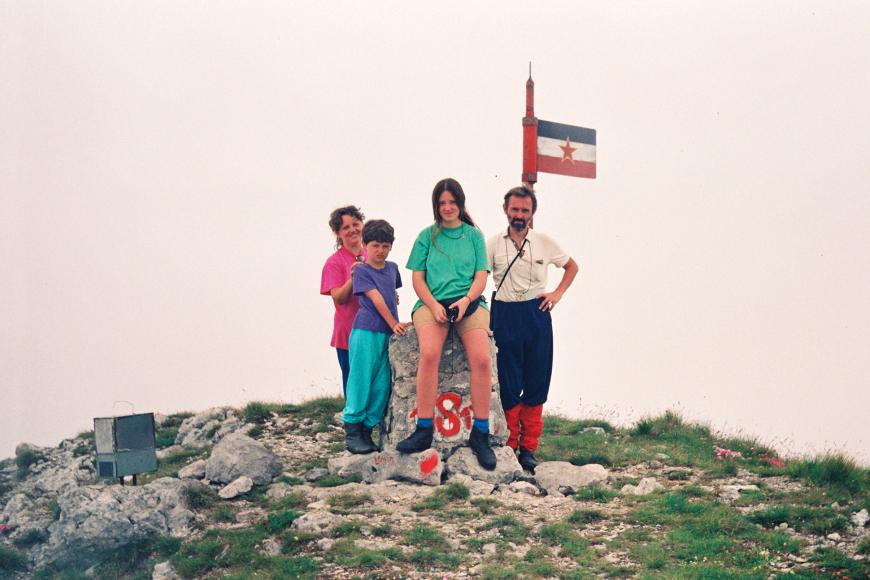
When Nataša Urban finds her father’s hiking diary, she takes it as a starting point for an enchantingly beautiful film about how she grew up during the Yugoslav War.
She left Serbia a long time ago and never looked back. But then Nataša Urban discovered her father’s hiking diary and began to connect his entries to the events of the Yugoslav Wars of the 1990s. The 1999 total eclipse of the sun is the central motif, employed by Urban as a metaphor for the way a dark past remains part of the present.
Kitted out with analogue film equipment, the director travels back to find the stories of her family, intimate friends and acquaintances. She listens to memories of inconceivably cruel acts; she watches the wind blow through leaves of grass. Her father, a lean, grey-haired man, hikes through the forest, striding again through the places he once visited. Dreamlike scenes meet sober descriptions of almost unbearable atrocities. Urban skilfully combines 16 mm and Super 8 film with archive material to explore the blurred boundaries between the individual and the collective, the private and public spheres, the personal and the political, resulting in an enchantingly beautiful work of art, a poetic reflection on growing up during the war.
On the Bosnian-Croatian border, many mines from the war have not been cleared yet, traumas are still virulent. This is where the paths of migrants and locals cross.
Somewhere on the Bosnian-Croatian border. Green hills, forests, fields, a few houses and sheds scattered along the roads. If the territory of the European Union did not end here, it would be a rather unspectacular, interchangeable region. But the seemingly untouched landscape is deceptive – many mines from the Bosnian war have not been cleared yet; war traumas are far from over. Today the paths of migrants and locals cross here, refugees from Afghanistan, Syria and Iraq trudge through the area, braving rain and snow in search of protection and a better life. At night you hear their cries from the forests when they are brutally chased across the border. The villagers on the Bosnian side open the old school building to allow their exhausted bodies a moment of rest. But everyday life continues. Wood is chopped, corn harvested, school kids recite poems. The imam calls to prayer. Everything normal, everything as usual. As a reporter, Nicole Vögele spent several years researching this border region, reporting on the illegal pushbacks of the Croatian police for the “Der Spiegel” news magazine and others. In her film essay, she now takes the time to observe. She does not ask direct questions, giving as much space to the seasons, the weather and the forest as she does to the people.
The once thriving pawnshop in the Polish city of Bytom is facing bankruptcy. What could help? Drying tears, ladling out soup, marketing drives, giving away presents?
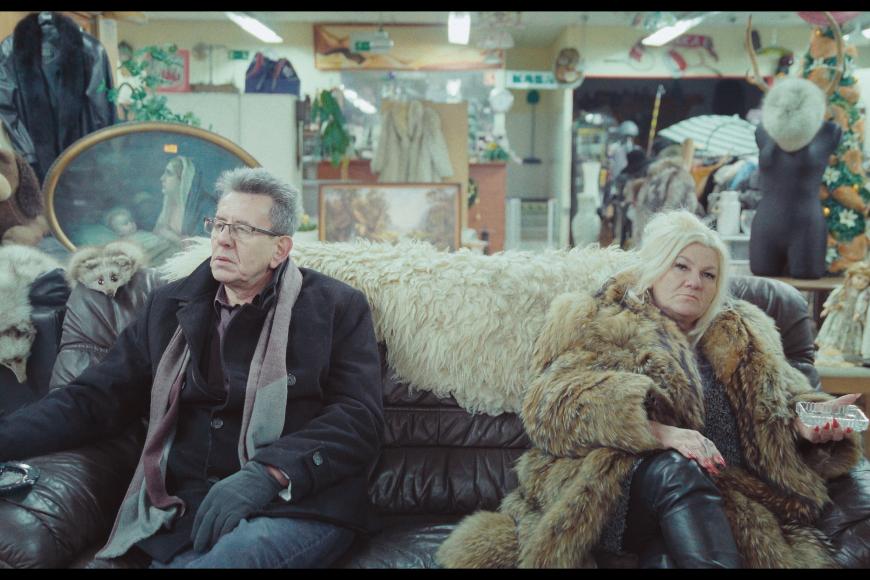
The Bytom area was once known for its coal mines, but structural change has caught up with it, too. The decline of the region is vividly demonstrated by the pawnshop of the Silesian city. Probably the biggest of its kind in Poland, the shop has seen better days. Jola and Wiesiek, the idiosyncratic operators, are each trying in their own way to cope with the crisis and revive business.
The closing of the mines and the resulting unemployment in Bytom left behind all those who were unable to adapt to the new age. In the huge hall, they put increasingly absurd and worthless objects on the counter. The once lucrative trade in jewellery, electric devices and furniture has dwindled and however hard the employees work, the till stays empty. The wiring is unsound, nerves are raw and the tone between them gets rougher. Before they know it, the small business has turned into a kind of counselling centre: drying tears, ladling out soup and giving away goods instead of selling them. Jola in her voluminous fur coat always has an open ear and a warm blanket ready. Wiesiek devises one marketing scheme after the other. But will it be enough to save their business? A documentary report from the “Polish Detroit”, observed with delicacy and pitch-black humour.
Lina Dinkla
Credits
Director
Łukasz Kowalski
Script
Łukasz Kowalski
Cinematographer
Stanislaw Cuske
Editor
Adriana Fernández Castellanos, Filip Kowalski, Jakub Darewski, Kosma Kowalczyk