A Prague food stall has run out of beer. Regular Hurikán takes matters into his own hands. An epic parkour in the drowsy but steep side streets of the city begins.
Beer is out in Prague … well, actually only at a food stall away from the touristy Old Town. But that doesn’t make the death rattle of the spigot less dramatic for Hurikán, a regular who spends his days and much of his nights at these haunts of lost souls. With a crush on the stall manager, Hurikán takes matters into his own hands. Things get rolling, just like the empty barrel he wants to have filled. An epic parkour begins, starting with small mocking gestures and rapidly expanding into a breakneck chase through the drowsy but steep side streets of Prague’s Žižkov neighbourhood. With brilliant timing and tongue-in-cheek humour, Jan Saska weaves typical genre elements from comics and action movies together, all revolving around a guy whose life is not easy. This time he needs luck if he does not want to die of thirst.
André Eckardt
Credits
Director
Jan Saska
Script
Jan Saska, Václav Hašek
Editor
Jan Saska
Producer
Kamila Dohnalová, Martin Vandas
Co-Producer
Antoine Lietout, Ivan Zuber, Juraj Krasnohorsky, Mladen Đukić, Alena Vandasová
Sound Design
Jiří Gráf
Animation
Marek Pokorný, Michaela Večerková, Jan Saska, Camille Chao, Hugo de Faucompret, David Štumpf, Jean-Christophe Lie, Félicia Gillibert, Delphine Grelet
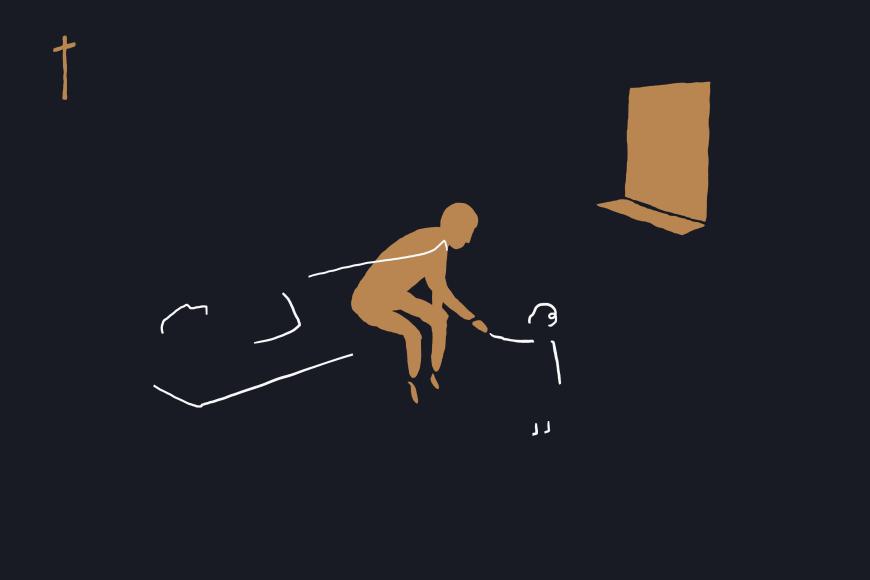
Rwanda, 1994: Like hundreds of thousands of Tutsis, the Rutikara family is persecuted by Huti militias. They are rescued by chance – because a soldier was moved by their baby as they fled.
Maybe it really was the innocent hand of an infant clasping a soldier’s index finger that was to determine the course of three lives. Lives that did not end in early death after all, but continued in the asylum of a foreign country. The Rutikaras reside on the outskirts of the capital of Rwanda and call their newborn child Justice, because justice is really becoming scarce in their country. In the spring of 1994, when the little boy is six months old, the political situation is getting increasingly tense, the Tutsi ethnic minority is being hunted, abused and murdered by the Hutu militias. In the summer of that year, the world learned of the extent of the violence: a genocide with hundreds of thousands killed. The Rutikaras are affected, too. But with luck, chance and their unperturbable baby they manage to save themselves in the care of the United Nations. Director Justice Rutikara, born in Kigali and grown up in Quebec, is the son of Valentine and Jean-Claude, who report from offscreen. His first animated film, carried by broadly coloured images, an impressive factuality and mild poetry, is a memento that rises above the individual and takes on a universal note in the chorus of human sounds, all the unifying and threatening ones.
An unpleasant examination by a meticulous doctor leads to a supposedly inevitable medical intervention that leaves the young patient scarred in body and soul.
In a sterile white examination room, a young woman is asked by a doctor to undress completely. An exhaustive examination of the protagonist’s skin begins during which every centimetre, the palm of her hand, the sole of her foot, the back and also the genital area are closely scrutinised. The doctor meticulously probes every nook and cranny of the young woman’s outer shell until she is able to identify a suspicious birthmark. A timely appointment to remove the mole is made.
Exposed and irritated, the protagonist finds herself confronted with her fears about the surgery and the after-effects of the examination. A tiny birthmark triggers an inner process: an analysis of her own body and the control others are allowed over it. Fragile lines on scarred paper and a tonal design that gives us goosebumps make us participate intensely in her emotions.
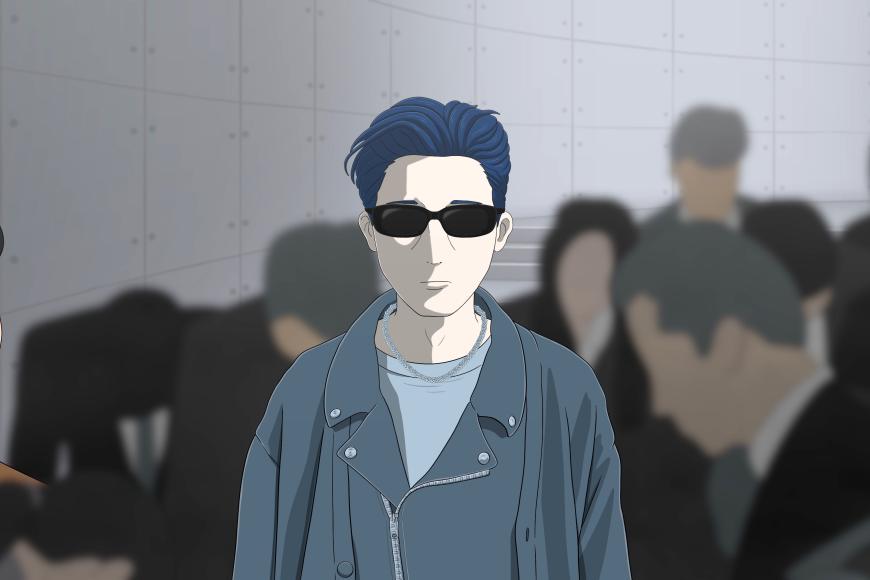
The life of a nameless orphan, from reluctant J-Pop idol to futuristic god figure. A hellish ride through the depths of human depravity, visualized with imagination and love.
The original title of this film can be roughly translated as “A Nameless Life” and there is really no other way to sum up the story. We will never learn the protagonist’s real name, but in the one hundred lonely years that we accompany him for 90 minutes of cinema, we see ever new facets of him. The film opens with a seemingly innocent montage of taxi rides in 1994. But as nonchalantly as the scenes are strung together here, it is important to pay attention to the subtleties if you want to stay on top of things during the ensuing century-long trip. The journey begins in the northern Japanese province and takes us through the J-pop world of Tokyo’s hip Harajuku district to a post-apocalyptic future where Fernand Léger and Stanley Kubrick shake hands. Ryuya Suzuki is considered an outsider in contemporary Japanese animation. He is the sole author, director, animator, editor, and musician here. “Jinsei” is entirely his vision, a film about life and death, fate and rebellion, about power and powerlessness, unsparing and emotional. The 2D animation is imaginative, surprising, usually minimalist, always irritating, occasionally contemplative and then explosive. A hellish ride through human abysses, produced with so much attention to detail that new spaces open up every time you watch it.
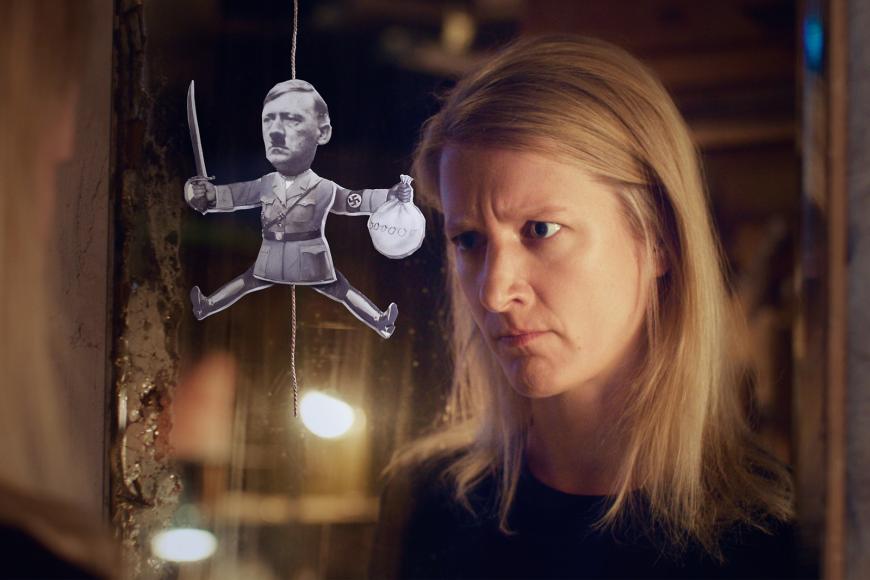
Design as a political act? In this animated collage, a contemporary advertising graphic designer explores the uncompromising work of the photomontage pioneer and anti-fascist John Heartfield.
As she visits an exhibition, a graphic designer is mesmerised by the photocollages of the anti-fascist John Heartfield, who became known as the “montage dada.” Stefanie falls through a vortex of paper and photo snippets into an old-fashioned looking studio. A pair of scissors – an analogue tool she herself hardly uses – attracts her attention. She begins to cut a figure out of cardboard, a miniature version of the artist who at once addresses her and explores his life and works with her. The studio turns out to be a living archive that ceaselessly produces documents and information about Johnny. The research gives Stefanie, stressed and disappointed by her job, new motivation, and the courage to choose a different path as a designer.
Both protagonists have the same profession and find themselves facing the same questions about the significance and recognition of their work. Both are struggling in their own way with frustration and fears, caused by the different social and political circumstances of their generations. The different elements of this animated documentary come together in a dialogic collage that reflects on the mission of art, its educative and critical power, and its potential to bring about changes in our society.
Franka Sachse
Credits
Director
Katrin Rothe
Script
Katrin Rothe
Cinematographer
Thomas Eirich-Schneider, Richard Marx, Manon Pichón
Editor
Hannes Starz
Producer
Gunter Hanfgarn, Andrea Ufer, Ralph Wieser, Sereina Gabathuler, Werner Schweizer
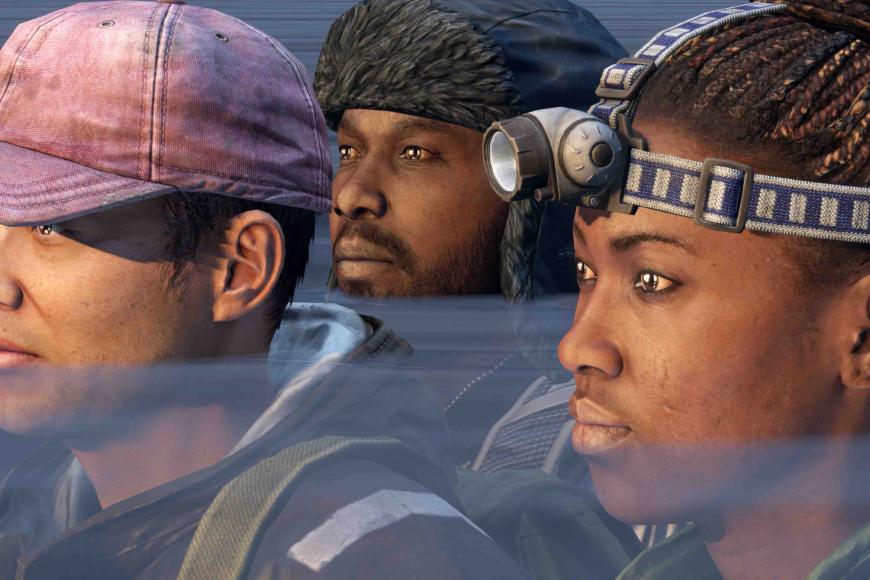
A documentary film crew spends 963 hours in a video game interviewing gamers. Little by little, they drop their masks and give insights into their “real” lives.
Running. Rapid breathing. A shot in the silence. The opening strikes the keynotes: caution, curiosity, thrills. A documentary film team spend 963 hours on the adventure playground of the video game DayZ. Online gamers explore the territory of a post-Soviet disaster province, permanently exposing themselves to the risk of being killed by hostile gamers. Despite their “press” badges, Guilhem, Ekiem and Quentin, as avatars, are subject to the same rules when they interview the gamers in their virtual world. The community is heterogenous: marauding gangs, cowboys with Samaritan ethics, curious wanderers.
Reality is never far away. The gamer “Feesh” is torn from her console during the interview because her IRL (in real life) child is crying. In the course of their conversation, “Iris” shoots her “toy”, a prisoner, before the eyes of the shocked documentary team – a conflict of documentary work opens up. “Knit’s Island” is a disturbing, melancholy to heartwarming tour of chance meetings and friendships of sleepless persons in the artificial world. Some avatars constantly twitch nervously and grotesquely because they act out darkest desires. Others “trick the game” and enter fascinating techno-psychedelic spheres. Game-playing and role-playing persona – sometimes they are one, sometimes two.
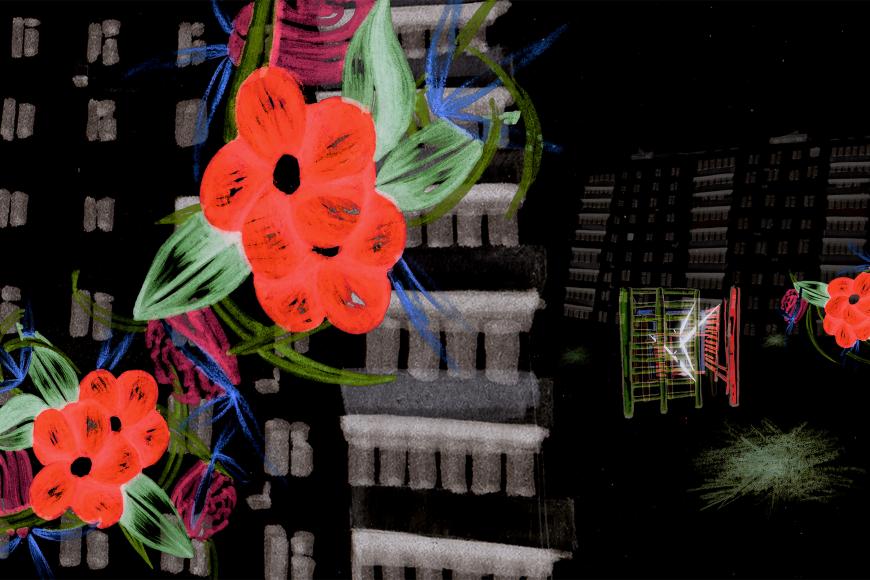
Kyiv, before 24 February 2022. A family is trying to make ends meet – though the fridge is permanently empty and the electric metre has sharp teeth. Then bombs hit the building across the street.
The stag in the bedroom painting vigorously stomps on the grass and the father wakes up. His wife and baby are still asleep. In worn-out boxer shorts that reveal one lost-looking testicle, he begins his daily battle with the electric metre which only closes its snapping jaws when it is fed enough banknotes. Mykyta Lyskov’s film is a scathing, incredibly funny and deeply sad portrait of the precarious pre-2022 life of a Ukrainian family. He uses anthropomorphic and surrealist exaggeration to bring home their poverty, and countless cultural references to raise questions of belonging and national pride. In Lyskov’s film, everything stays bleak, as if 1990 was not so long ago: endless canyons of prefabricated buildings, garbage, lack of perspective. No wonder then that the father guards his passport like a veritable treasure and flutters away as a small yellow-blue bird to work in Western Europe. He leaves behind his wife, who ingeniously keeps the greedy electric metre at bay, while the son grows up to become a hooligan. It is absolutely outrageous that this family, sort of re-united around the kitchen table in this hopeless hodgepodge, is forced to watch as a bomb coming out of nowhere demolishes the building opposite. It is fantastic that Lyskov captures this for us with so much exuberant rage.
Marie Ketzscher
Credits
Director
Mykyta Lyskov
Script
Mykyta Lyskov
Editor
Mykyta Lyskov
Producer
Kalev Tamm
Sound Design
Horret Kuus
Animation
Aili Allas, Tarmo Vaarmets, Mykyta Lyskov, Shara Arus
Nominated for:
Gedanken Aufschluss Prize,
mephisto 97.6 Audience Award
The breasts are in place, the feathers are smoothed, off to the date! Her daughter does not comprehend the ritual of desire yet … Erotically crude, with pointed beaks in the conflicts.
Breasts lifted, bottom tight, feathers smoothed. She is ready for her date. But her daughter clings and refuses to let her go to this as yet incomprehensible, repulsive ritual of desire. Very soon the fully-fledged adolescent will indulge in sexual lust herself … and experience disappointments. In the conflicted world of the two women, men evade partnership and fatherhood. The faithful bitch offers the only support.
As in her previous film, Carla Melo Gampert transfers her impressive but uncompromising analysis of family relationships to the lives of wading birds. Human traits show through in the anatomy, but the bird’s bodies including their feathers and sounds lend themselves perfectly to the apt exaggeration of emotions. Delicate strokes turn into cuttingly sharp movement lines of the animal characters, both in their erotically crude acts of love and their “hands-on” disputes. Soft splashes of watercolour glow incandescently in the heat of lust and warningly in the hopeless fury.
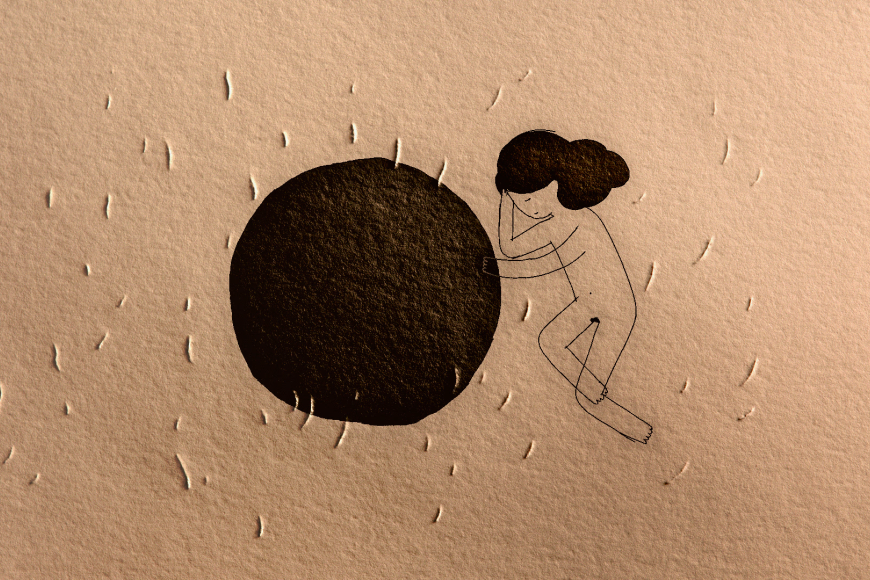
White drawings on light-sensitive material. This film about the ambivalence of memory builds a bridge to our childhood ability to find everyday magic in the smallest objects.
Only light lifts the outlines of the world from darkness. In cyanotype, light-sensitive material is used to make white drawings materialize on a blue background. Tata Managadze challenges the light-sensitivity of our mind. She uses reflections and mirrors to expose the sensitive, gossamer-thin material of association in ways that make ephemeral memories and emotions visible. The poem at the beginning tells us how soothing and at the same time brutal her protagonist – light – can be. Like children in a playground, we are seduced by and forever searching for the dance of lights. Flower patterns on the dishes in the sink begin to spin when our eyelids grow heavy and sleep is approaching. Everything moves. In the transitory state between waking and dreaming, a different kind of life stirs in the prefabricated building estate: The stars of the restaurant leap from the sign and scratch traces into the wall. Or are these scars that must still heal? Perhaps scars from the Soviet era? Again and again, well-known fragments are re-assembled. This non-narrative animated documentary takes us on a spiral of remembrance to an untraceable origin, building a bridge to our childhood ability to find magic in the most mundane things.
Children who are stillborn or die too young – not an uncommon fate. But society hardly ever talks about it. This film gives parents a space to grieve and break the silence.
“Apparently, it had to happen to me before I learned it was ‘normal’.” This statement by a protagonist sums up how our society deals with stillborn children or children who die young: Star children are omnipresent (one in four mothers has lost a child) and yet absent. We lack the vocabulary, the sensitivity, and the tranquillity to enable parents to mourn. Remo Rauscher’s animated documentary confronts us with this inability, letting twenty people in mourning or who deal with mourning speak: Thinking out loud, struggling for words, regarding the pain from different perspectives, discovering dignity and strength in it and helping us to overcome the taboo. They object to being an “error in the system”, to accepting the speechlessness. In Rauscher’s film, the darkness is ambivalent and palpable on all levels: It is absorbing and caring. It is generous and gives us moments of beauty, humility, and hope. The 2D animations in muted colours on a dark background are always abstract, sketchy, and restrained – an expression of tact and respect. They draw attention to themselves only once in a while, while the voices are given a lot of space and can unfold without fear. This film opens a space to mourn that society is unable to offer yet.
Two colour surfaces battle, taking up more and more space in their contest to outdo each other, causing breathlessness. An abstract and yet physically tangible cinematic event – large and loud.
Breathing is vital and needs space. A small blue square appears out of nowhere, vibrating nervously and growing into a narrow line. Its red mirror image follows suit. Both take up more and more room in a contest to outdo the other, while a growing shortness of breath is wedged between them. Martin Schmidt pulls off an astonishing feat: He generates a physically tangible cinematic experience from abstraction. He choreographs smooth surfaces in the cold, technical logic of their skirmish and electronically deconstructs the sounds of gasping. As the battle is getting fiercer, things are visually and acoustically compressed and stretched, twisted and filtered, until a heavy monster of tension emerges. “Lines” is big and loud; it can be read metaphorically, but also understood only in terms of its aesthetic power.
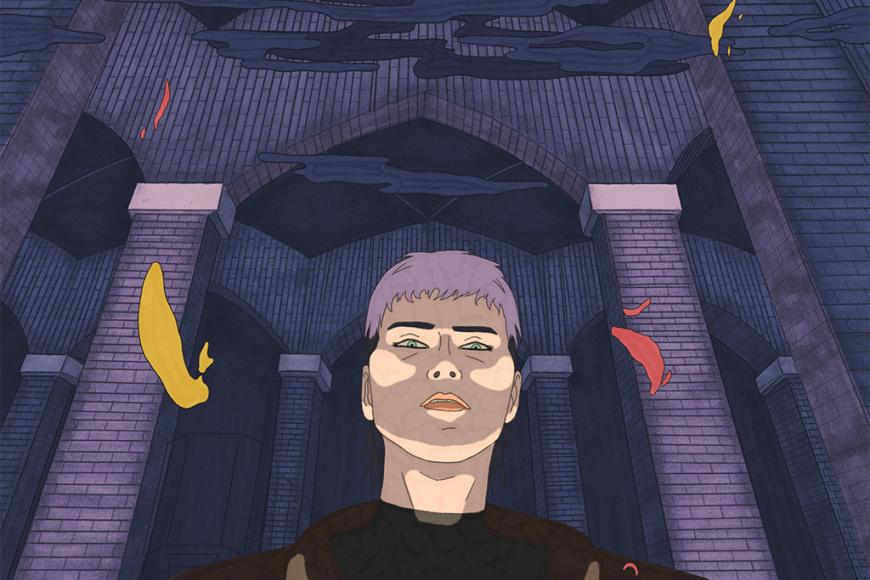
Leipzig, 1989. A young punk, detained in a mental hospital, longs to be close to her boyfriend. A doomed love story in the midst of the collapse of the GDR.
The end of real-socialist oppression, doomed love and tacit double morals unfold in colourful felt-pen images and clear lines. Leipzig, 1989. The city still belongs to the blue shirts of the Free German Youth, there is still talk of a flourishing country in festive speeches. Locked away in a mental hospital for belonging to the Leipzig punk scene and abused as “belonging to an enemy faction” that undermines the GDR from within: Margarethe can stand it. Ultimately, however, the lack of briquettes and the cold water in the communal shower make the young woman dream of being close to her boyfriend Heinrich. While the protests in the streets are growing, Heinrich and his band play church-organised punk concerts that hint at the prospect of freedom. But Stasi spies are more present than ever – until the newly gained freedom to travel scatters them to the winds along with the lights of the fireworks.
Jana Kraft
Credits
Director
Lucas Malbrun
Script
Lucas Malbrun, Marie Larrivé
Cinematographer
Lucas Malbrun
Editor
Clara Saunier, Vincent Tricon
Producer
Nicolas de Rosanbo, Céline Vanlint
Sound
Elodie Thevenin
Sound Design
Quentin Romanet
Score
Mael Oudin
World Sales
Miguel Español Celiméndiz
Artistic Design
Morgan Curt, Hippolyte Cupillard, Jean-Baptiste Peltier, Charlie Belin, Jonas Schloesing, Daria Skripka, Yehor Bondarenko, Angelina Dorozhinskaia
1945. The Red Army are moving into Germany. A child, a Soviet soldier, a Nazi officer and a Hitler Youth have been stuck in a hotel ever since, which binds them together for years in bizarre ways.
In 1945, the Red Army are advancing on German territory, the Second World War is drawing to an end. Families are still trying to escape to America, but many plans fail. Five-year-old Sophie also loses her father and mother during the flight. They are killed by Nazi officer Scharf and a Soviet soldier named Vasily, with Hitler Youth Beckmann as a witness. The gruesome event takes place in an extremely strange hotel which henceforth will bind the four survivors to its premises in bizarre ways, no matter which rooms of the truly scary building they find themselves in. Up in the lounge, where the new customers arrive one by one, down in the kitchen, where the now grown-up Sophie prepares food, or even in an alcove near the elevator shaft, where Beckmann hides with the rats. The involuntary permanent guests age but never tire of courting Sophie. Heinrich Sabl has built an excitingly disturbing dollhouse decorated with quotes from reality for the German-Soviet history of guilt and coping. In his first feature-length animated film, on which the director worked for more than twenty years, he sends extraordinary characters on an equally extraordinary visual and acoustic time journey through the war-damaged suites of the 20th century.
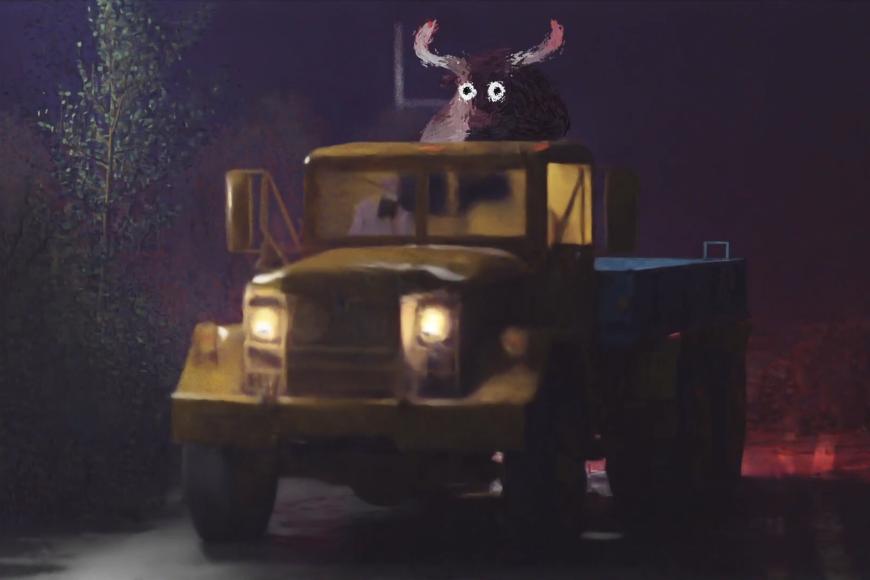
People wonder about the disappearance of the moon. Meanwhile, a bull escapes from his herd and takes a poetic trip through the night – with a surprising finale.
On a moonless night, a cheeky bull escapes from his herd. He dashes through fields and over hills until he finally stops at a pond, where a piece of paper on which a poem is emerging attaches itself to him. The bull shakes off the paper and sneaks into town, where he watches people at their nocturnal business. He witnesses a police investigation, listens in on two truck drivers and observes the theft of a bus stop shelter. All these experiences are accompanied by the narrator’s poetic comments and culminate in a hilarious singing sequence, complete with a dance and performance number by the bull.
Meanwhile, the people in the town are in an uproar about the undetectable moon. They search, discuss and protest. But the moon stays missing – until the bull transforms himself at the end of his journey.
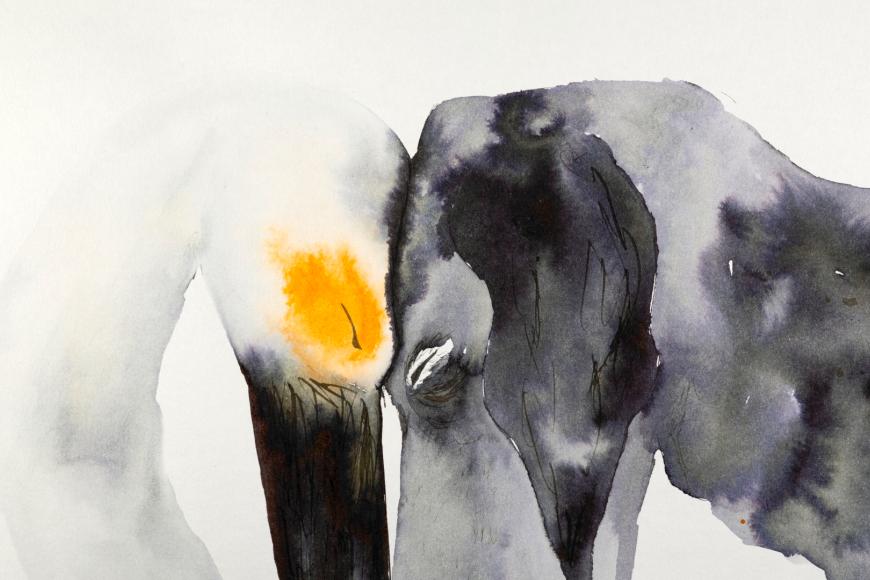
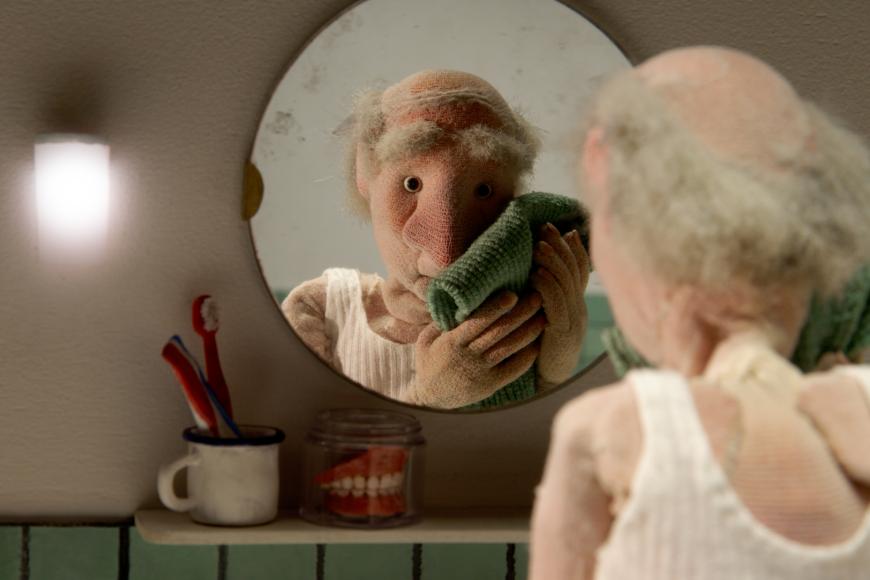
Starlings circle in flocks above the retirement home. What does the end of life feel like? A man grows the first feathers and senses that he is gradually drifting from this world.
Flocks of starlings are circling above the retirement home. These impressive natural spectacles are called murmurations because from a distance they sound like collective murmuring. Not everyone hears or sees them, but the old man notices. Sometimes the starlings send a single twittering messenger to his window. Often, the birds are more present to him than his fellow humans, more present than the old demented fellow resident who regularly waters a still life of flowers, more present than his neighbours in the amateur choir. And then it happens: The old man finds a first feather in his hair, then a second, then several. Soon he grows a beak so that instead of singing he can only caw. The last phase of life we witness here is lovingly animated: The puppet animation was created with gauze bandages, a beautiful approach to the vulnerability that comes with aging. The farewell to life shown here is devoid of pathos, not even that over-produced grief we know from many narratives of dying. Even the retirement home is a completely mundane place, neutrally portrayed. Instead, we follow this feathered farewell as a quiet but growing alienation from the world, a no-longer-belonging. And one day we will all grow the wings that go with it.
Marie Ketzscher
Credits
Director
Janneke Swinkels, Tim Frijsinger
Script
Janneke Swinkels, Tim Frijsinger
Cinematographer
Janneke Swinkels, Tim Frijsinger
Editor
Janneke Swinkels, Tim Frijsinger
Producer
Peter Lindhout
Co-Producer
Annemie Degryse, Janneke Swinkels, Tim Frijsinger, Ben Tesseur
Sound
Corinne Dubien
Sound Design
Corinne Dubien
Score
Roos Rebergen, Sjoerd Bruil
Animation
Rosanne Janssens, Mirjam Plettinx, Geertrui de Vijlder
After the graduation ceremony, Ba, a young musician, leaves the hall with his tuba over the shoulder. At the door he meets his teacher who makes him promise something: report back as soon as he has found a job. As nobody picks him up at the student residence, Ba makes his own way through the barren rural area. Home at last, he discovers that his father has found a new wife who now lives with him. There is no more room for Ba. He leaves his former home and sets out to look for a job. Various futile attempts to find employment follow, first as a musician, then unrelated to his training. All efforts fail in the face of the absurd requirements of potential employers. Ba would first have to buy an expensive suit and could expect to get wages only after an unpaid initial phase, as he was still a beginner. Ba can only fend off his teacher’s intrusive questions by inventing white lies.
This world, where there is not a shred of green landscape left, where the plaster crumbles from the walls, where everything is falling apart, has no use for the musician Ba. His daily expenses consume his last bit of money. Hopes of happiness and being able to earn his living fade away. Ba’s tuba falls silent.
Franka Sachse
Credits
Director
Xu Jingwei
Producer
Yang Leiting, Yang Xintong
Animation
Yang Leiting
World Sales
Shuting Li
Winner of:
Golden Dove Feature-Length Film (International Competition Animated Film)