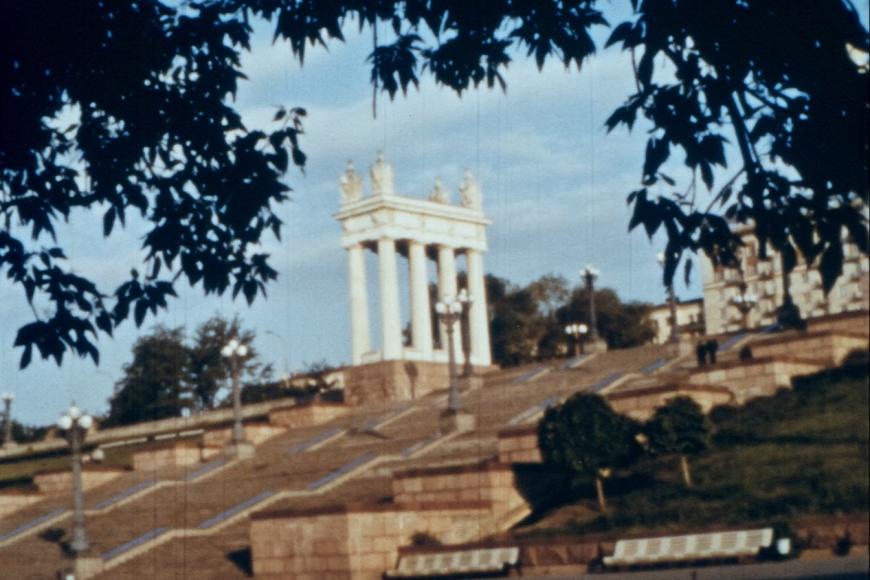
A representative of the Volgograd Section of the German-Soviet Friendship Society recalls German “comrades who fought against Hitler here […] and at other front sectors.” Equalisation with the people in the Soviet Union is completed at the Mamayev Kurgan memorial: The (German) visitors merge with the survivors who mourn their fallen.
Konstantin Wiesinger
Credits
Director
Volker Kastius
Cinematographer
Willy Reitze
Producer
Amateurfilmstudio VEB Elektromotorenwerk Wernigerode
A narrator explains surviving evidence of the events on the grounds of the Langenstein-Zwieberge subcamp. The film ends with a formulaic ritual of remembrance.
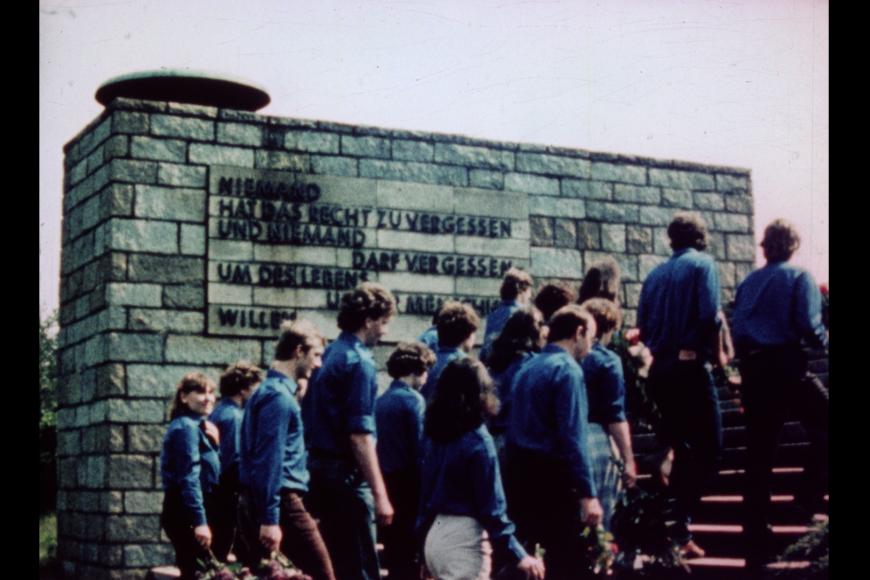
A male voice, accompanied by the eponymous instrumental piece by Reinhard Lakomy, comments on photographic and material evidence of the events on the grounds of the Langenstein-Zwieberge subcamp. The audiovisual tour concludes with a visit by an FDJ (Free German Youth) group who lay down wreaths at the memorial site built in 1949. The speaker unequivocally classes this ritual of remembrance as part of the raison d’état.
Konstantin Wiesinger
Credits
Director
F. Faust
Script
A. Faust
Cinematographer
R. Muschke
Editor
F. Faust
Producer
Technische Hochschule Magdeburg, Bezirkskabinett für Kulturarbeit Magdeburg
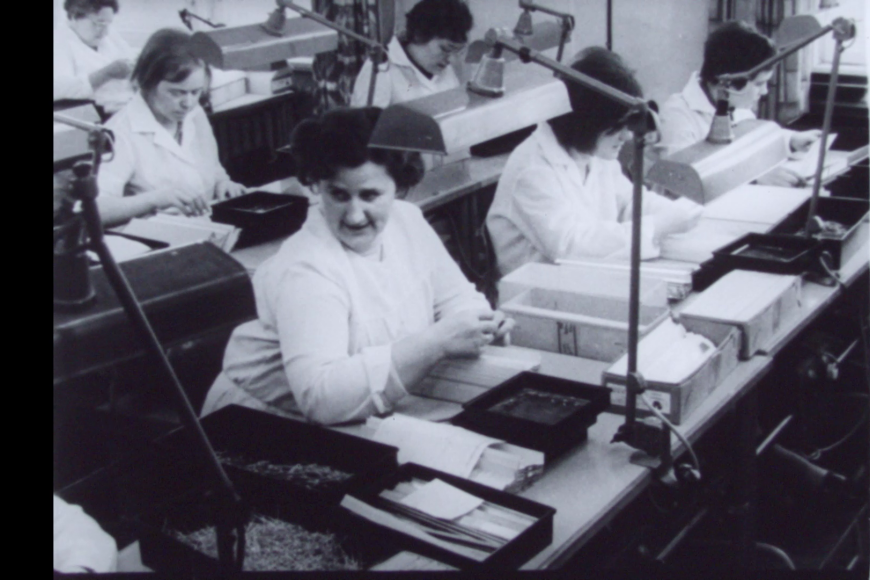
The company and details of its machinery are presented. A montage from two different sources on the title, one of them tinted fragments, the other well-preserved black-and-white footage.
A tinted nitrate fragment of the company film “A. Gutberlet & Co., Leipzig-Mölkau, Spezialfabrik für Falzmaschinen und Faden-Buchheftmaschinen, gegründet 1901“ (specialist in the manufacture of folding machines and thread book stitching machines, established 1901) was an exceptional find. It could be restored in its original colour tones by analogue methods in 2024 and then digitised. Combined with the dupe negative of another version, it now offers insights into the factory halls and the work on the machines.
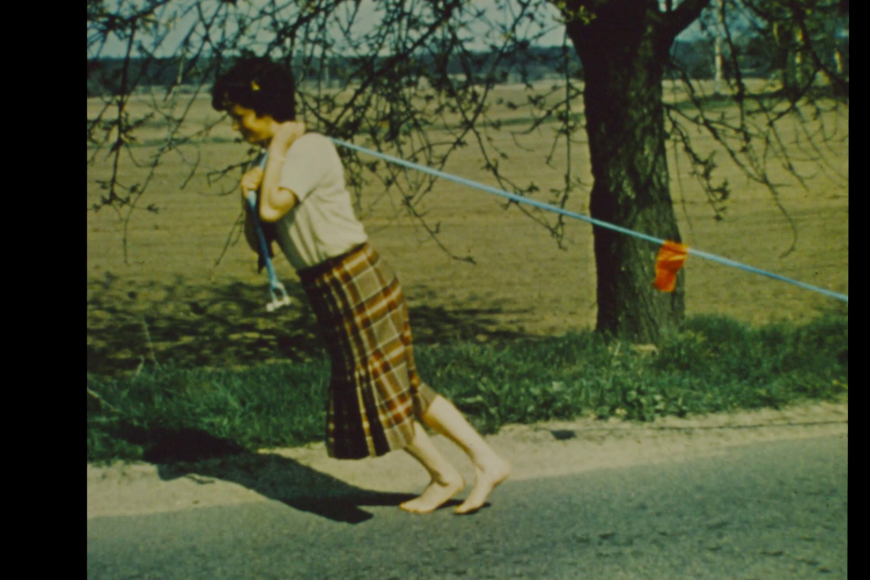
An entertaining vision for International Women’s Day as an admonition, inspiration and commentary about gender relations in GDR everyday life, in the form of a puppet animation.
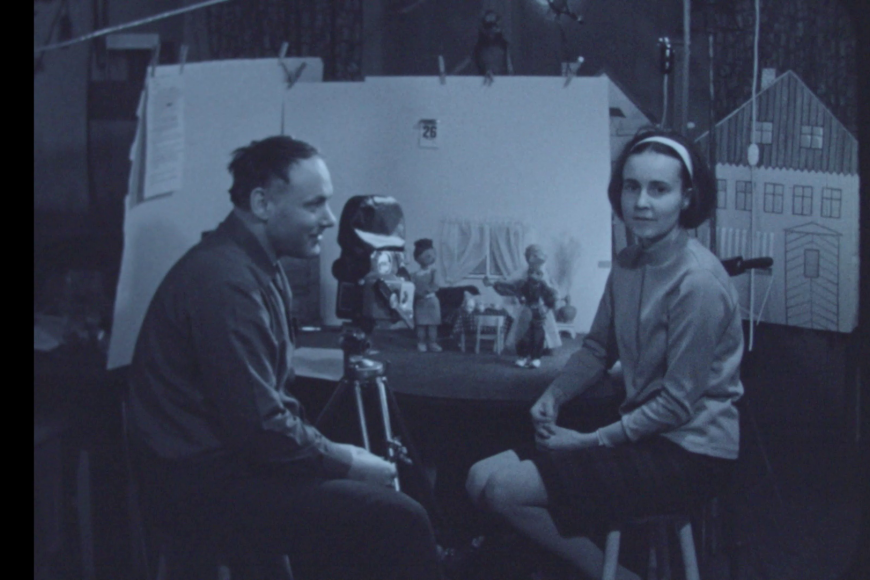
The married couple Angelika and Horst Butter sum up successes and setbacks of their joint amateur filmmaking. They now produce elaborate puppet animations in their private rooms, under sometimes adverse conditions. They adapt fairy tale and fantasy sources, but also take up topical social issues, for example in an entertaining vision for International Women’s Day.
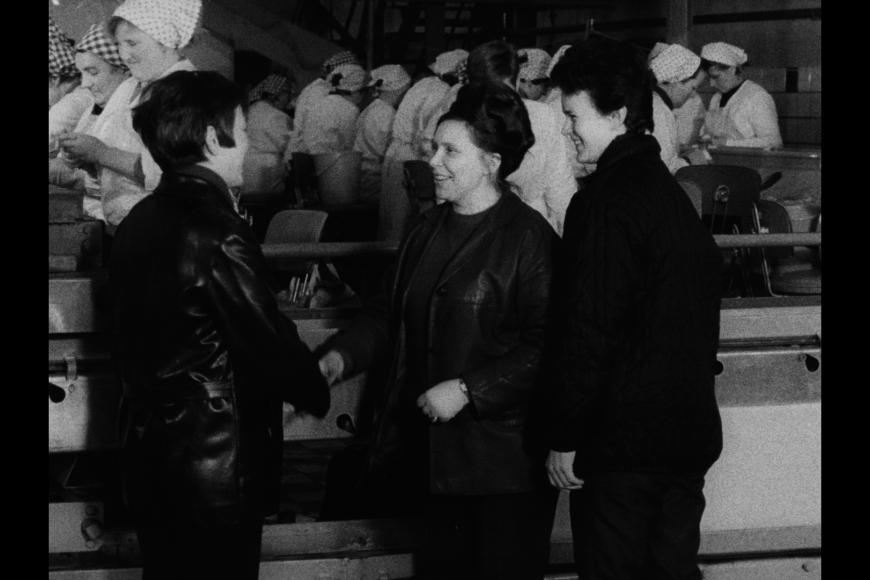
With the participation of several company and amateur film associations, the film accompanies a trip to Leipzig by delegations from 40 countries on the occasion of the 10thWorld Youth Games in Berlin.
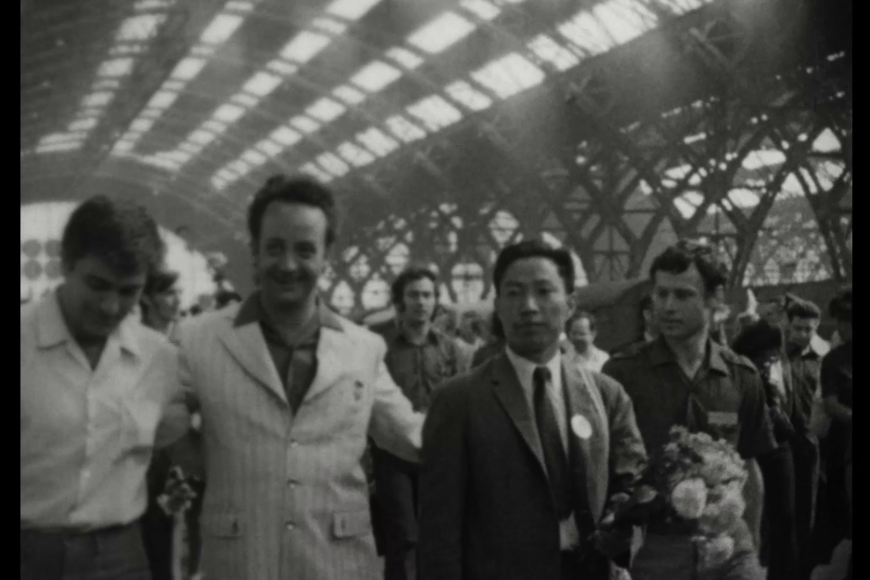
East Berlin plays host to the world at the 10th World Youth Festival. The secret capital of the GDR, Leipzig, also gets some reflected glory. On 3 August 1973, festival delegations from forty countries take a special train to the trade fair city. Between the official events there is room for ambiguous side glances, captured in this report of the day made by several Leipzig company and amateur film groups.
Konstantin Wiesinger
Credits
Director
collective
Producer
Pionierfilmstudio Haus der Jungen Pioniere “Georg Schwarz” Leipzig, Ensemble “Deutsch-Sowjetische Freundschaft” Leipzig, Club Leipziger Filmamateure, VEB Verlade- und Transportanlagen Leipzig, VEB Spezialbaukombinat Leipzig
According to the film’s voice-over, it is the duty of a factory’s women’s committee to “exert a constant influence on systematic ideological-political and technical qualification”.
The women’s committees in the GDR factories promote the technical and ideological-political qualification of female staff members. However, the film identifies deficits in the women’s private environment, since the men by their side often support their professional development only to a limited extent and the women’s multiple responsibilities persist despite state support.
Mother, working woman, housewife and wife all in one: A tightly scheduled everyday life seems to leave next to no space for developing one’s personality beyond these roles.
A creative and skilful montage as well as dramatically spot-on sound and music effects are combined in a snappy plot to offer a mordant commentary on the constitutionally enshrined equality of men and women in the GDR. The film was awarded a medal at the 1982 congress of UNICA, the Union Internationale du Cinéma, in Aachen.
Konstantin Wiesinger
Credits
Director
Edith Schneider, Joachim Schneider
Producer
Betriebsfilmstudio Filmstudio VEB Bohrungen und Schachtbau Welzow
International Book Art Exhibition Leipzig 1977 [excerpt]
Jan Hempel
Leipzig’s tradition as a city of books, polygraphic firms, publishing houses and, last but not least, the Book Fair and its audience are captured by one of the few private filmmakers.
International Book Art Exhibition Leipzig 1977 [excerpt]
Internationale Buchkunst-Ausstellung 1977 [Ausschnitt]
Jan Hempel
Matinee Saxon State Archive 2025
Documentary Film
GDR
1977
7 minutes
German
Subtitles:
None
Following a quarrel with the DEFA, the Sorbian animation and documentary filmmaker Jan Hempel established the independent IWT-Film studio in Dresden. Commissioned by the German Book Traders’ Association, these impressions of the 1977 International Book Art Exhibition were created there. Referencing Leipzig’s century-old tradition as a book city, the film presents production companies, publishers and, last but not least, the IBA itself.
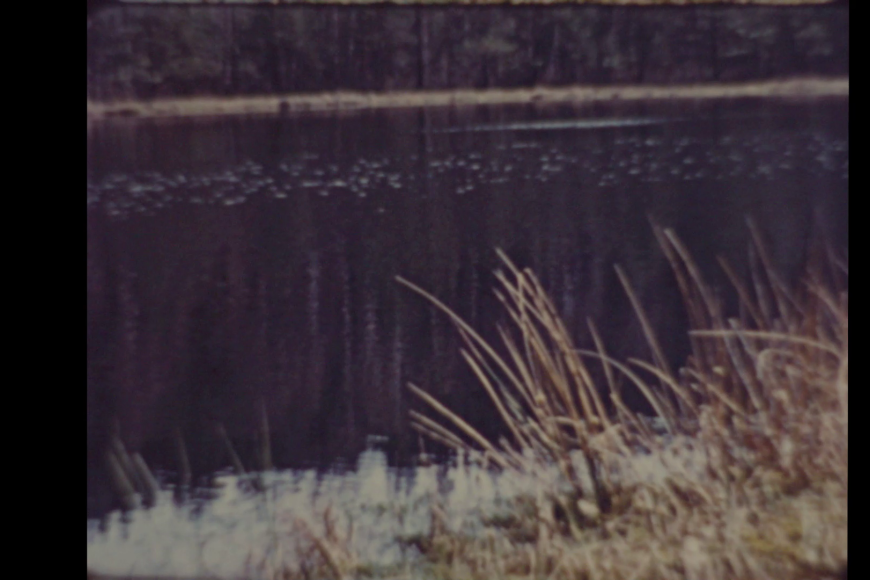
Technically elaborate and sensitively composed, the self-taught nature filmmaker Ingeborg Tölke unlocks fantastic and cruel aspects of the natural landscape of a moor.
The self-taught nature filmmaker Ingeborg Tölke uses quotes from literary encounters with the flora and fauna of the moor in a gentle approach to this landscape. With great empathy, she uncovers the often all-too-hastily overlooked beauties and cruelties of the place, using time-lapse and macro techniques. Her debut work, which was also amazing in terms of film craft, won several awards.
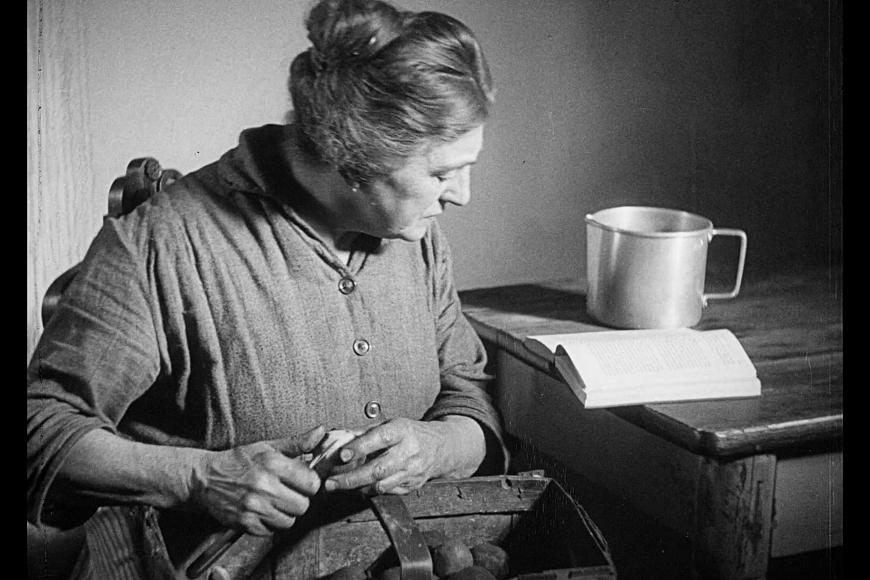
Telling stories without being able to use language. A silent homage to reading with expressive images. Young, old, poor, rich – everyone is transported to other worlds.
In 1929, the German Book Traders’ Association declared 22 March, the anniversary of Goethe’s death, the “Day of the Book”. To boost general awareness of the date, the politically versatile educational filmmaker Hans Cürlis was commissioned to produce this silent signature spot. Through cross-fades, the imagined worlds of a variety of readers – young or old, workers or intellectuals – merge with the stylised realities of their lives.
What was unsuccessful 400 years earlier in the German Peasants’ Wars is achieved in 1945 by the unbreakable bond with the Soviet Union: Under adverse conditions, workers and peasants build a socialist state. In 1970, when this film was made, the SED (Socialist Unity Party of Germany) asserts its claim to leadership grounded in the past – it moves forward on the “Way from the I to the We”.
A historical trade show film on various folding and stapling machines which are shown in action and explained in abundant detail, featuring exterior views of the factory in Plagwitz.
The Gebrüder Brehmer company produced wire stitching and folding machines and was one of the largest of its kind in Germany with up to 1,000 employees. Even in the early days of the medium, the company used film to promote its goods and cultivate its reputation. This image film presents the factory in Plagwitz and special folding machines, for example the “¾-Automatic Sheet Feeder”.
In the summer of 1957, the talented amateur filmmaker Alfred Dorn travelled to Moscow for the 6thWorld Youth Games and wandered the Soviet metropolis with his camera in amazement.
Moscow, summer 1957: The famous amateur filmmaker Alfred Dorn takes us to the 6th World Festival of Youth and Students, which was intended to promote encounters and exchange between young people from all over the world as a reaction to the Second World War. Curious and amazed, the camera explores the metropolis Moscow with its iconic buildings and squares, complete with numerous festival visitors.
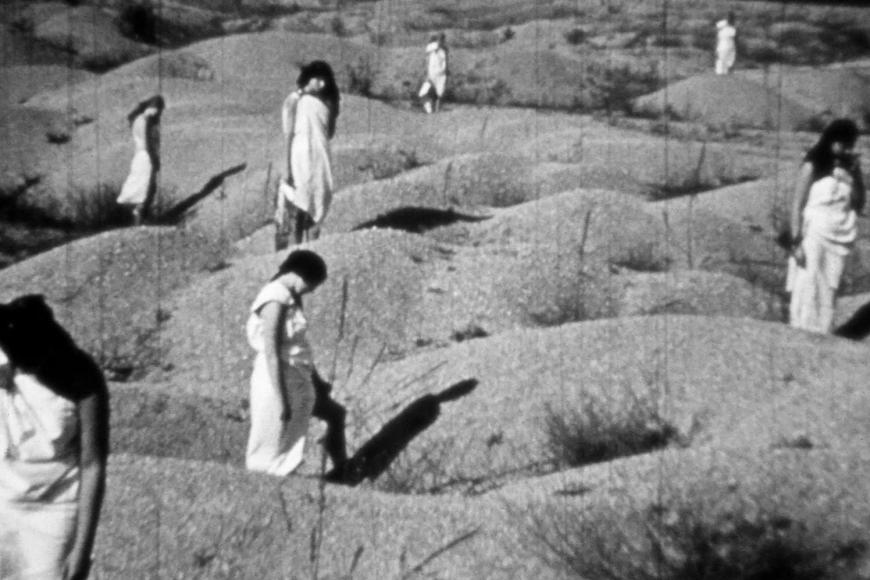
SOS – help! A clear and simple visual language to disturbing sounds. The distinguished Lithuanian film and theatre director Vladislovas Algimantas Blinstrubas condenses the violent, centuries-long history of the Baltic in timeless metaphors. The naked, vulnerable human being is at the centre of this filmic exploration. The space opens up to pain and grief.
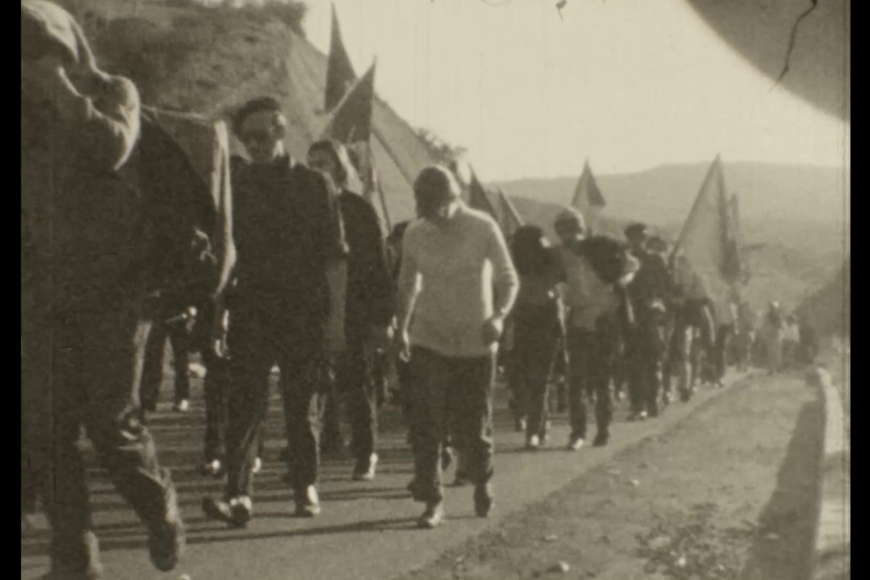
A contemporary documentary from Chile about the 1970 presidential election campaign, in support of the candidate Salvador Allende, who was to become world-famous.
Students of the State Technical University in Santiago de Chile film and accompany the “March for Life”, which was part of the September 1970 presidential elections in their country. An electoral alliance of communists, socialists and sections of the Christian centre, the “Unidad Popular”, successfully supported Salvador Allende’s bid for the presidency.
Konstantin Wiesinger
Credits
Director
collective
Producer
Universidad Técnica del Estado – Área de Comunicaciones y Extensión, Central Única de Trabajadores de Chile
Restitution of the Art Treasures to the Green Vault
anonymous
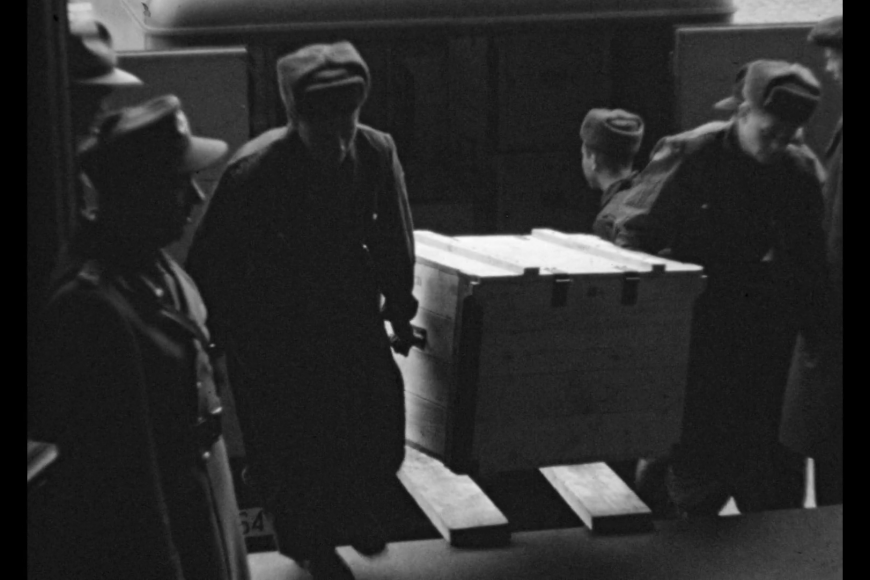
After the defeat of the Nazi regime, the Soviet occupiers – later friends – were anxious to establish good relationships: They returned “evacuated” art treasures amidst great media attention.
Restitution of the Art Treasures to the Green Vault
Rückgabe der Kunstschätze an das Grüne Gewölbe
anonymous
Matinee Saxon State Archive 2023
Documentary Film
GDR
1958
5 minutes
without dialogue
Opening the film is a highly visible Soviet coat of arms with translations of Marx’s call “Workers of the world, unite!” into several languages. In the middle of a media circus, representatives of the Soviet Union restituted art treasures to the GDR. The highlight was the return of “evacuated” objects to the Green Vault in Dresden.




![Filmstill Fa. Gutberlet & Co. [Ausschnitt]](/sites/default/files/styles/stepped_teaser_/public/fiona/films/stills/94a765f0-53ce-4935-bc20-309db0abbb7f.jpg?h=346bc062&itok=5n_TqdCp)
![Filmstill Internationale Buchkunst-Ausstellung 1977 [Ausschnitt]](/sites/default/files/styles/stepped_teaser_/public/fiona/films/stills/e48262c7-c12a-4dea-b4bc-96679d872fbf.jpg?h=346bc062&itok=xR-_bdxg)
![Filmstill Messefilm der Fa. Gebrüder Brehmer [Ausschnitt]](/sites/default/files/styles/stepped_teaser_/public/fiona/films/stills/9a4bd28d-d399-49b5-aa0c-02a279d358df.jpg?h=346bc062&itok=L3e-BX-j)
![Filmstill Moscow Mosaic [excerpt]](/sites/default/files/styles/stepped_teaser_/public/fiona/films/stills/97d3f4f5-53ac-4847-a150-2deaa3f7dbc5.png?h=d1cb525d&itok=YcCtfcZ9)



![Filmstill Fa. Gutberlet & Co. [Ausschnitt]](/sites/default/files/styles/film_stills_full_content_view/public/fiona/films/stills/94a765f0-53ce-4935-bc20-309db0abbb7f.jpg?h=346bc062&itok=0mNa-FNw)


![Filmstill Internationale Buchkunst-Ausstellung 1977 [Ausschnitt]](/sites/default/files/styles/film_stills_full_content_view/public/fiona/films/stills/e48262c7-c12a-4dea-b4bc-96679d872fbf.jpg?h=346bc062&itok=MQ_gHboE)


![Filmstill Messefilm der Fa. Gebrüder Brehmer [Ausschnitt]](/sites/default/files/styles/film_stills_full_content_view/public/fiona/films/stills/9a4bd28d-d399-49b5-aa0c-02a279d358df.jpg?h=346bc062&itok=ND0OPpZr)
![Filmstill Moscow Mosaic [excerpt]](/sites/default/files/styles/film_stills_full_content_view/public/fiona/films/stills/97d3f4f5-53ac-4847-a150-2deaa3f7dbc5.png?h=d1cb525d&itok=Hx66n6rx)


