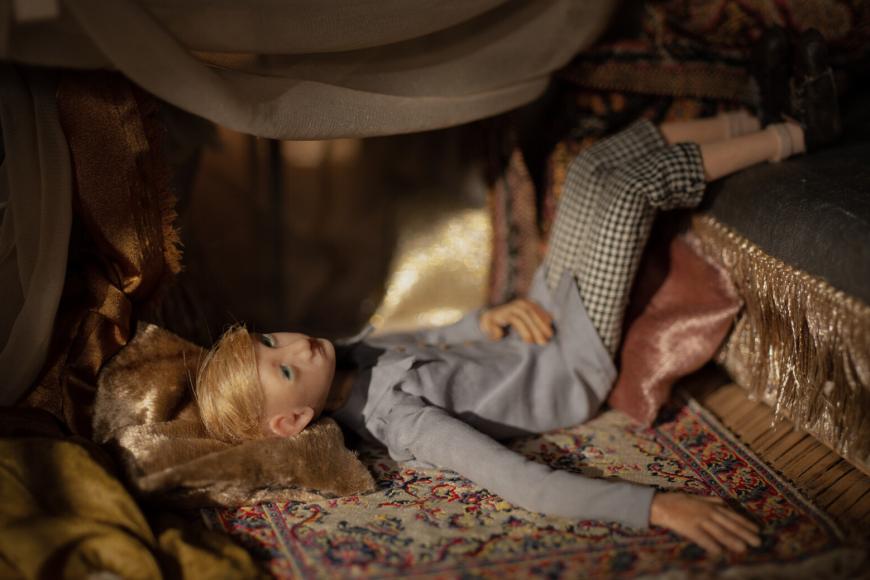
András and his daughter Zsófia enjoy a relaxed Sunday in their stately city mansion, just before the collapse of the Austro-Hungarian monarchy. But soon the silence in the house is disturbed by an escaped pig, closely followed by an unexpected visit: András’ brother, his large family and lots of luggage barge in through the front door. Running children and garrulous relatives bring noise and bedlam to all floors. Art objects are handled without permission, furniture is moved, objects fall to the ground. The visitors have brought chaos. Zsófia’s father and the maid try in vain to restore calm and order. Though András and his brother get closer to each other, the old house is not up to the changed circumstances. A leaking water pipe heralds a finale that at least makes them all stand still together.
Franka Sachse
Credits
Director
Lea Vidaković
Script
Lea Vidaković
Cinematographer
Lea Vidaković, Damien Buquen
Editor
Iva Kraljević
Producer
Draško Ivezić, Jean Francois le Corre, Nikolina Vucetic Zecevic
Sound Design
Zoran Maksimovic
Animation
Marion le Guillou, Bilitis Levillain, Violette Delvoye
What do Mao and Mickey Mouse have in common? Maybe we still do not know even after this wild cutout animation ride, but we definitely chuckled a lot in the meantime.
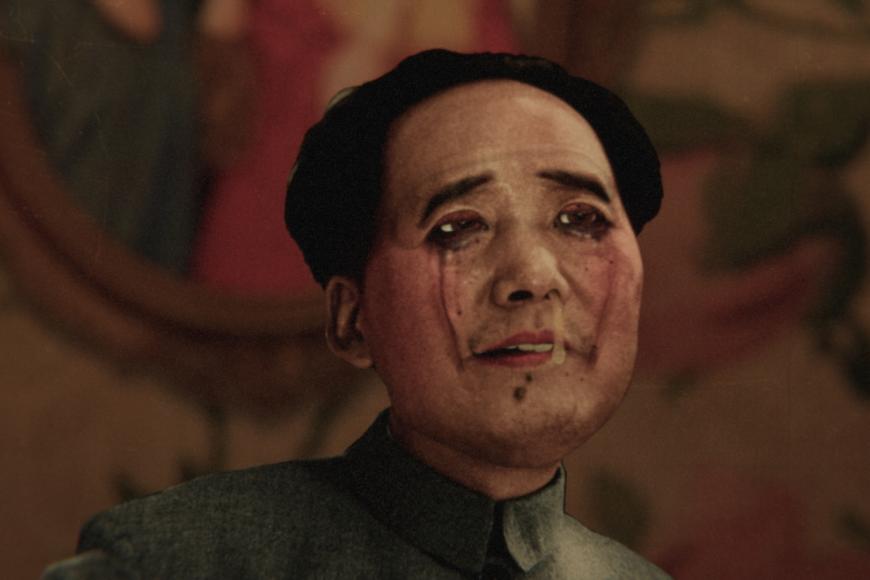
“Do not attempt to reason with this movie. It is raving mad and makes no sense at all.” Aria Covamonas places this announcement right at the start of this wild cutout animation ride through Chinese and Western history (of philosophy) – and keeps their word. Countless figures appear in seemingly arbitrary order who, with no discernible common thread, condemn to death, argue or flirt – but do it in the most absurd and funny way. At one point, for example, Plato appears, who must be bathed by the elephants because he spent too much time in his cave. But Mao, Mickey Mouse, Nietzsche and Lacan also make appearances. They are all taken from the public domain, as are the Chinese dialogues which issue from their mouths, edited by rhythm; the English subtitles have nothing to do with them. According to Covamonas, any interpretation is possible – and welcome. Nonetheless, themes begin to emerge: The arbitrary use of violence that characterises every authoritarian regime is lampooned, and so is the absurdity of every canon. But Covamonas, too, is influenced by it: A visual homage to Dadaistic collage art à la Hannah Höch, an acoustic reference to the noise of early sound films, this exuberant treasure-trove of sampled global culture can be thoroughly enjoyed and invites us to discover references while drifting through it.
Film sketches compete for the filmmaker’s attention, scenarios push each other out of the way. Too much distraction, all the time. A feverishly associative animation about a neurodivergent mind.
Grandfather’s hands making pottery, the vertical linearity of a tower, a train crashing into a car – all of these are fragile, newly born film sketches that crowd each other out in a survival game for the filmmaker’s attention. The sceneries fight against each other, intertwine to form new strands, sink into an endless flood of information, shatter in a sea of open browser tabs. With his authentic voice-over and a mesmerising collection of moving images, director Konstantin von Sichart’s alter ego offers us a deep insight into his creative process. Marked by his neurodivergence, he learns before our eyes to cope with his inability to concentrate on one thing – and to weave meaning from these strands, remain true to his film idea. But how can this ever result in a film? Toxically coloured images, naively drawn and finely crafted, AI-generated, filmed from a monitor, collaged, worked-on – a wealth of tools and aesthetic approaches translates the described mental overload into the language of design. The film thus becomes more than a self-reflection of modern filmmaking: It is the portrait of a new generation – caught between the compulsion to take everything in and have a position on everything and the urge to stand still or even run away.
Two filmmakers – brother and sister – hire a chef to play their father. The boundaries between the film and the reality of the single father’s life become increasingly blurred.
Lines scrawled on white paper with a ballpoint pen. Everything looks like a hastily drawn scribble – a sketch of ideas rather than a finished film, possibly only a quick storyboard. The jerkily connected images show a food stall somewhere in the middle of nowhere. Something extraordinary happens here: Two filmmakers – brother and sister – hire the chef as the leading actor of their project. They are planning a biopic about their father. The fast-food expert is not only the spitting image of the famous man, he is just like him! The casting could not be more apt, the film business newcomer lets them convince him. But the task turns out to be difficult. Though the cook does everything to do justice to this demanding role, he seems less and less suited for the job every day. Completely engrossed in the preparations for the part, he becomes increasingly distant from his own children. The boundaries between the film and the single father’s real life begin to blur. Is it possible that shooting has already begun?
A story inspired by Bach’s timeless music, narrated on the editing table and painted on six rolls of toilet paper. A multicoloured and at the same time profound pleasure.
Something is wrong. Something is completely wrong. With the sound and with the image. The notes are crooked, the piano lid squeaks, the movement falters. Corrections are needed to bring everything together in harmony and in tune with Johann Sebastian Bach’s beautiful music. Six roles of painted toilet paper are worked on by human hands on an editing table, one after the other. The editing device consists of coloured building blocks and a few wooden sticks. It is a game, a trick, it’s entertainment. At the same time, the simple images on the film strip take us deep into the current events of our time. But the material resists sharply delineated representation. It soaks up the paint and blurs the boundaries. It tears. It is limited. Before the story can pick up speed, the roll is unspooled. Narrative is difficult in view of this situation. And yet animation artist Anna Samo manages, with a very light touch, to transform ambivalent feelings, confusion, rigidity and speechlessness into a work of hope and courage.
Adam’s body becomes a mirror of his soul, making every grievance visible to everyone through strange deformations. A brilliant insight into the mind of a 15-year-old boy.
Adam is 15, bullied by his schoolmates and ignored by the girl of his dreams. His grandmother, who has teased him all his life with nasty remarks about his appearance, uses her dying breath to bring home to him once more his supposed physical shortcomings. Even the prospect of the upcoming summer holidays hardly raises Adam’s spirits, because his father has organised several unpleasant holiday jobs for him to build his character. On top of everything else, the teasing and negative comments manifest in Adam in strange deformations of his body which provoke additional stress and ridicule.
Adam is different. He stays outside while the people around him go about their usual – their “normal” – activities. He watches his sister being cheated on by her boyfriend, must bear a neighbour’s fanatical lawn care accuracy and discovers that a resident of his street throws bags of dog faeces up into the branches of the alley trees. The more the daily madness around him becomes evident, the more Adam emerges as an empathetic and mature young adult. Contrary to all claims he, whom the others regard as a strange eccentric, is in control of his life.
A Palestinian neighbourhood in southern Damascus. The memory of a lost home is patched together from pictures of a life between the debris of war, constant threats, youth and jasmine.
A dimly lit, scarcely furnished flat, the hissing and buzzing of an open microphone. What follows is an argument in Arabic between mother and son. She complains about his lethargy. He sees no point in school while the country is at war. At last, the boy sets out through the busy streets of his neighbourhood which is a chaotic patchwork of everyday life and the debris of war. Using 3D graphics software, Husein Bastouni reconstructs from his personal memories the situation in the Palestinian refugee camp of Yarmouk in the south of Damascus when the area found itself between the frontlines in the Syrian war. Visually and acoustically – indeed, almost olfactorily – his film draws you into this world from the first second with terrifying immediacy, and yet poetically. In a moment of shock, the rhythm slows down, the images become sparser, but the protagonist’s reflections become crystal clear. In the silence of thought, the eye glides like a deep-sea diver through a sunken city and a lost home.
“I don’t want to say it out loud, but my flat’s lower down,” the narrator remarks. The camera at first follows her legs climbing up the stairs of the hallway. That is all we see of her. Very soon, her gaze determines our perspective in this unsettling story. At first it all sounds like a mistake, but at some point, the tenant gets used to the fact that in some inexplicable way and completely unceremoniously she is pulled down from the fourth floor to the coal cellar, floor by floor. A decline that the neighbourhood lets happen in deafening silence.
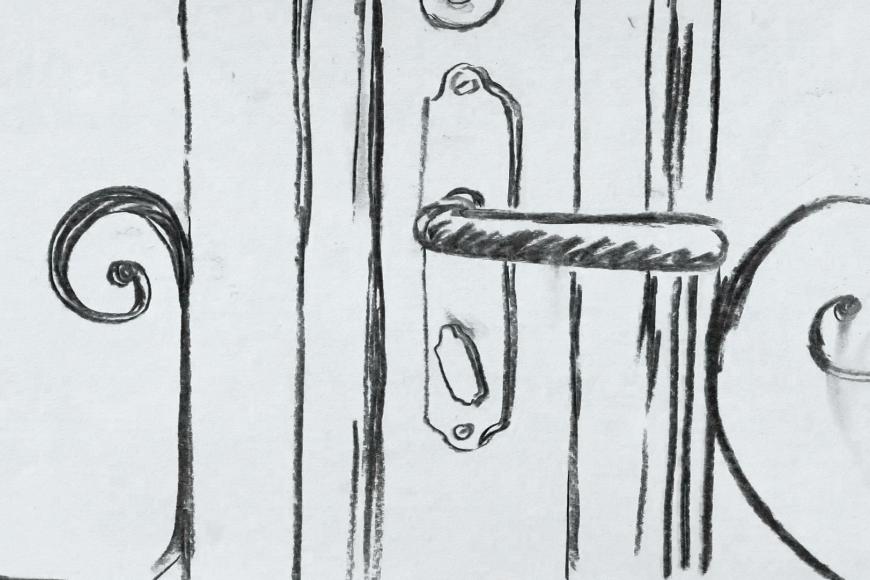
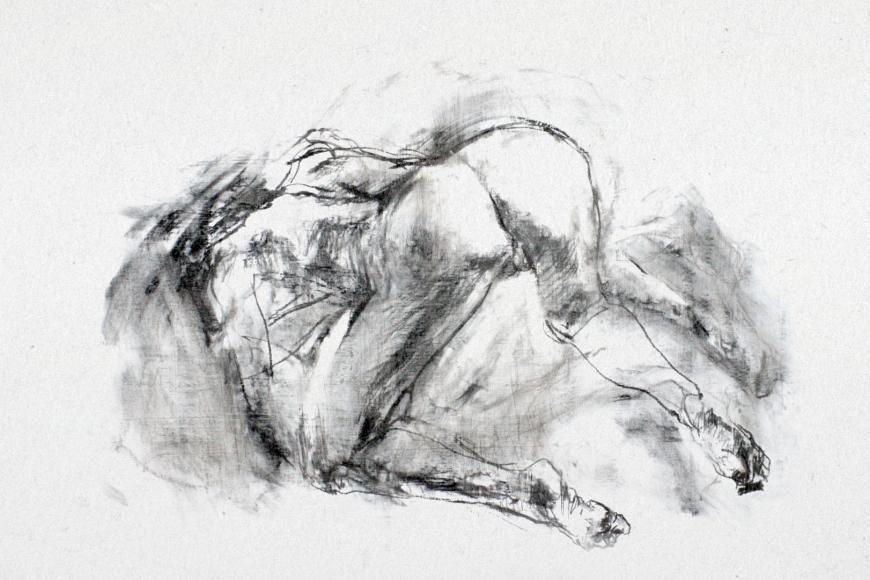
The “falling” protagonist’s irritated soliloquy, sometimes resigned, often full of calculated optimism, is accompanied by charcoal drawings. Their clarity and architectural detail – down to the curlicued decorations of the upper-class mansion – gradually fade over the course of events. The spatial representation becomes more and more vague and is reduced to a few strokes, only to dissolve into soft areas of charcoal dust in the end. In this nightmarish story, reality no longer offers any support, only one’s own ego. Susi Jirkuff has adapted Ilse Aichinger’s eponymous, multilayered story, which was first published in the mid-1950s, with a remarkable urgency that demonstrates the topicality of Aichinger’s text and writing.
“Y” sensually draws the progress of a same-sex relationship from playful beginning to turbulent end. Charcoal strokes become the language in which the filmmaker tells us of the process of growing closer to and away from each other, of intimacy and estrangement. A shared chapter of life is sketched, corrected and discarded.
But the line also explores the female body. The tip of the charcoal wanders through curves, hills and valleys, circling soft flanks like a finger and gently stroking breasts and hips. In the darkness of the cinema, the eye is free to glide along the emerging and disappearing shapes. We become part of an erotic triangle and are given an intimate insight into the protean psychological and physical aspects of this partnership.
Rough poetry in images, words and sounds. Full of emotional power, this film uses photography, painting, collage and video to negotiate the tipping point between physical desire and emotional injury.
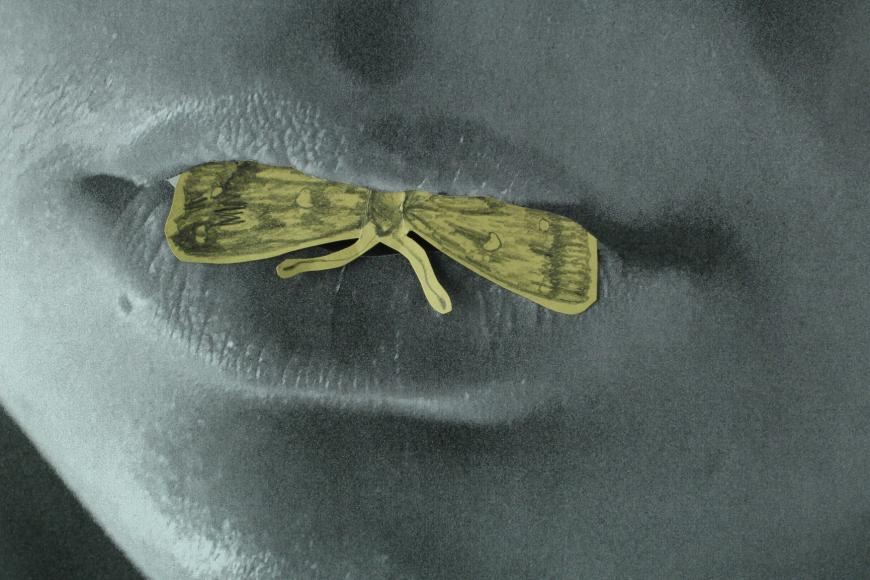
Powerful poetry in image, word and sound – Max Ferguson’s work is a rough diamond that testifies to an emotional, unpolished force and whose light is refracted in many colours. Mixing elements from photography, painting and collage with short video sequences, Ferguson finds strong verbal and visual images to mark the tipping point between physical desire and emotional violation. Rough aesthetics and a gloomy atmosphere reminiscent of early underground films are combined with extreme delicacy and a constantly alert, almost animalistic curiosity. They manifest a very contemporary female self-image. The balancing act between pain and self-respect takes place in a sound cosmos of electronic thunder and nervous buzzing. While the brawny truck cannot leave its lane, the deer follows its instinct and finds a (new) way, even if it must learn from the wolf.
A Polish fishing village in deceptive winter silence … This expressively designed everyday mosaic of a village community talks of Anka, Jesus, warmth of heart and coldness of feeling.
German Subtitles for deaf and hard-of-hearing, English
Going under or a lonely island life – there is not exactly a surfeit of options in this Polish village by the sea. The community functions, but social intercourse is rough, alcohol present. Archaic-seeming rituals and social patterns are handed down from the old to the young men. Winter envelops the village in white silence which every now and then betrays its deceptive appearance in small things. At midnight on Christmas Eve the voices of the dead and tortured souls ring out. Anka lives in the middle of this. The young woman takes hits, gets up, struggles through with her love of Jesus.
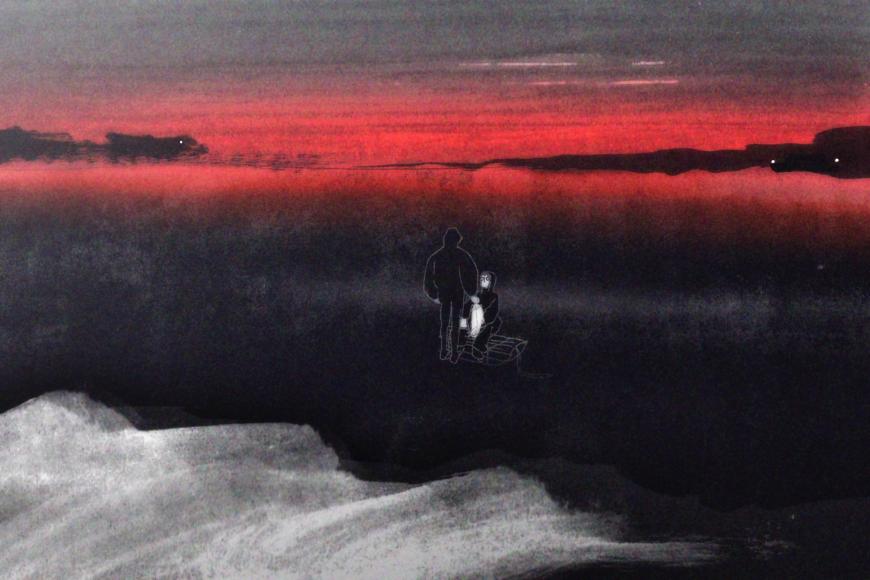
“Zima” portrays a state of suspension with occasional rollercoaster rides and builds up to tremendous emotional power. Colours are rare in the black and white drawings of the winter landscape and the dark houses, but when they appear, they lend great intensity to the events. Scenes of daily routines and village life are associatively interwoven both on the sound and graphic level. They burst with excess and expressive design, transforming into mystical dream images.
André Eckardt
Credits
Director
Tomek Popakul, Kasumi Ozeki
Script
Tomek Popakul
Cinematographer
Tomek Popakul
Editor
Tomek Popakul
Producer
Marcin Podolec, Wiktoria Podolec
Sound
Michał Fojcik
Sound Design
Michał Fojcik
Animation
Tomek Popakul, Jakub Baniak, Alicja Błaszczyńska, Michał Orzechowski, Olga Kłyszewicz
World Sales
Marta Świętek
Artistic Design
Magdalena Basińska, Magdalena Botor, Agnieszka Czachór, Jagoda Czarnowska, Alicja Grotuz, Karolina Kajetanowicz, Marcin Kotliński, Adrianna Matwiejczuk, Katarzyna Melnyk, Michalina Musialik, Maria Nitek, Marcin Podolec, Weronika Szyma, Marcjanna Urbańska, Pola Włodarczyk, Agata Mianowska-Zamarło, Patrycja Ćmak
In 2043, humanity launches the spaceship Zoopticon to send a greeting to distant galaxies. An extraterrestrial opera with cheering colours and radiant pop charm in the darkness of space.
In 2043, humanity launches a spaceship called Zoopticon to send a greeting to distant galaxies. Lightyears later, the once proud – loaded with valuable cultural artefacts and lots of hope, after all – ambassador’s spirits sink in the infinite expanse. Loneliness leads to a blundering suicide attempt which jolts the spaceship’s body awake, whereupon the genetic material of five animals from five continents stored in petri dishes unexpectedly comes to life.
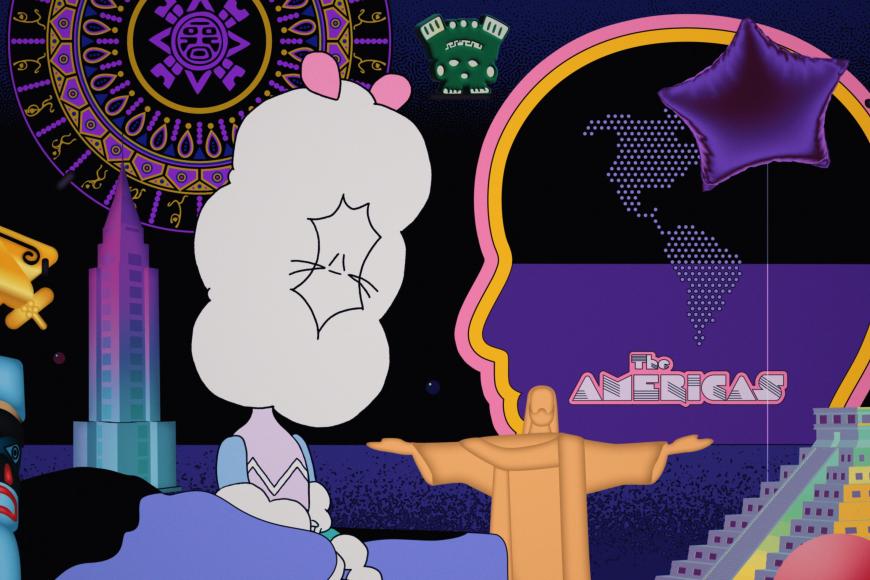
Jon Frickey, Sandra Trostel and Thies Mynther brush the science fiction classic “2001” against the grain. Their Zoopticon, a benevolent relative of Stanley Kubrick’s supercomputer HAL 9000, takes a surprising route on its odyssey through space. Their extraordinarily stylish animation starts with a moving monologue of the sensitive protagonist and finds its perfect orbit as a grandiose opera gradually begins to unfold – complete with soulful drama, brightly coloured radiant pop charm and tongue-in-cheek cathartic confidence.
André Eckardt
Credits
Director
Jon Frickey, Thies Mynther, Sandra Trostel
Script
Jon Frickey, Thies Mynther, Sandra Trostel, Christoph Mathieu