Film Archive

Jahr

Sections (Film Archive)

International Competition Documentary Film 2024

Things of a Lifetime, Intimate Archeological Exercises

Céline Ségalini
Céline arranges objects in the house of her deceased grandmother. It is an attempt to understand her better – her relationship to her own identity and France’s colonial history.

Filmstill Things of a Lifetime, Intimate Archeological Exercises

Things of a Lifetime, Intimate Archeological Exercises

Les choses d’une vie, exercices d’archéologie intime
Céline Ségalini
International Competition Documentary Film 2024
Documentary Film
France
2024
50 minutes
French
Subtitles: 
English
The filmmaker’s grandmother moved into this house in 1971. When Rolande Ségalini died, everything remained as it was during her lifetime. But what to do with all the accumulated things? As her granddaughter Céline begins to film this material legacy, she realises that her grandmother has remained an enigma to her to this day. Room by room, she inventories, classes, counts, sorts the possessions retrieved from wardrobes, drawers, cabinets and boxes and arranges the objects into new still lives. It is an attempt to understand the deceased woman better and find out more about her. Step by step, the heiress discovers various connections to France’s colonial history.
The film unfurls the facets of a discreet relationship with one’s origin – searching, questioning, interpreting, at the same time investigating the construction and external perception of identity, the practice of passing. The things of a life, displayed like the findings of an archaeological dig, are laid out ready to be analysed. They express a desire: to be recognised as a white Frenchwoman.
Seggen Mikael

Credits DOK Leipzig Logo

Director
Céline Ségalini
Cinematographer
Pierre Nativel, Christophe Leroy, Céline Ségalini
Editor
Anne-Laure Viaud
Producer
Marc Faye, Magali Hériat
Sound
Christophe Leroy
Sound Design
Loïc Villiot
Nominated for: Silver Dove, Prize of the Interreligious Jury, FIPRESCI Prize
Filmstill Three Windows on South West

Three Windows on South West

Three Windows on South West
Mariia Ponomarova
International Competition Documentary Film 2023
Documentary Film
Ukraine,
Netherlands
2023
8 minutes
Ukrainian,
Russian
Subtitles: 
English
In 2002, the filmmaker moved into an apartment on the 15th floor of a Kyiv high-rise. She was twelve at the time. Today, from the safe distance of another country, she talks to people who remember the flat and the time spent together. Coming-of-Age, the love of cinema, a sense of community and the erotic charge of individual moments combine to create an image of missing home and intimacy. With every memory, we zoom a little out of the still image on screen: three windows facing southwest, a balcony facing southeast, a rooftop protected from view, a high-rise panorama. The warm and personal gaze at the sky and houses of Kyiv is mirrored in the cold attentiveness of international war reporting.
Jan Künemund

Credits DOK Leipzig Logo

Director
Mariia Ponomarova
Script
Mariia Ponomarova
Editor
Mariia Ponomarova
Producer
Mariia Ponomarova
Sound Design
Sergio González Cuervo
World Sales
Lucila Riggio
-
Oleksii Isakov
Filmstill Twice into Oblivion

Twice into Oblivion

L’oubli tue deux fois
Pierre Michel Jean
International Competition Documentary Film 2024
Documentary Film
France,
Haiti,
Dominican Republic
2023
100 minutes
French,
Haitian Creole,
Spanish,
English
Subtitles: 
English
In 1937, Dominican dictator Rafael Leónidas Trujillo ordered the murder of the Haitian population of the Dominican Republic. Tens of thousands were brutally killed. A language test made the difference between life and death: The Creole-speaking Haitians who could not pronounce the Spanish word “perejil” had to die, which is why this genocide went down in history under the innocuous name of “Parsley Massacre.” Until today, the region is marked by deep traumatisation, racism and classism, which are linked to the colonialist past of this two-state island.
Haitian filmmaker Pierre Michel Jean approaches this rarely examined subject with great delicacy and succeeds in creating a history lesson that combines different historiographies – from factual research to problematic narrative constructions through to the haunting testimonies of the last survivors – in a kind of montage of knowledge. At the same time, his documentary addresses the complexity of collective guilt and the important question of who can and should say “mea culpa” today, more than eighty years later. A performance workshop organised by theatre director Daphné Ménard, which brings together artists from both states, and the memories of the elderly Henry Noncent form the heart of this filmic monument whose empathy makes it compelling.
Borjana Gaković

Credits DOK Leipzig Logo

Director
Pierre Michel Jean
Cinematographer
Pierre Michel Jean, Louvenson Saint Just, Réginald Louissaint Jr
Editor
Marie Bottois
Producer
Maud Martin, Lysa Heurtier Manzanares
Sound
Jeannis Bazelais, Macaisse Bellegarde
Sound Design
Brice Kartmann, Marie Moulin
Nominated for: Prize of the Interreligious Jury, FIPRESCI Prize, Leipziger Ring, Silver Dove
Winner of: Prize of the Interreligious Jury, Silver Dove Feature-Length Film (International Competition Documentary Film)
Filmstill Universe Department Store

Universe Department Store

Yunibeoseu
Taewoong Won
International Competition Documentary Film 2023
Documentary Film
South Korea
2022
80 minutes
Korean
Subtitles: 
English
Our memory is not to be trusted; it is interwoven with wishful thinking, dreams, romanticisations or repressions, superimposed or replaced by accidentally glimpsed images. If you want to make sure of your history, you might seek out the places of your childhood or youth to embark on a journey into the past. But what if those places are long gone, themselves as fleeting as the memories of them?

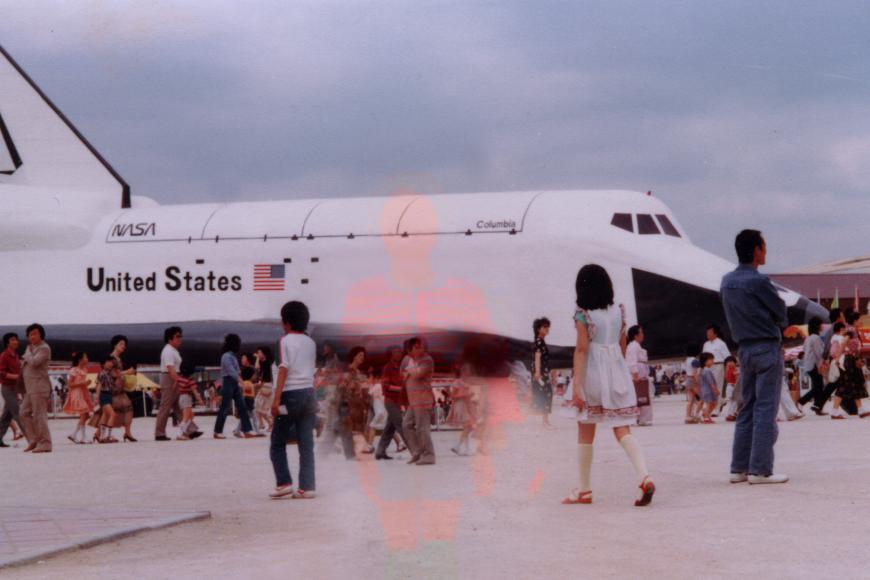
Director Won Taewoong was born in 1981, at a time when the city of Seoul, devastated in the civil war, was rapidly developing. Under the South Korean military dictatorship rice paddies turned into business and residential areas, multi-storey department stores with long escalators and attractions for children were built. In front of the Universe Department Store in Cheonho-dong on the eastern outskirts of the city, a space shuttle was erected that made the children’s imaginations run wild. But while modernisation was picking up speed, most of these malls closed down again after a few years. “Universe Department Store” is an attempted reconstruction. In conversations with peers whose memories often show enormous discrepancies and in hypnosis sessions, the director gets to the bottom of what memory is and discovers a dazzling universe between fact and fantasy.
Christoph Terhechte

Credits DOK Leipzig Logo

Director
Taewoong Won
Cinematographer
Taewoong Won, Suyu Lee
Editor
Taewoong Won
Producer
Il-kwon Kim
Sound
Suhyun Kim
Sound Design
Jiyoon Lee, Sungyui Lee
Score
Minkook Kang
Animation
Taewoong Won
World Sales
Sol ah Jin
Winner of: FIPRESCI Prize
Filmstill Valentina and the MUOSters

Valentina and the MUOSters

Valentina e i MUOStri
Francesca Scalisi
International Competition Documentary Film 2024
Documentary Film
Switzerland,
Italy
2024
80 minutes
Italian
Subtitles: 
English
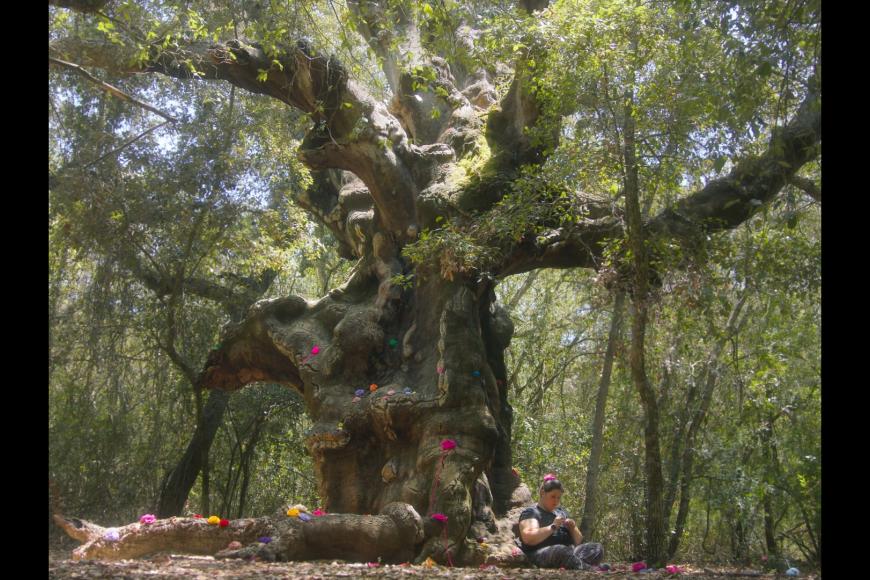
26-year-old Valentina still lives with her parents. She has always put their welfare before her own needs. The two, on the other hand, keep harping on how clumsy and unambitious she is. The sensitive young woman finds reassurance in the artful crocheting of woollen blossoms and among the thousand-year-old cork oaks of the nature reserve surrounding her hometown. The small Sicilian town of Niscemi is of the highest global political importance: Since 2016, the US Navy has been operating a ground station with huge parabolic antennas here for their satellite communication system MUOS. The system also serves to locate Russian military in the Ukraine and turns the region into a potential target for attacks. The locals have been protesting for years. Due to the strong electromagnetic waves the health risks are enormous.
The remarkable sound design underlines the danger and conveys a sense of unease that grows with all the other threats: massive environmental destruction caused by intensive agriculture, drought, fires. Valentina is deeply shaken. Against her parents’ wishes, she takes part in anti-MUOS rallies, wants to become independent at last, drive a car, get a job. This tender story of emancipation is enchanting with its subtle narrative and dream-like interventions. Valentina will be remembered for a long time!
Annina Wettstein

Credits DOK Leipzig Logo

Director
Francesca Scalisi
Script
Francesca Scalisi
Cinematographer
Stefania Bona
Editor
Marzia Mete
Producer
Mark Olexa
Co-Producer
Chiara Galloni, Ivan Olgiati
Sound
Balthasar Jucker
Sound Design
Adrien Kessler, Olga Kokcharova
Score
Olga Kokcharova
World Sales
Raluca Iacob
Nominated for: FIPRESCI Prize, Prize of the Interreligious Jury
Winner of: FIPRESCI Prize
Filmstill We Had Fun Yesterday

We Had Fun Yesterday

We Had Fun Yesterday
Marion Guillard
International Competition Documentary Film 2024
Documentary Film
Belgium
2024
34 minutes
French,
English
Subtitles: 
English
Unexpectedly, Marion Guillard captures the perfect shot: A flock of birds pirouette in the evening sky, the camera follows their graceful movements as if hypnotized, symbiotically. The road to this moment was long. Guillard shares her journey to the USA with us, which is not only marked by feelings of alienation from her family – the postcard motifs spread before her eyes also leave her cold. In a voiceover, she talks about her relationship to herself and her body, about an ideal of femininity she does not conform to, and disturbing encounters with men.
“We Had Fun Yesterday” follows Guillard’s stream of thought, both autobiographical exploration and reflection about the way we look at others: animals – wild or caged; nature - unspoiled or shaped by humans. The result is a surprising weave in which mental and digital images arise and crumble.
Carolin Weidner

Credits DOK Leipzig Logo

Director
Marion Guillard
Script
Marion Guillard
Cinematographer
Marion Guillard
Editor
Pauline Piris-Nury, Lenka Fillnerova
Producer
Cyril Bibas
Co-Producer
Stefanie Bodien
Sound
Marion Guillard
Sound Design
Maxime Thomas, Sébastien Van Dhelsen, Jeff Levillain
Filmstill What Goes Up

What Goes Up

What Goes Up
Samar Al Summary
International Competition Documentary Film 2024
Documentary Film
Saudi Arabia,
USA
2024
29 minutes
English
Subtitles: 
English
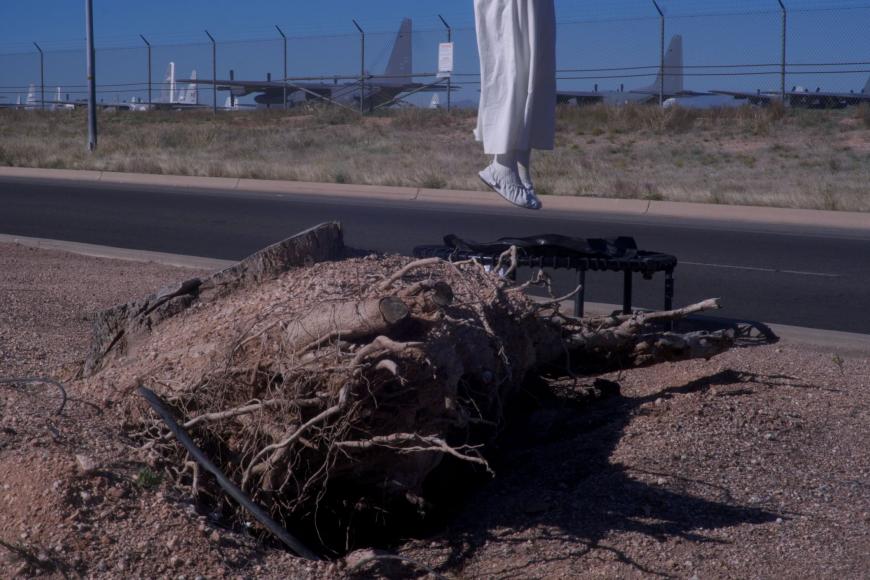
The aeroplanes are stationary, nothing moves, nothing takes off at the US military airbase in Arizona – until a young woman in a white dress begins to jump on a trampoline outside the fence, framed by an idyllic sunset. She conveys her story from the silent offscreen – only through subtitles. Having come from Saudi Arabia, she is stuck in the US because her father stole her identity papers. So homesick that she is considering drastic measures to get back home, she almost enlists in the military. But the US Army is suspicious and would not station her, a risk factor, anywhere near the Middle East. But there is a Baghdad in Arizona, too …
Artist Samar Al Summary’s work is an investigation into systems of power. She does not only talk about herself, the prejudices and obstacles she faces as a Saudi woman, but also about the crash of two Iraqi air force pilots who were to be trained by the US Air Force but never made it home either. In her dramatically condensed film essay, she takes up the symbolic fight – both against gravity, which she can at least temporarily defy by using cinematic means, and against patriarchy. The latter, however, is not so easy to fight.
Borjana Gaković

Credits DOK Leipzig Logo

Director
Samar Al Summary
Cinematographer
Samar Al Summary
Producer
Samar Al Summary
Nominated for: Silver Dove
Winner of: Silver Dove Short Film (International Competition Documentary Film)
Filmstill What We Ask of a Statue Is That It Doesn’t Move

What We Ask of a Statue Is That It Doesn’t Move

Afto pou zitame apo ena agalma ine na min kinite
Daphné Hérétakis
International Competition Documentary Film 2024
Documentary Film
Greece,
France
2023
31 minutes
Greek
Subtitles: 
English
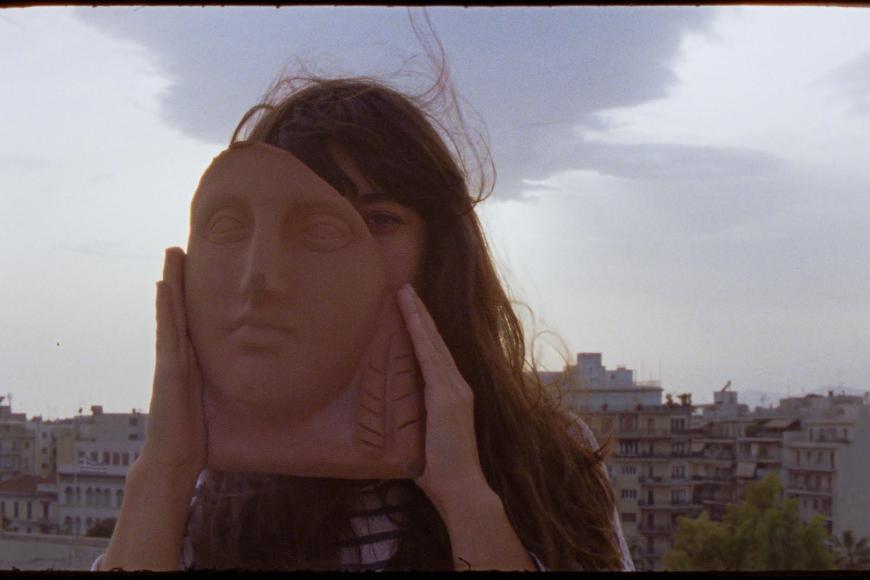
An Athenian filmmaker is struggling with insomnia and seeks help from a tarot reader. She says that when she does manage to sleep, her dreams are strange, she dreams of her childhood apartment, where everyone has turned to stone. Yet such surreal thoughts hardly sound outlandish given the current state of Greece: petrified monuments to past glories as far as the eye can see, even as any sort of movement in the present has slowed to a standstill. She sets out to understand this curious paradox, dipping into literature, fiction and documentary to do so, disparate elements given unity by playfulness, political sensibility and shimmering celluloid.
Conversations with locals on the streets of the Greek capital about the nature of statues; the 1944 manifesto by poet Yorgos Makris that proposed blowing up the Parthenon and the groupuscule that now seeks to complete his work; the story of the political prisoners forced to rebuild the same monument in miniature; a rogue Caryatid now discovering love. Such times are hard to make sense of, whether in Greece or beyond, and perhaps there is only one way to proceed, to move forward, to live: everything bit by bit. “When will we gather the world together piece by piece?”
James Lattimer

Credits DOK Leipzig Logo

Director
Daphné Hérétakis
Script
Daphné Hérétakis
Cinematographer
Robin Fresson, Daphné Hérétakis
Editor
Daphné Hérétakis, Konstantinos Samaras, Jean Costa
Producer
Jasmina Sijerčić, Daphné Hérétakis, Ethan Selcer, Konstantinos Samaras
Sound
Nicole Assimossi, Dimitra Xeroutsikou
Sound Design
Alexandre Hecker, Simon Apostolou
Score
Kornilios Selamsis
Filmstill Where Zebus Speak French

Where Zebus Speak French

Sitabaomba
Nantenaina Lova
International Competition Documentary Film 2023
Documentary Film
Burkina Faso,
France,
Germany,
Madagascar
2023
103 minutes
French,
Malagasy
Subtitles: 
English
Does farmer Ly have dealings with the Chinese, who have recently been tampering with the infrastructure of the village of Sitabaomba, not far from the Malagasy capital of Antananarivo, director Nantenaina Lova asks as bluntly as mischievously. Ly denies it. However, it becomes increasingly clear in the course of “Where Zebus Speak French” that the various development measures, often introduced by foreign initiatives and fuelled by corrupted politicians, also affect him.

Focussing on Sitabaomba, Lova shows over several years how the village population attempt to defend their farmland. Their fight is reminiscent of David against Goliath but doesn’t lead to despondence. Because in Madagascar, a very unique form of artistic, especially linguistic expression has always been cultivated which, at its best, allows people to maintain an inner independence. The commentary is therefore spoken in the style of “Kabary.” This polite, rhetorically sophisticated and sometimes mocking form of speech elegantly circumvents criticism, thus stating it all the more clearly. An artist also visits the village repeatedly and makes stones speak with the children, confirming an attitude Nantenaina Lova describes as follows: “Laughing at injustice rather than crying, resisting rather than pitying.”
Carolin Weidner

Credits DOK Leipzig Logo

Director
Nantenaina Lova
Script
Nantenaina Lova, Eva Lova-Bély
Cinematographer
Nantenaina Lova, Nantenaina Fifaliana
Editor
Nantenaina Lova, Emmanuel Roy
Producer
Eva Lova-Bély, Candy Radifera
Co-Producer
Nicole Gehards, Nina Fernandez, Michel Zongo
Sound
Jonathan Narlysh Rafidiarison, Nantenaina Fifaliana
Sound Design
Julien Verstraete
Score
Various Malagasy Music Bands
Animation
Herizo Ramilijaonina
Narrator
Claudia Tagbo
Winner of: Leipziger Ring
Filmstill While the Green Grass Grows

While the Green Grass Grows

While the Green Grass Grows
Peter Mettler
Hommage Peter Mettler 2023
Documentary Film
Canada,
Switzerland
2023
166 minutes
English
Subtitles: 
German
A film that teaches us mindfulness. In his audiovisual diary, award-winning Swiss-Canadian filmmaker Peter Mettler says farewell to his mother and father. But the film transcends his personal work of mourning. In an always dialogue-oriented search movement over the cycle of life, he reflects on this world and the next, on existence and time. It is an eternal circuit and flow – like the continuous passing of clouds and rivers.

Visually as well as intellectually, Peter Mettler draws upon personal conversations, philosophical and spiritual texts as well as his own film and sound archive. His approach is characterised by openness and humility towards life and nature. This attentive attitude characterises the director’s notion of “film-making” per se that has shaped all his works. “While the Green Grass Grows” comprises two parts of a larger epic diary project with the same title.
Annina Wettstein

Credits DOK Leipzig Logo

Director
Peter Mettler
Script
Peter Mettler
Cinematographer
Peter Mettler
Editor
Jordan Kawai, Peter Mettler
Producer
Cornelia Seitler, Peter Mettler, Brigitte Hofer
Sound
Peter Mettler
Sound Design
Jordan Kawai
Winner of: Golden Dove Feature-Length Film (International Competition Documentary Film)