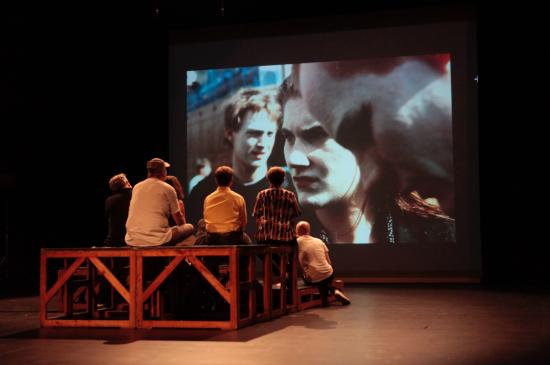
The MDR is committed to the broad public perception and further development of the documentary film genre. As a partner of DOK Leipzig, MDR presents a film production to the festival audience that particularly highlights this endeavour.
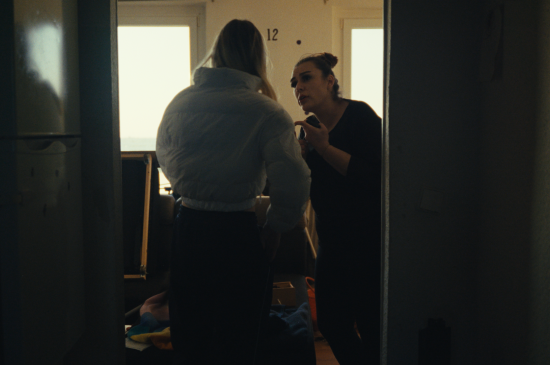
Anne (36) lives in Halle (Saale) and her life is in chaos. An apartment full of moving boxes, a yapping dog. She tells her mother on the phone that the electricity is about to be cut off again. Sometimes her daughter Leonie (14) drops by. Like her mother, she is at risk of slipping into drug addiction. Anne has already lost custody of her two younger children, too. The camera stays purely observational, captures loose scenes from the life of a woman who wants to take responsibility again. The film does not look for psychological explanations but shows Anne as she is. On her drives through the prefabricated housing estate, she seems isolated from her surroundings. Mother and daughter grow closer over an ice cream in a public square. Anne’s visit to her mother provides support but creates pressure, too. We grow ever closer to Anne, sharing her wish that she can become a role model for her daughter.
Anke Leweke
Contains mentions of addiction, death, drug-use
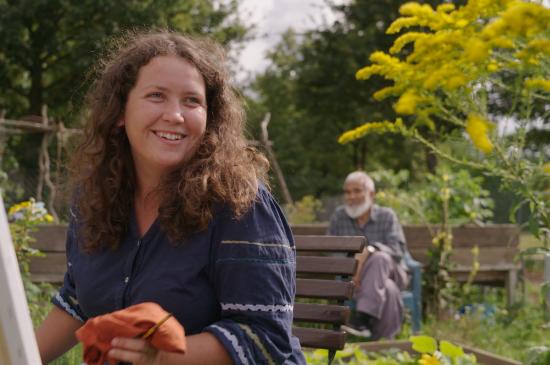
“We don’t fit together”, one of them says of the “motley crew” tending a garden plot in a pre-fab estate in Schwerin. At first, everyone “muddles through” alone: Omar from Syria, who struggles with being voiceless in a foreign land. Manfred, a widower who thinks of his wife every day and looks after everyone. Kateryna from Ukraine, who tries to paint over the war with colourful pictures. Fawze, who lost his homeland three times. Ronny, Wiebke and Max, who are trying to make a fresh start after a life of drugs and violence. Sabine, whose laughter and mischief flare up briefly and vanish again. Petra, who cannot afford to go to a concert after a lifetime of hard work. Richard, who hangs up mirrors not to be alone. Abdul from Afghanistan, master of okra. They communicate with their hands, feet and “russki jasyk”, swap tips on the right way to plant garlic and on tools, soon sit together under the chestnut tree, singing, fighting for the project … And from her balcony Mrs. Müller recites Goethe, following it up with a peace poem. DEFA veteran Dieter Schumann and his cinematographer Michael Kockot achieve what was once the origin and virtue of documentary film: giving the unheard a voice through precise observation, a voice based on closeness, trust and respect. The neighbourhood garden is a site of “small miracles”. One of them is this film.
Grit Lemke
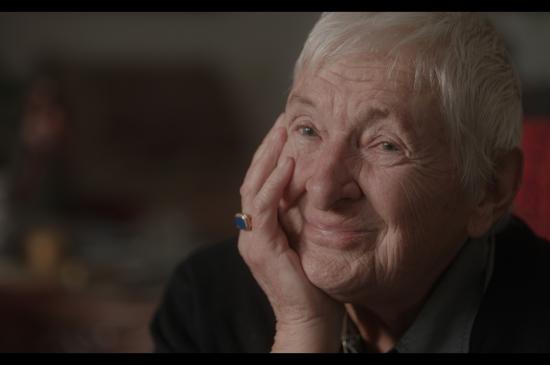
„A little flame that lit up and inspired people to tell different stories about the GDR.” This is how a protagonist describes the 1977 book “Guten Morgen, du Schöne” (Good morning, beautiful) by the writer Maxie Wander, a collection of records in which a wide variety of women talk about themselves. One of the most successful books in the GDR and one of the most influential in German literary history: It affected generations of women (and men!) and encouraged them to question their own lives – ample reason for the director to let a few of the women look back on the book and their lives today. It is about equal rights and emancipation, life plans and rebellion, dreams and failure, love and sexuality, mothers and fathers, men and women, happiness and loneliness, death and, above all, the hunger for life. With respect and great tenderness, Susanne Schüle films faces and bodies on which time has left its mark. Age and beauty, fragility and strength. On the visual level, the stories are subtly commented on by amateur footage: bodies marching in step to the ideologies, Hitler salutes and mass rallies. Again and again contrasted with naked bodies, the wild and non-conformist life beyond the dictatorships. War, peeling potatoes, kisses, children. This is how it was. This is how it is. In the end, the monologues of the past lead up to a contemporary dialogue between the sexes and generations. A flame.
Grit Lemke
Free entry
Free entry
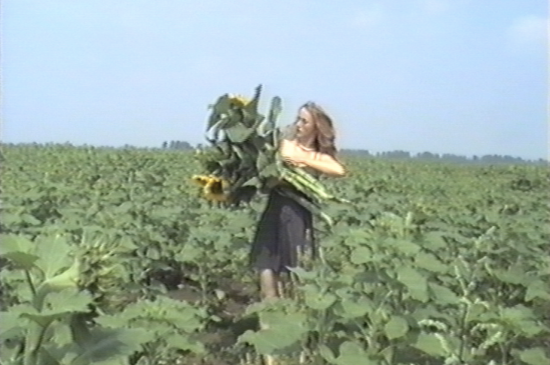
1995. It is the sixth summer since the fall of the Berlin Wall. Artists live, love and work on a farm in East Germany. They film each other with a video camera. They have seen the world, have wondered and learned, became homesick and returned. To where there was space. Fruit hangs from the trees, sparrows chirp, sculptures in the garden. Time and again the camera captures a young woman, her open gaze, her focus. The material which has become fragile today vibrates, gets stuck, freezes. Unperturbed, the narrative evokes the paean of summer, which will not be followed by a seventh for one of them. A white light shines into the present.
Jan Künemund
Contains mentions of death
Free entry
A cinematic observation of a landscape shaped and still marked by borders. Even 35 years after reunification, borders are still present in Marienborn. There is the memorial recalling the violence of the SED regime. Just a stone’s throw away, new borders have been added. Refugees now live in the former NVA barracks, which have been converted into a collective accommodation centre. To get here, they, too, had to cross borders, often clandestinely and at the risk of their lives. Now another border separates them from the outside world: a combination of wall and fence that inevitably brings to mind the former border security facilities of the GDR. In long tracking shots whose wide-angle view makes them seem almost otherworldly, the film observes this coexistence of opening and delineation. While the images make continuities visible, the sound brings out the subtle differences between the various locations.
Luc-Carolin Ziemann
Contains mentions of racism
Free entry
Cranes on flat country. A Taiwanese chip giant is building Europe’s biggest semiconductor factory north of Dresden. The “building blocks of modern economy” play a central role against China, the USA, the rest of the world … Yet it is precisely in this place, where the new is grandly heralded, that a “forgotten future” lies buried. This was the centre of GDR semiconductor research, which strove to realise a social utopia by means of microelectronics. Some see the chip as a “weapon” in the fight for economic dominance and profit, others saw it as a political programme on the path to the “new human”. Jonas Meschede mixes neon-coloured images of a futuristic setting from the cleanrooms of the present with GDR science fiction and archive footage, unearthing what was buried. Once more, the promises of a golden future appear at the end. And the certainty that in the ground on which its gleaming factories are built what was declared dead only lies dormant.
Grit Lemke
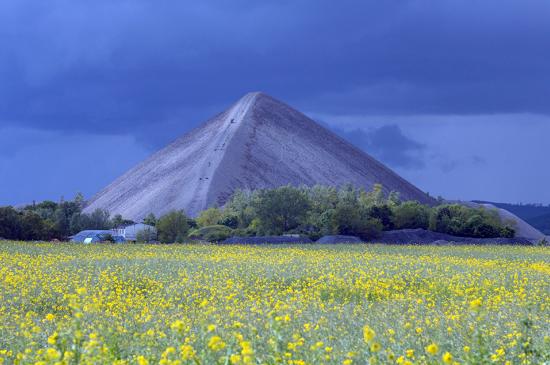
Mansfeld, an East German mining region: The land is gone, but the slag heaps are still there. As a mighty colossus on a barren plain, as the top of a pyramid behind a terraced house, as a dark line on the horizon. These piles of former mining waste have become imposing landmarks. Emerson Culurgioni views them as sediments of history. The carefully framed tableaus of an empty, post-industrial landscape, crossed only occasionally by a Simson moped gang whizzing by, recall James Benning’s exploration of a human-made environment. In contrast to the stillness of the images, a stream of far-reaching reflections about soil and resources, war and crises, labour and destruction, East and West, origin and identity, home and belonging meanders on the soundtrack. Layer by layer, long-dumped memories are uncovered. At the end is the question: What value do we attach to them.
Grit Lemke
A theatre stage, Hamlet: the "call for freedom": The ones who declaim it have learned their craft. Right here, in Rostock, they had begun their studies a month before the German reunification. 35 years later, they remember. 1990: They come from different backgrounds, from East and West. They are strangers, live in prefabricated homes. And they quickly find themselves in a maelstrom sweeping across the whole of the East: Like the factories around them, the theatre school is to be "phased out". At the same time, the "Sonnenblumenhaus" is burning in Rostock-Lichtenhagen. They must learn to organise themselves. Like pieces of a jigsaw, individual tales, supplemented by archive images and historical rehearsal videos, come together to form a picture of those times. Embodied by today’s students, who re-enact scenes from the past, the past is reflected in the present. The story of the East German student movement of the early 1990s has been almost completely erased from the collective memory today. As in Rostock, nothing at Leipzig University reminds us that the existence of a number of scientific or artistic institutes and institutions is owed solely to their commitment. "Die Klasse von 1990" is an urgently needed corrective to a Western-dominated historiography, and a lesson in self-empowerment and democracy.
Grit Lemke
On New Year's Eve 2023, Thomas Heise begins to shoot his new film. It is to be called “Übergang”. His idea: A film in the “Heimatfilm” tradition revolving around Berlin’s Schönhauser Allee, where he has lived for decades. The author is to be a character in the film. A few months later, Heise falls seriously ill and dies. The small team continues to work on the film, unearthing unpublished texts and images from Heise’s estate and archives. “Images are […] encompassing”, Heiner Müller is quoted, but dreams curdle quickly. As soon as the personal story becomes a false image, it is gently but persistently put into perspective. A touching email exchange Heise had with a female high-school graduate in Karlsruhe who is searching for truth contains a whole primer for documentary filmmaking: “See what you would not otherwise see. Stay patient. […] Never expect financial security. Be happy about that. Because it won’t change.” Peter Badel and Chris Wright have not produced a hermetic artist tribute, but have, utterly in the spirit of Heise, pieced together fragments of lived history.
Jan Künemund
Contains mentions of death
Free entry
He is „always sad“, says Uncle Thuận. Connected via mobile phone with his family who are scattered across the world he sings sentimental songs about spring in Hanoi. Meanwhile, his wife Thúy tirelessly looks after the restaurant that the two have been managing in North Rhine-Westphalia for twenty years. They came to the GDR as contract workers at the age of 19. In conversations with their daughters, life stories unfold in which they were rarely expected to decide anything but always to work hard and to function. A role they accept without complaint and justify even today. But the protective shell accumulated over decades increasingly begins to show cracks. And somewhere in the endless routines and tasks of a restaurant kitchen which also structure the film, a question quietly emerges: the question of happiness. In Minh Anh Nguyễn, a post-migrant generation speaks up who regard contract work and racism in the GDR not as a closed chapter but as part of their history. Casual and very close to her protagonists, she tells of colonial legacies that have inscribed themselves into biographies and across generations. At the same time, she shows how this cycle can be broken: By the daughters asking questions which – even outside the Vietnamese community and above all in the East – are long overdue.
Grit Lemke
International Leipzig Festival for Documentary and Animated Film
26 October to 1 November 2026
Leipziger Dok-Filmwochen GmbH
Katharinenstraße 17
04109 Leipzig
Germany
info [at] dok-leipzig [dot] de (info[at]dok-leipzig[dot]de)
+49 (0)341 30864-0