Filmtype
Custom type
Topic
La hora de los hornos. Neocolonialismo y violencia
A call for radical political change, an agitation pamphlet for the national liberation of Argentina: Like few other films, “La hora de los hornos” stirred the generation of 1968 all over the world. The more than four-hour-long film essay was banned for many years, not just in Argentina. Taking the form of a multilayered documentary collage, it is a masterful exploration of the possibilities of image-sound-editing which unfolds a panorama of the prevailing social and political conditions. “Neocolonialismo y violencia” analyses the colonisation of Latin America, its economic and cultural dependence on the industrialised states of the so-called First World, especially the USA, as well as the omnipresence of violence. The second part, “Acto para la liberación”, delivers a chronicle of Peronism and the resistance after Perón’s fall in 1955. “Violencia y liberación”, the shorter third part, openly advocates armed struggle. After two years of clandestine work by a small team around Fernando E. Solanas and Octavio Gentino, “La hora de los hornos” had its world premiere on 2 June 1968 at the Mostra Internazionale del Cinema Nuovo in Pesaro. The Friends of the German Cinematheque (today: Arsenal Filminstitut) screened the three-part film only a few weeks later on the occasion of the Berlinale. After the opening of the Arsenal cinema in January 1970 on Welserstraße in Berlin-Schöneberg, countless screenings of the distribution prints of the film followed at their own venue and elsewhere.

Florian Wüst
Contains depictions of physical violence, racism
Screenings & Tickets
Credits
Contact
Lavra Dor
After the military coup in Brazil in March 1964, the new rulers stopped the fairer distribution of land that had already begun. The agrarian reforms implemented instead favoured big land owners and the agribusiness sector; unions were suppressed. Against this backdrop, Paulo Rufino and Ana Carolina address the struggles and hardships of agricultural labourers. In a free and poetical style, they assemble photographs, film sequences, quotes in words and images into an experimental collage that probes the limits of the documentary. In particular, they play with the instrument of repetition – in a kind of non-linear interpretation of “Lavra Dor” (1962) and other poems by Mário Chamie. The film was screened in the “Week of New Cinema: Latin America” section of the 1970 Berlinale which was compiled by Peter B. Schumann. Four years earlier, Schumann had already shown a cross section of the Brazilian “Cinema Novo” in West Berlin as part of the festival’s retrospective.

Florian Wüst
Screenings & Tickets
Credits
Contact
Leave This Room Buried
James Lattimer
Trailer
Screenings & Tickets
Credits
Contact
vanja@bonobostudio.hr
Líber Arce, liberarse
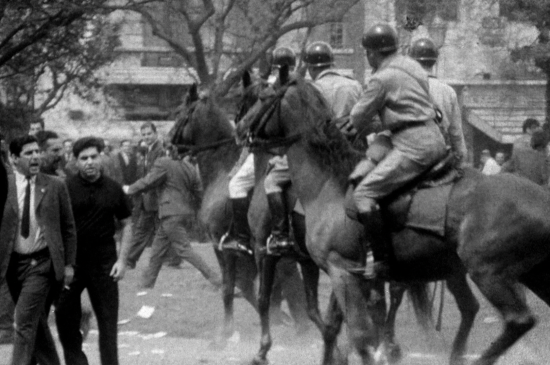
Líber Arce was the name of a communist student who was shot dead by the police at a protest on the university campus of Montevideo. The film documents the events before and after his burial, its title transforming the name of the victim into a call for action: liberarse, to liberate oneself. The fact that the film is silent and the indictment of the social and economic conditions as well as US imperialism is spelled out in intertitles turns the lack of resources for a soundtrack into an aesthetic quality. We look more closely because there is nothing to hear. Mario Handler is a cofounder of the “Cinemateca Tercer del Mundo” (1969-1974) film collective, which sought to build its own cinema of counter-information and published a magazine. Above all, however, it screened the militant films from the other Latin American countries and popularised them far beyond the circles of bourgeois culture in Uruguay.
Florian Wüst
Contains depictions of physical violence