Filmtype
Accessibility
Custom type
Topic
Accessibility
Second Course
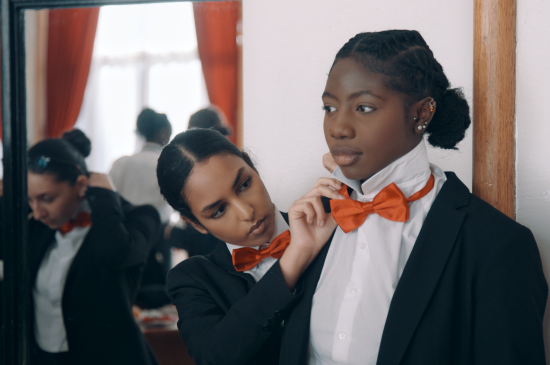
At a vocational college for the hotel industry, Alma, Moussa, Chaïli, Sarah and their classmates swap their everyday clothes, smartphones and chewing gum for uniforms and serving trays. At the college restaurant and in the classroom, they learn the rules and precisely processes linked to French restaurant service: a field in which tradition, discipline and perfection are a priority. Strict, yet fair, the teachers convey the value of a profession that demands patience and putting one’s needs to the side above all else. Between teaching sessions and the different components of service, the portrait of a generation confronted with the expectations of the labour market comes into focus: they need to learn a profession and conform while simultaneously looking for recognition and their own path. The film observes these young people in their training routines with sympathy and attentiveness and explores the contrasts between the idealised image of gastronomy and the harsh reality. For them, this training isn’t always a decision based on conviction, but merely one of the few possible paths into professional life. A lively, unadorned look at becoming an adult and looking for one’s place in a future that offers little and demands many compromises.
Lina Dinkla
Screenings & Tickets
Credits
Contact
samy@andanafilms.com
Silicon Saxony
Cranes on flat country. A Taiwanese chip giant is building Europe’s biggest semiconductor factory north of Dresden. The “building blocks of modern economy” play a central role against China, the USA, the rest of the world … Yet it is precisely in this place, where the new is grandly heralded, that a “forgotten future” lies buried. This was the centre of GDR semiconductor research, which strove to realise a social utopia by means of microelectronics. Some see the chip as a “weapon” in the fight for economic dominance and profit, others saw it as a political programme on the path to the “new human”. Jonas Meschede mixes neon-coloured images of a futuristic setting from the cleanrooms of the present with GDR science fiction and archive footage, unearthing what was buried. Once more, the promises of a golden future appear at the end. And the certainty that in the ground on which its gleaming factories are built what was declared dead only lies dormant.
Grit Lemke
Trailer
Screenings & Tickets
Credits
Contact
meschedeleon@gmail.com
Somos +
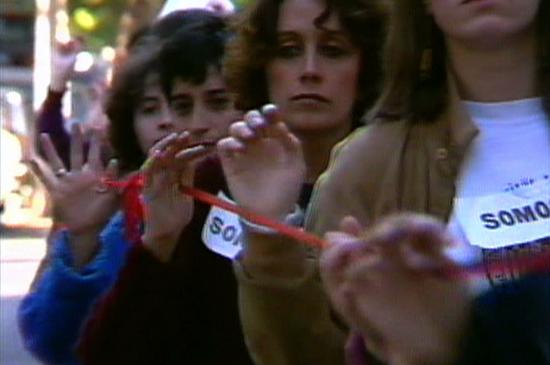
Encouraged by the UN Resolution of 6 November 1974, which condemned the human rights violations of the Chilean military dictatorship, relatives of imprisoned and disappeared persons first began to join forces. Whether in this or other initiatives fighting for a return of democracy to Chile, the resistance was always primarily driven by women. It became more and more visible in the 1980s, not least due to the creativity of their forms of action. One example: On 30 October 1985, the “Mujeres por la vida” organised a protest in the Providencia district of Santiago under the slogan “Somos+” (We are more). The women formed three rows moving towards each other, each holding a ribbon in one of Chile’s national colours. The video documentation of the protest and its violent breakup by the police won multiple awards at the 1986 West German Short Film Festival in Oberhausen.
Florian Wüst
Contains depictions of physical violence
Screenings & Tickets
Credits
Contact
spicher@kurzfilmtage.de
Son of a Bitch
Franka Sachse
Contains depictions of murder, physical violence, nudity
Screenings & Tickets
Free entry
Credits
Contact
daniela@lancafilmes.com.br
Spray and Pray
Marie Ketzscher
Trailer
Screenings & Tickets
Credits
Contact
studio@venetaandrova.com
Staßfurt – Windhoek
Philip Zengel
Screenings & Tickets
Credits
Contact
defa-filmverleih@deutsche-kinemathek.de
Summer of Smooth Asphalt
André Eckardt
Trailer
Screenings & Tickets
Credits
Contact
mariadakszewicz@gmail.com
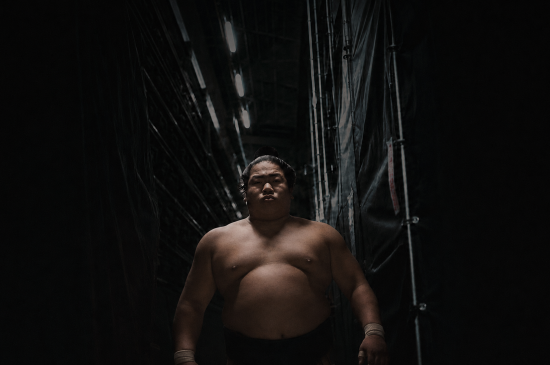
Sumo: Spirit Weighs Nothing
Carolin Weidner
Screenings & Tickets
Credits
Contact
ESPN
Swarm
In November 2013, the European Space Agency (ESA), as part of the SWARM Mission, launched three identical satellites into orbit to study our home planet’s magnetic field more closely. The translation of the measured data into sound makes the fluctuations in the magnetic field of our planet audible. Kamil Czapiga, whose intermedia art project “Cosmodernism”, founded in 2019, is an exploration of a very personal version of abstraction in the micro- and macrocosm, combines these sounds with fascinating material from his moving image universe. Even though they seem alien and unreal, his compositions are made from entirely earthly ingredients like oils, dyed water and magnetic liquids, which are stimulated to undergo chemical reactions in microscopically small film sets. Home-made mechanisms and special lighting enhance the resulting footage to a visual experience that seems out of this world.
Franka Sachse
Created in collaboration with the European Space Agency
Screenings & Tickets
Credits
Contact
hello@cosmodernism.com