Topic
- Activism
- Animated Documentary
- Archival Footage
- Arts/Culture
- Coming of Age
- Digital Culture
- Eastern German
- Environment
- Experimental
- Family
- Gender
- History
- Human Rights
- Humour
- Labour/Economy
- LGBTQIA2S+
- Music
- Politics/Current Affairs
- Portrait/Biography
- Psyche/Mind
- Religion/Spirituality
- Science/Technology
- Social Issues
- Sports
- Underrepresented Communities
- War/Conflict
- Youth
Filmtype
Länge
Accessibility
Section
- Animation Night
- Animation Perspectives
- DEFA Matinee
- Doc Alliance
- DOK Neuland
- Fokus Ost
- German Competition Documentary Film
- Hommage: Helena Třeštíková
- Hommage: Trollfilm
- International Competition Animated Film
- International Competition Documentary Film
- Kids DOK
- Matinee Saxon State Archive
- Retrospective
Custom type
Topic
- Activism
- Animated Documentary
- Archival Footage
- Arts/Culture
- Coming of Age
- Digital Culture
- Eastern German
- Environment
- Experimental
- Family
- Gender
- History
- Human Rights
- Humour
- Labour/Economy
- LGBTQIA2S+
- Music
- Politics/Current Affairs
- Portrait/Biography
- Psyche/Mind
- Religion/Spirituality
- Science/Technology
- Social Issues
- Sports
- Underrepresented Communities
- War/Conflict
- Youth
Length
Accessibility
Section
- Animation Night
- Animation Perspectives
- DEFA Matinee
- Doc Alliance
- DOK Neuland
- Fokus Ost
- German Competition Documentary Film
- Hommage: Helena Třeštíková
- Hommage: Trollfilm
- International Competition Animated Film
- International Competition Documentary Film
- Kids DOK
- Matinee Saxon State Archive
- Retrospective
La infancia de Marisol
Cuban documentary film was never aimed only at its own nation but saw its task as providing information about the events in the so-called Third World. Well-known films by Santiago Álvarez deal with the anti-imperialist struggles in Vietnam and Laos. Starting in the late 1970s, the focus was expanded to include the civil wars in Nicaragua and El Salvador, a shift clearly reflected in the Leipzig festival programmes. Meanwhile, in 1980, Oberhausen screened, in addition to the retrospective “Cinema in Cuba 1959–1979”, Bernabé Hernández’s “La infancia de Marisol”. The film was one of the first Cuban productions made after the victory of the Nicaraguan Revolution in July 1979. It is based on the accounts of 14-year-old Marisol who describes how she joins the Sandinista Liberation Front, fights against the dictatorship, is taken prisoner and, like her father and brother, brutally tortured. The film ends with the prospect of a new life: Marisol’s studies in Cuba.
Florian Wüst
Contains mentions of physical violence, torture
Screenings & Tickets
Credits
Contact
spicher@kurzfilmtage.de
Lavra Dor
After the military coup in Brazil in March 1964, the new rulers stopped the fairer distribution of land that had already begun. The agrarian reforms implemented instead favoured big land owners and the agribusiness sector; unions were suppressed. Against this backdrop, Paulo Rufino and Ana Carolina address the struggles and hardships of agricultural labourers. In a free and poetical style, they assemble photographs, film sequences, quotes in words and images into an experimental collage that probes the limits of the documentary. In particular, they play with the instrument of repetition – in a kind of non-linear interpretation of “Lavra Dor” (1962) and other poems by Mário Chamie. The film was screened in the “Week of New Cinema: Latin America” section of the 1970 Berlinale which was compiled by Peter B. Schumann. Four years earlier, Schumann had already shown a cross section of the Brazilian “Cinema Novo” in West Berlin as part of the festival’s retrospective.
Florian Wüst
Screenings & Tickets
Credits
Contact
Leave This Room Buried
James Lattimer
Trailer
Screenings & Tickets
Credits
Contact
vanja@bonobostudio.hr
Lederwarenfertiger – Ein Beruf für Dich [excerpt]
Meike Weimann
Screenings & Tickets
Credits
Contact
Líber Arce, liberarse
Líber Arce was the name of a communist student who was shot dead by the police at a protest on the university campus of Montevideo. The film documents the events before and after his burial, its title transforming the name of the victim into a call for action: liberarse, to liberate oneself. The fact that the film is silent and the indictment of the social and economic conditions as well as US imperialism is spelled out in intertitles turns the lack of resources for a soundtrack into an aesthetic quality. We look more closely because there is nothing to hear. Mario Handler is a cofounder of the “Cinemateca Tercer del Mundo” (1969-1974) film collective, which sought to build its own cinema of counter-information and published a magazine. Above all, however, it screened the militant films from the other Latin American countries and popularised them far beyond the circles of bourgeois culture in Uruguay.
Florian Wüst
Contains depictions of physical violence
Screenings & Tickets
Credits
Contact
Lice n’ Shine
Franka Sachse
Trailer
Screenings & Tickets
Credits
Contact
artbyomaria@gmail.com
Light
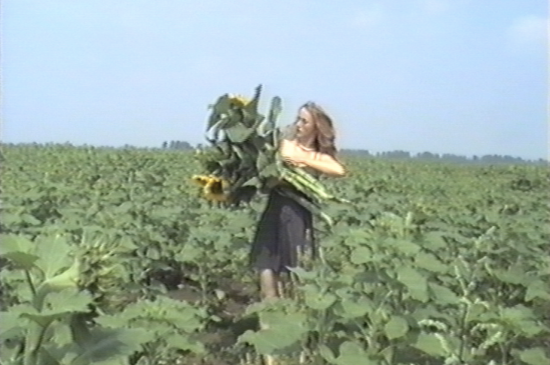
1995. It is the sixth summer since the fall of the Berlin Wall. Artists live, love and work on a farm in East Germany. They film each other with a video camera. They have seen the world, have wondered and learned, became homesick and returned. To where there was space. Fruit hangs from the trees, sparrows chirp, sculptures in the garden. Time and again the camera captures a young woman, her open gaze, her focus. The material which has become fragile today vibrates, gets stuck, freezes. Unperturbed, the narrative evokes the paean of summer, which will not be followed by a seventh for one of them. A white light shines into the present.
Jan Künemund
Contains mentions of death
Screenings & Tickets
Credits
Contact
juliane.ebner@gmx.de
Living in Water
The use of the immersive medium allows audiences to face this particular climate disaster first-hand, and to feel the anxiety which ensues. Within the virtual reality headset, viewers experience a mediated feeling of being within floodwater, in a manner which two-dimensional media cannot replicate. By employing the intimacy of VR, the film makes a slow and more invisible catastrophe feel like the emergency that it actually is.
Dana Melaver
Contains depictions of mental health conditions
Screenings & Tickets
This work is part of our exhibition
DOK Neuland: Landslide
27/10–1/11/2026
Free entry
Find seven works at Kohlrabizirkus.
Tue–Sun | 11:00–18:00
Wed | 12:00–20:00
Taking place at Kohlrabizirkus with one piece situated at the Leipzig Central Station ground-floor and a special performance at Heilandskirche/Westkreuz.
All about the DOK Neuland exhibition
Subject to the General Terms & Conditions of DOK Leipzig. Please be advised that due to a limited number of visitors allowed in the venues longer waiting times are to be expected. Thanks in advance for your patience.
Credits
Contact
Look, We’re in Europe
Anca Păunescu
Trailer
Screenings & Tickets
Credits
Contact
riad_arfin@hotmail.com
Maro’s Photo
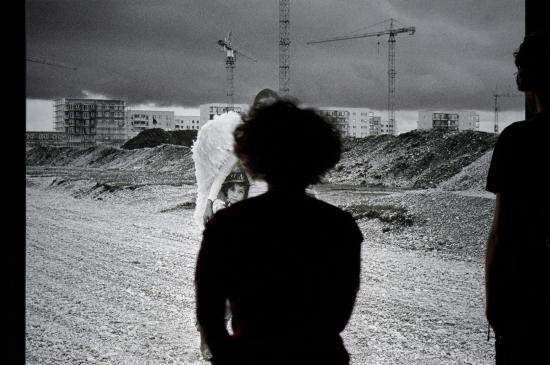
In the early 2000s, Maria Nikolaidou took a photo on Munich’s “Panzerwiese” (tank meadow): Her son Alexandros and another little boy playing war. A woman with angel’s wings wraps her arms protectively around the two of them. Twenty-three years later, mother and son return to the spot where the black and white photo was taken. Alexandros now uses the same camera to make a photo film about the image and also meets with his former playmate. Their voice-over memories and associations reveal different perspectives and moods. The history and stories behind a photograph are being reconstructed: What was overlooked at the time? Why were Alexandros’ grandparents not allowed to give him a gun? Who is the person on the hill in the background? In the end, a new image emerges.
Anke Leweke
Trailer
Screenings & Tickets
Credits
Contact
a.murboeck@posteo.de
Mein Leipzig – lobt das keiner mehr?
Meike Weimann
Screenings & Tickets
Credits
Contact
Melk
André Eckardt
Contains depictions of violence against animals, murder, physical violence