Filmtype
Accessibility
Custom type
Topic
Accessibility
The Snake Charmer
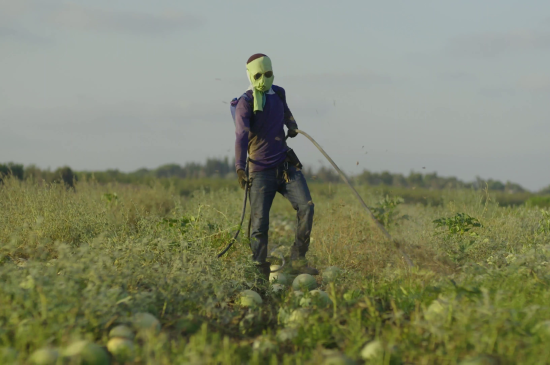
Luscious avocado plantations. Smoke rising on the horizon. Then echoes of explosions. In the “Envelope”, just before the border with Gaza, Yo, Tom, Yan, Piak and Lee work in Israeli fields. Like many other migrant workers, they were recruited from Thailand. They work for below-market wages, often seven days a week, up to 17 hours a day, to support their distant families. They are being observed by a robot snake that crawls through the fields looking for Hamas tunnels beneath the farmland. Bullet casings among the weeds, makeshift shelters in front of the barracks – a psychogeography of fear and vulnerability. Sometimes, in brief moments of leisure, the light-hearted games and the community of young men provide a distraction. On 7 October 2023, the underworld opens up and interrupts the film, which then shifts to the families of the victims. On the banks of the Mekong, the mythical snake god Naga guards the threshold between the living and the dead. An intangible, floating and empathic narrative about precarious labour movements through a military-agrarian complex.
Jan Künemund
Contains mentions of physical violence, war scenes
Contains depictions of death
Screenings & Tickets
Credits
Contact
mel@madeingermany-film.de
The Class of 1990
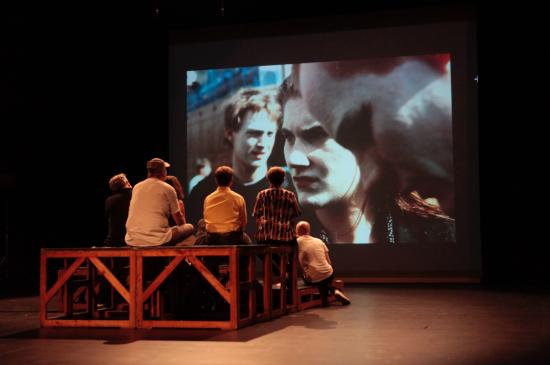
A theatre stage, Hamlet: the "call for freedom": The ones who declaim it have learned their craft. Right here, in Rostock, they had begun their studies a month before the German reunification. 35 years later, they remember. 1990: They come from different backgrounds, from East and West. They are strangers, live in prefabricated homes. And they quickly find themselves in a maelstrom sweeping across the whole of the East: Like the factories around them, the theatre school is to be "phased out". At the same time, the "Sonnenblumenhaus" is burning in Rostock-Lichtenhagen. They must learn to organise themselves. Like pieces of a jigsaw, individual tales, supplemented by archive images and historical rehearsal videos, come together to form a picture of those times. Embodied by today’s students, who re-enact scenes from the past, the past is reflected in the present. The story of the East German student movement of the early 1990s has been almost completely erased from the collective memory today. As in Rostock, nothing at Leipzig University reminds us that the existence of a number of scientific or artistic institutes and institutions is owed solely to their commitment. "Die Klasse von 1990" is an urgently needed corrective to a Western-dominated historiography, and a lesson in self-empowerment and democracy.
Grit Lemke
Screenings & Tickets
Credits
Contact
office@poison-berlin.com
The Masturbator – The Adventures of Edgar Hilsenrath
Ola Staszel
Screenings & Tickets
Credits
Contact
antrag@majade.de
The Maternity Ward
Carolin Weidner
Screenings & Tickets
Credits
Contact
contact@ajimatifilms.com
The Nights
James Lattimer
Contains depictions of nudity, explicit sex scenes
Screenings & Tickets
Credits
Contact
The Orbit of Minor Satellites
Marie Ketzscher
Contains mentions of death
Trailer
Screenings & Tickets
Credits
Contact
chrissullivanx@gmail.com
Transition
On New Year's Eve 2023, Thomas Heise begins to shoot his new film. It is to be called “Übergang”. His idea: A film in the “Heimatfilm” tradition revolving around Berlin’s Schönhauser Allee, where he has lived for decades. The author is to be a character in the film. A few months later, Heise falls seriously ill and dies. The small team continues to work on the film, unearthing unpublished texts and images from Heise’s estate and archives. “Images are […] encompassing”, Heiner Müller is quoted, but dreams curdle quickly. As soon as the personal story becomes a false image, it is gently but persistently put into perspective. A touching email exchange Heise had with a female high-school graduate in Karlsruhe who is searching for truth contains a whole primer for documentary filmmaking: “See what you would not otherwise see. Stay patient. […] Never expect financial security. Be happy about that. Because it won’t change.” Peter Badel and Chris Wright have not produced a hermetic artist tribute, but have, utterly in the spirit of Heise, pieced together fragments of lived history.

Jan Künemund
Contains mentions of death
Screenings & Tickets
Free entry
Credits
Contact
Tricontinental, Letter to Open in Case Of
French critic and activist Michèle Firk died at the age of 31 and left little behind: several texts in the film magazine Positif, the draft script for a film never made, diary entries and a farewell letter in case of her death. Taking these writings as a starting point, Laura Cazador traces out her short, radical life in the late 1950s and 1960s. A life that is not just closely connected to film history, but also the left-wing discourses and anti-imperialistic movements of that era. Firk politicised during the Algerian War, got involved in Socialist Cuba and later joined the armed struggle in Guatemala. Ben Barka, Salvador Allende, Fidel Castro and Ché Guevara drift eerily through the fascinatingly dense archival material of this film – everything connected by the idea of the Tricontinental. The Havana conference that Firk worked on was supposed to be held in 1966 and call a new, non-aligned alliance between the countries of Asia, Africa and Latin America into being. Having trained as a film director herself in Cuba, Cazador grasps Firk as a point of contention and of reference for her own filmmaking in the present. The film thus reflects on the connection between cinephilia and political engagement not just based on Firk’s texts, but also with the images of the “Third Cinema”.
Jan-Philipp Kohlmann
Trailer
Screenings & Tickets
Credits
Contact
mrkolexa@gmail.com
Two Mountains Weighing Down My Chest
Felix Mende
Screenings & Tickets
Credits
Contact
kkiefel@mediawan.com