Filmtype
Section
- Animation Night
- Animation Perspectives
- Audience Competition
- DEFA Matinee
- Doc Alliance
- DOK im Knast
- DOK Neuland
- Fokus Ost
- German Competition Documentary Film
- Hommage: Helena Třeštíková
- Hommage: Trollfilm
- International Competition Animated Film
- International Competition Documentary Film
- Kids DOK
- Matinee Saxon State Archive
- MDR Special Screening
- Opening Film
- Positions
- Retrospective
- Short Film Reel
- Young Eyes
Custom type
Topic
Section
- Animation Night
- Animation Perspectives
- Audience Competition
- DEFA Matinee
- Doc Alliance
- DOK im Knast
- DOK Neuland
- Fokus Ost
- German Competition Documentary Film
- Hommage: Helena Třeštíková
- Hommage: Trollfilm
- International Competition Animated Film
- International Competition Documentary Film
- Kids DOK
- Matinee Saxon State Archive
- MDR Special Screening
- Opening Film
- Positions
- Retrospective
- Short Film Reel
- Young Eyes
Opening Film
Black Rain
Created using still and moving images sourced from NASA’s STEREO satellite solar observation mission, “Black Rain” turns unprocessed scientific data into a raw and glitched-out perspective on nearby interplanetary space. Embracing the artefacts, the film gives us an unmanicured and almost voyeuristic view of space, distant from the glamour of sci-fi or the carefully colourised images normally released by NASA to the press, as we track solar winds, coronal mass ejections and passing comets, sometimes recognisable only as blurs of lines and pixels, across a monochrome background of stars and the milky way.
Ben Sassen
Photosensitivity warning: Contains flashes of light that may trigger seizures for people with visual sensitivities.
Screenings & Tickets
Credits
Contact
Cosmonauts
Everyone who longs for tenderness is welcome aboard the Pompelmo Express, a huge pink rocket ship. Together with a number of diverse passengers who shimmer in all the colours of the rainbow, Delfino, Rita and Zenf journey through the cosmos of possibilities. While a party rages on in the spaceship, Zenf discovers a fiery comet through his huge telescope. At an atmospheric tea party, Delfino falls head over heels in love with Carlos, and Rita begins to quarrel with her body. The infinite expanse and warm darkness of space envelop the friends benignly and offer a space to live out the most varied needs. “Say goodbye to your lonely days.”
Franka Sachse
Contains depictions of nudity
Screenings & Tickets
Credits
Contact
Galaxies
Pioneering multimedia artist and computer animator Lillian Schwartz created “Galaxies” during the early period of her 33-year tenure as artist-in-residence at renowned North American research facility Bell Labs. The piece draws on modeled simulations of galaxies from NASA’s Langley Research Center, which were rendered on a powerful mainframe computer and given to Schwartz to turn into a complete film. Schwartz, who had a background in Japanese calligraphy and painting and whose work often intersects art and technology, approached the material creatively, layering, distorting and colourising the images to breathe new life into the scientific data, with visually striking effect.
Ben Sassen
Photosensitivity warning: Contains flashes of light that may trigger seizures for people with visual sensitivities.
Screenings & Tickets
Credits
Contact
Good Evening, Beautiful
„A little flame that lit up and inspired people to tell different stories about the GDR.” This is how a protagonist describes the 1977 book “Guten Morgen, du Schöne” (Good morning, beautiful) by the writer Maxie Wander, a collection of records in which a wide variety of women talk about themselves. One of the most successful books in the GDR and one of the most influential in German literary history: It affected generations of women (and men!) and encouraged them to question their own lives – ample reason for the director to let a few of the women look back on the book and their lives today. It is about equal rights and emancipation, life plans and rebellion, dreams and failure, love and sexuality, mothers and fathers, men and women, happiness and loneliness, death and, above all, the hunger for life. With respect and great tenderness, Susanne Schüle films faces and bodies on which time has left its mark. Age and beauty, fragility and strength. On the visual level, the stories are subtly commented on by amateur footage: bodies marching in step to the ideologies, Hitler salutes and mass rallies. Again and again contrasted with naked bodies, the wild and non-conformist life beyond the dictatorships. War, peeling potatoes, kisses, children. This is how it was. This is how it is. In the end, the monologues of the past lead up to a contemporary dialogue between the sexes and generations. A flame.
Grit Lemke
Screenings & Tickets
Free entry
Free entry
Credits
Contact
info@shootfromthehip.de
Green Planet
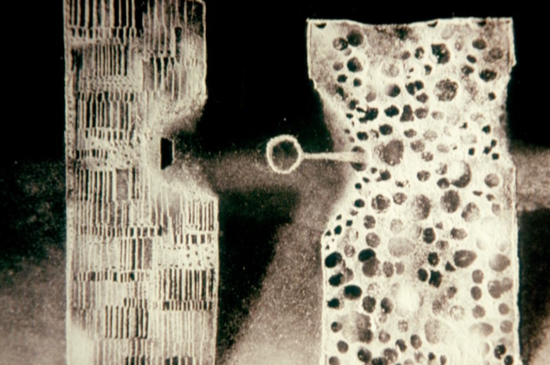
The RK12 galaxy is twenty-eight billion kilometres away from earth and contains a sandy desert planet inhabited by an extraterrestrial species. Without sunlight, these creatures live off the energy of movement itself. They produce time, love music and push their mortal gods back into space when they are tired of them. A fictitious reportage that showcases Piotr Kamler’s extraordinary skill. In addition to a feature-length sci-fi film, the Polish avant-garde film artist created a number of original and technically outstanding short films. “Green Planet” is a masterful stop motion animation in which Kamler brings delicate shapes made of fine sand to life. Carefully directed lighting, contrasts and focus create a fantastical world whose spatial depth is impressive. The music by Ivo Malec, a pioneer of electro-acoustic and New Music, reinforces the otherworldly atmosphere of the distant setting.
Franka Sachse
Screenings & Tickets
Credits
Contact
Moon Flight
A Slavic legend whose essence can also be found in Tibetan records inspired the two Soviet scientists Mikhail Vasin and Alexander Shcherbakov to formulate their “Hollow Moon” hypothesis in 1970. In this hypnotic film, the Hungarian director, autodidact and graphic designer Sándor Reisenbüchler probes the theory in a highly poetical manner, sending us across the centuries from an imagined past to a distant future. His unmistakeable collages, which he brought to life with meticulous precision working alone at the animation table, combined with experimental moving image material, recall memories of analogue projections and the liquid light shows of the 1960s. Organic shapes and colourful patterns generate a fascinating pull which carries us through a magical portal into a hypothetical space ship inside the moon.
Franka Sachse
Photosensitivity warning: Contains flashes of light that may trigger seizures for people with visual sensitivities.
Screenings & Tickets
Credits
Contact
Swarm
In November 2013, the European Space Agency (ESA), as part of the SWARM Mission, launched three identical satellites into orbit to study our home planet’s magnetic field more closely. The translation of the measured data into sound makes the fluctuations in the magnetic field of our planet audible. Kamil Czapiga, whose intermedia art project “Cosmodernism”, founded in 2019, is an exploration of a very personal version of abstraction in the micro- and macrocosm, combines these sounds with fascinating material from his moving image universe. Even though they seem alien and unreal, his compositions are made from entirely earthly ingredients like oils, dyed water and magnetic liquids, which are stimulated to undergo chemical reactions in microscopically small film sets. Home-made mechanisms and special lighting enhance the resulting footage to a visual experience that seems out of this world.

Franka Sachse
Created in collaboration with the European Space Agency
Screenings & Tickets
Credits
Contact
hello@cosmodernism.com
White Hole
Where a black hole is characterised by a region of space in which objects become trapped and prevented from escaping, a white hole is a hypothetical region of spacetime which cannot be entered from the outside, but from within which things can emerge and be released. Such is the setting for this visually rich, hypnotically abstract journey into the universe's expansive voids. “White hole” was released towards the end of a period of exceptional creative experimentation for director Toshio Matsumoto, one of Japan’s most highly acclaimed and masterful experimental film and video makers. In contrast to his earlier celluloid work, “White hole” uses video synthesizers and heavy image processing to achieve a salient cinematic experience, reminiscent of Stanley Kubrick’s 'Stargate’ sequence from “2001: A Space Odyssey”, with similar overtones of psychedelic, and perhaps consciousness expanding cosmological exploration.
Ben Sassen
Photosensitivity warning: Contains flashes of light that may trigger seizures for people with visual sensitivities.
Screenings & Tickets
Credits
Contact
World
In fluid sequence, the birth of a world is depicted as a bioastronomical event. Nebulous, whirling gaseous spheres condense, becoming molten membranes, then a flashing planet. Descent into its erupting electronic forces, to the nucleus, finds the life-spark doubling and multiplying, ascending toward consciousness, into crystal symmetries. An awareness of the whole is focused into the beginning of superconsciousness. This film was preserved with the support of the National Film Preservation Foundation.
Pyramid Films
Photosensitivity warning: Contains flashes of light that may trigger seizures for people with visual sensitivities.