The Regis-Breitingen Youth Detention Centre is DOK Leipzig’s most unusual venue. The screenings are open to inmates and our audience. Advance registration is required.
Free entry
“My life is a prison”, Adelina says. The young woman is smoking and looking into the camera, her parents sitting on the sofa to her right and left. In black and white and the narrow 4:3 ratio, this family scene feels oppressive: Adeline spent eleven years under house arrest here, with a father who refuses to accept her identity and a mother who seems loving but powerless. In Georgia, there is neither freedom nor security for trans persons like Adelina. Anti-queer attacks happen in broad daylight; the legal situation of the LGBTQ community has recently deteriorated further. When the protagonist at last leaves her parents’ village to go to Vienna, the style of Rati Tsiteladze’s debut film also changes. The lipstick glows red, the lights of the big city neon yellow. A different, freer life seems possible. But the freedom brings new challenges: financial and health problems, communicating in a foreign language – and loneliness. “A Song Without Home” is the intimate, impressionistic long-term portrait of a person who wants to define herself and clings to an unshakeable conviction: “No law can erase who we are.”
Jan-Philipp Kohlmann
Contains mentions of discrimination against LGBTQIA2S+ persons
Contains depictions of discrimination against LGBTQIA2S+ persons
Free entry
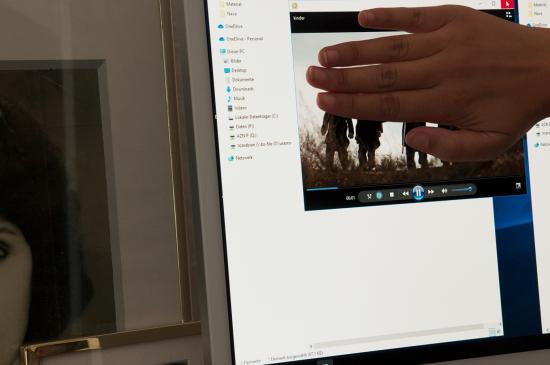
Through numerous video essays in film and media theory, Kevin B. Lee has played a key role in developing the form of the so-called desktop film. The elegant meta-staging reflects the fact that his digital desktop is research tool, media archive and distribution channel at the same time. Lee’s first feature-length film in this style dissects a historical work of propaganda: In 2014, the “Islamic State” terror militia, then at the height of its territorial power, published an elaborately produced film entitled “Flames of War”, which many media outlets compared to the aesthetics of Hollywood blockbusters. Lee manages to abstract and defamiliarize the extreme violence of those images, but comes to the realisation that their ideological power cannot be decoded by the tools of film analysis alone. “Afterlives” broadens the perspective and looks for alternative models in dialogue with experts from the arts, political education and terrorism studies: They reconstruct destroyed cultural assets, develop strategies against extremist radicalisation and study what motivates people to leave terrorist groups. In all this, Lee’s intelligent essay never loses sight of the colonialist western image of the Middle East.
Jan-Philipp Kohlmann
Contains mentions of torture
Contains depictions of war scenes, torture
Contains mentions of war scenes
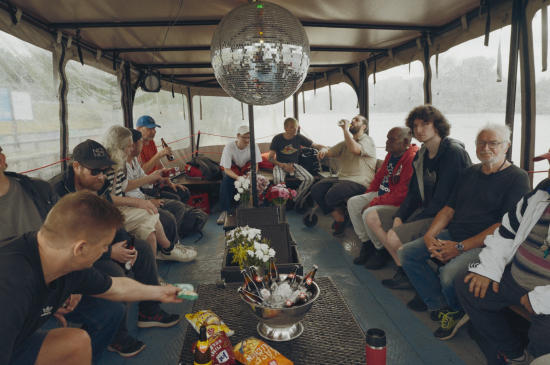
Schnapps is carefully poured into hip flasks and handed to the men. Their faces are marked by the traces of homeless life. A housing project in Berlin Kreuzberg gives them more than a roof over their head. The people who work here listen to them, accompany them to the doctor and hand out controlled amounts of alcohol. The project’s approach is consistently addiction-accepting – without the enforcement of abstinence and with the goal of relieving the affected persons from existential pressure. In this protected space, the men can breathe freely again after many years of living in the streets, rediscover their own personality and dignity. The camera follows some of the residents and social workers over several years, always at eye-level, showing the work of this institution and leaving space for the men’s personal stories. A fragile community emerges in front of the lens.
Anke Leweke
Contains mentions of addiction, death, mental health conditions, drug-use
Contains depictions of addiction
Free entry
Contains mentions of death
International Leipzig Festival for Documentary and Animated Film
26 October to 1 November 2026
Leipziger Dok-Filmwochen GmbH
Katharinenstraße 17
04109 Leipzig
Germany
info [at] dok-leipzig [dot] de (info[at]dok-leipzig[dot]de)
+49 (0)341 30864-0