Topic
- Activism
- Animated Documentary
- Archival Footage
- Arts/Culture
- Coming of Age
- Digital Culture
- Eastern German
- Environment
- Experimental
- Family
- Gender
- History
- Human Rights
- Humour
- Labour/Economy
- LGBTQIA2S+
- Music
- Politics/Current Affairs
- Portrait/Biography
- Psyche/Mind
- Religion/Spirituality
- Science/Technology
- Social Issues
- Sports
- Underrepresented Communities
- War/Conflict
- Youth
Filmtype
Accessibility
Custom type
Topic
- Activism
- Animated Documentary
- Archival Footage
- Arts/Culture
- Coming of Age
- Digital Culture
- Eastern German
- Environment
- Experimental
- Family
- Gender
- History
- Human Rights
- Humour
- Labour/Economy
- LGBTQIA2S+
- Music
- Politics/Current Affairs
- Portrait/Biography
- Psyche/Mind
- Religion/Spirituality
- Science/Technology
- Social Issues
- Sports
- Underrepresented Communities
- War/Conflict
- Youth
Accessibility
Moving Sisters
Sisters Nazieh, Shazieh and Hanieh are from Afghanistan and live with their father at a refugee camp in Athens without any idea of how long they will stay there. Their mother has already arrived in Germany, where a new law now prevents the family from reuniting there as planned. They start growing up in a situation where waiting is the norm. The film accompanies the trio over seven years and shows the fragile normality they establish separately and together in the face of adversity: sport training sessions, language classes and shooting their own film scenes, which are marked by their experiences as refugees. Educator and filmmaker Christos Stefanou got to know the three sisters at the refugee camp, where he worked for five years as a teacher. Aware of the vulnerability of their situation and this phase in life, he follows a collaborative approach in his first feature-length documentary. Drawing on close-up observation, he captures the three sisters’ gestures, thoughts and everyday routines, which reveals their developmental steps and the passing of time not just in physical terms. And while their learning successes sometimes lose any meaning in the face of their constantly changing life situation, one essential question remains: will the family manage to get back together despite all the imponderabilities?
Tina Jany
Screenings & Tickets
Credits
Contact
christef@gmail.com
no_mercy_in_Mexico
André Eckardt
Contains mentions of drug-use, death, murder
Contains depictions of physical violence, torture
Trailer
Screenings & Tickets
Credits
Contact
Silicon Saxony
Cranes on flat country. A Taiwanese chip giant is building Europe’s biggest semiconductor factory north of Dresden. The “building blocks of modern economy” play a central role against China, the USA, the rest of the world … Yet it is precisely in this place, where the new is grandly heralded, that a “forgotten future” lies buried. This was the centre of GDR semiconductor research, which strove to realise a social utopia by means of microelectronics. Some see the chip as a “weapon” in the fight for economic dominance and profit, others saw it as a political programme on the path to the “new human”. Jonas Meschede mixes neon-coloured images of a futuristic setting from the cleanrooms of the present with GDR science fiction and archive footage, unearthing what was buried. Once more, the promises of a golden future appear at the end. And the certainty that in the ground on which its gleaming factories are built what was declared dead only lies dormant.
Grit Lemke
Trailer
Screenings & Tickets
Credits
Contact
meschedeleon@gmail.com
Somos +
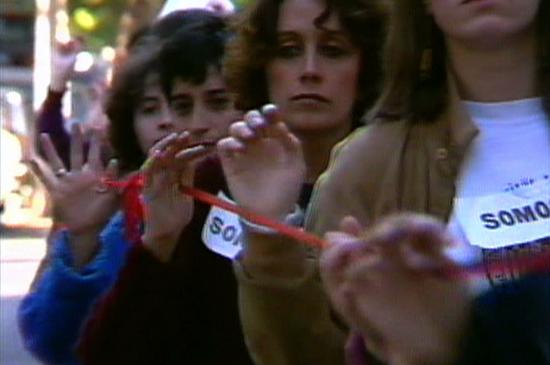
Encouraged by the UN Resolution of 6 November 1974, which condemned the human rights violations of the Chilean military dictatorship, relatives of imprisoned and disappeared persons first began to join forces. Whether in this or other initiatives fighting for a return of democracy to Chile, the resistance was always primarily driven by women. It became more and more visible in the 1980s, not least due to the creativity of their forms of action. One example: On 30 October 1985, the “Mujeres por la vida” organised a protest in the Providencia district of Santiago under the slogan “Somos+” (We are more). The women formed three rows moving towards each other, each holding a ribbon in one of Chile’s national colours. The video documentation of the protest and its violent breakup by the police won multiple awards at the 1986 West German Short Film Festival in Oberhausen.
Florian Wüst
Contains depictions of physical violence
Screenings & Tickets
Credits
Contact
spicher@kurzfilmtage.de
Spray and Pray
Marie Ketzscher
Trailer
Screenings & Tickets
Credits
Contact
studio@venetaandrova.com
The Snake Charmer
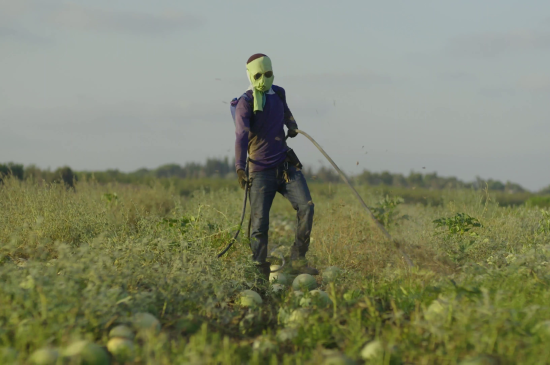
Luscious avocado plantations. Smoke rising on the horizon. Then echoes of explosions. In the “Envelope”, just before the border with Gaza, Yo, Tom, Yan, Piak and Lee work in Israeli fields. Like many other migrant workers, they were recruited from Thailand. They work for below-market wages, often seven days a week, up to 17 hours a day, to support their distant families. They are being observed by a robot snake that crawls through the fields looking for Hamas tunnels beneath the farmland. Bullet casings among the weeds, makeshift shelters in front of the barracks – a psychogeography of fear and vulnerability. Sometimes, in brief moments of leisure, the light-hearted games and the community of young men provide a distraction. On 7 October 2023, the underworld opens up and interrupts the film, which then shifts to the families of the victims. On the banks of the Mekong, the mythical snake god Naga guards the threshold between the living and the dead. An intangible, floating and empathic narrative about precarious labour movements through a military-agrarian complex.
Jan Künemund
Contains mentions of physical violence, war scenes
Contains depictions of death
Screenings & Tickets
Credits
Contact
mel@madeingermany-film.de
The Class of 1990
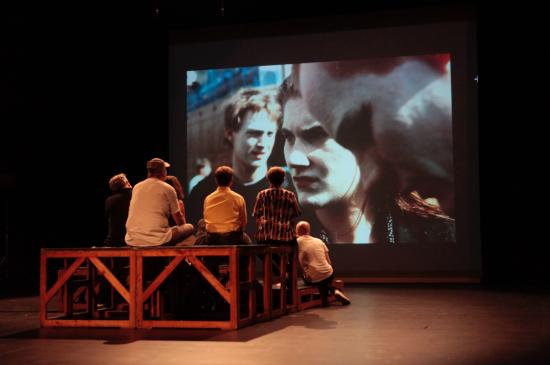
A theatre stage, Hamlet: the "call for freedom": The ones who declaim it have learned their craft. Right here, in Rostock, they had begun their studies a month before the German reunification. 35 years later, they remember. 1990: They come from different backgrounds, from East and West. They are strangers, live in prefabricated homes. And they quickly find themselves in a maelstrom sweeping across the whole of the East: Like the factories around them, the theatre school is to be "phased out". At the same time, the "Sonnenblumenhaus" is burning in Rostock-Lichtenhagen. They must learn to organise themselves. Like pieces of a jigsaw, individual tales, supplemented by archive images and historical rehearsal videos, come together to form a picture of those times. Embodied by today’s students, who re-enact scenes from the past, the past is reflected in the present. The story of the East German student movement of the early 1990s has been almost completely erased from the collective memory today. As in Rostock, nothing at Leipzig University reminds us that the existence of a number of scientific or artistic institutes and institutions is owed solely to their commitment. "Die Klasse von 1990" is an urgently needed corrective to a Western-dominated historiography, and a lesson in self-empowerment and democracy.
Grit Lemke
Screenings & Tickets
Credits
Contact
office@poison-berlin.com
The Maternity Ward
Carolin Weidner
Screenings & Tickets
Credits
Contact
contact@ajimatifilms.com
There’s No Place Like Rome
Why are we so fascinated by the ancient world even today? In 2023, the viral hashtag #RomanEmpire brought to light how many people are still captivated by ancient Rome – men above all. For Pinji, the director’s uncle, this fascination has long since become a life project. He lives in an old house in Bulgaria, looks after a collection of antique treasures and has been writing a book about antiquity for years. When his nephew comes to visit, uncle Pinji does not hesitate: With humorous implacability, he launches into a rhetorical "demolition" of the present age. Toddi listens closely and decides to join the fight. He implements himself and Pinji in a computer game, right into the middle of an antique battle. Now the present is battling the past – outcome uncertain.
Luc-Carolin Ziemann
Trailer
Screenings & Tickets
Credits
Contact
t.musev@gmx.de
Tricontinental, Letter to Open in Case Of
French critic and activist Michèle Firk died at the age of 31 and left little behind: several texts in the film magazine Positif, the draft script for a film never made, diary entries and a farewell letter in case of her death. Taking these writings as a starting point, Laura Cazador traces out her short, radical life in the late 1950s and 1960s. A life that is not just closely connected to film history, but also the left-wing discourses and anti-imperialistic movements of that era. Firk politicised during the Algerian War, got involved in Socialist Cuba and later joined the armed struggle in Guatemala. Ben Barka, Salvador Allende, Fidel Castro and Ché Guevara drift eerily through the fascinatingly dense archival material of this film – everything connected by the idea of the Tricontinental. The Havana conference that Firk worked on was supposed to be held in 1966 and call a new, non-aligned alliance between the countries of Asia, Africa and Latin America into being. Having trained as a film director herself in Cuba, Cazador grasps Firk as a point of contention and of reference for her own filmmaking in the present. The film thus reflects on the connection between cinephilia and political engagement not just based on Firk’s texts, but also with the images of the “Third Cinema”.
Jan-Philipp Kohlmann
Trailer
Screenings & Tickets
Credits
Contact
mrkolexa@gmail.com
Two Rivers
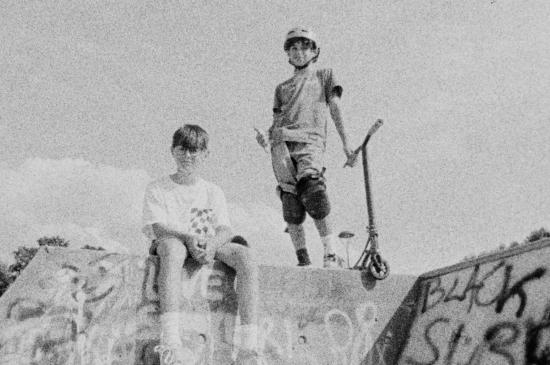
Szymon and Franek live near the river Oder, where Poland and Germany meet. They spend everyspare moment with their friends at the skate park, a place where everyone meets, no matter where they come from. This short documentary, shot on 16mm, follows two children growing up in a border region who wonder what borders actually are: Something tangible, like the river they look at, or something that exists only in their minds?
Lina Dinkla
Trailer
Screenings & Tickets
Credits
Contact
info@felixmariabuehler.de
Union Town
Seggen Mikael
Contains mentions of death
Screenings & Tickets
Free entry