Topic
- Activism
- Archival Footage
- Arts/Culture
- Coming of Age
- Digital Culture
- Eastern German
- Environment
- Family
- Gender
- History
- Human Rights
- Labour/Economy
- LGBTQIA2S+
- Music
- Politics/Current Affairs
- Portrait/Biography
- Psyche/Mind
- Religion/Spirituality
- Social Issues
- Sports
- Underrepresented Communities
- War/Conflict
- Youth
Filmtype
Accessibility
Custom type
Topic
- Activism
- Archival Footage
- Arts/Culture
- Coming of Age
- Digital Culture
- Eastern German
- Environment
- Family
- Gender
- History
- Human Rights
- Labour/Economy
- LGBTQIA2S+
- Music
- Politics/Current Affairs
- Portrait/Biography
- Psyche/Mind
- Religion/Spirituality
- Social Issues
- Sports
- Underrepresented Communities
- War/Conflict
- Youth
Accessibility
Atlas of Disappearance
Seggen Mikael
Contains mentions of murder, death
Trailer
Screenings & Tickets
Credits
Contact
internacional@agenciafreak.com
Baby Jackfruit Baby Guava
Seggen Mikael
Contains mentions of mental health conditions
Screenings & Tickets
Credits
Contact
tommaso@luminaliafilm.com
Between Summers
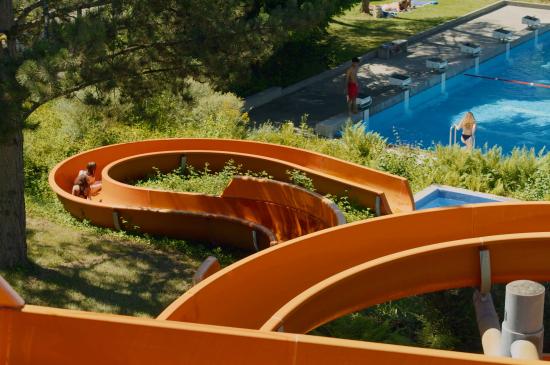
A public swimming pool complex in the middle of a forest which is soon to be renovated: between water slides, French fries, TikTok and sun cream, six teenagers spend the long summer days in the “Badi”, as outdoor pools are called in Swiss German. It is a place to discuss, laugh, try things out and simply hang out together. Whether on the grass, in the water or between the different pools, their conversations revolve around everything that currently moves them. This sun-kissed film accompanies these adolescents at a moment of transition. They talk about the past, think about the future and try to find out who they are and how they will find their place in a changing world. The film stays close to their glances, conversations and encounters, taking an unvarnished look into the inner world of these adolescents – their curiosities, their humour, their contradictions and their insecurities. For one summer long, the Badi becomes a place where childhood and future can exist alongside each other. And while the orange slide is dismantled, the question of what will remain of this summer bubbles up through the water.
Lina Dinkla
Trailer
Screenings & Tickets
Free entry
Credits
Contact
cd@doklab.com
Cold River: I Am in Leipzig
Haiguang dreams. Of his dead grandmother, his birthplace Lěng Shuǐ Jiāng in China, his performances and art projects and his job at a wholesale warehouse in Leipzig. But Haiguang not only dreams, he also films. Himself and his surroundings. Persistent, stoical, sometimes with a handheld camera, sometimes using a tripod – knowing that there is another layer under one’s everyday life that can only be perceived if one dares to search for meaning beyond the visible. If you dare to lie down on a crossing in the park and wait for what happens. If you dare to address the pressure to perform in Chinese society through a performance dragging a car tyre through Beijing. If you dare acknowledge your own fears and doubts and reveal them. Stylistically confident and constantly shifting between places and levels of meaning, Haiguang interlaces his life and dream in eight vignettes in which emotions condense and take on a form that goes beyond the personal. He interweaves the elements of his everyday life between the art academy and his parents’ coal shop in Changsha with equally precise and poetic descriptions. Thus, a puddle by the roadside can become the very place that connects him with his granny across space and time.
Luc-Carolin Ziemann
Trailer
Screenings & Tickets
Credits
Contact
lihaiguang02@gmail.com
For Life
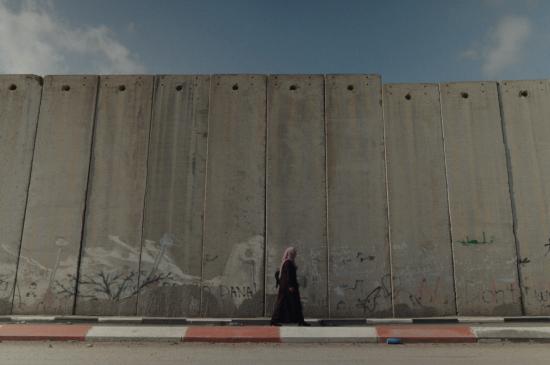
A Palestinian woman, Hind Mashahra, longs for motherhood, but this seems hardly possible as her husband is serving a life sentence in an Israeli prison and is barred from marital visits. Smuggling her husband’s sperm out of prison may be the only chance for her to become a mother again. The documentary follows Hind as she sets out on a risky mission to obtain and deliver her husband’s sample to a fertility clinic. Her repeated attempts are hampered by the traffic, checkpoints, and the short life of semen, perishing within just hours. Unadorned in its language, the film stays close to Hind’s inner experience in the throes of drama, shaped by the reality in the West Bank and East Jerusalem, as well as in quieter moments of waiting that are no less charged. Weaving in accounts of other prisoners’ wives, the documentary chronicles a Palestinian woman’s journey as she pursues motherhood at an extraordinary cost.
Sevara Pan
Contains mentions of death, physical violence
Contains depictions of physical violence, death
Screenings & Tickets
Credits
Contact
benahmetseven@gmail.com
Fracture
James Lattimer
Screenings & Tickets
Credits
Contact
philippe.cotte@cvb.be
Free Zone
Abtin, a young anarchist from Iran, now lives in Greece after fleeing his own country. Back home he managed an underground library of banned books and was reportedly arrested, detained and tortured because he took part in protests. He continues his political struggle in Athen’s Exarchia district – a place of left-wing utopias and a fiercely contested site of gentrification: He joins the movement for refugees, squats in houses, protests against illegal pushbacks and fights for alternative ways of living, though his own situation is highly precarious, because every contact with the state can jeopardise his residence status. Director Jasmine Alakari follows Abtin over the course of a year, experiences his rage, hope and powerlessness, but also euphoria and solidarity. Time and again, the film returns to the question of how much political activism should be allowed to shape one’s life and what role violence plays in this. Meanwhile, the conflict with the police comes to a head in the street and Abtin finds himself in the crosshairs of the state. Alakari keeps filming but realises that she must also examine her own role. What does it mean to be an observer? How far can a film visualise the fears and hopes of a person who does not have the freedom to escape this situation? “Free Zone” has no easy answer to this question but passes it on. To us – the audience.
Luc-Carolin Ziemann
Contains depictions of physical violence
Screenings & Tickets
Credits
Contact
jasmine.alakari@gmail.com
Growing Up
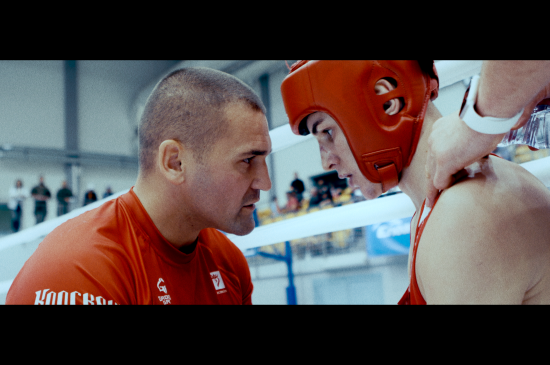
Łukasz dreams of becoming a professional boxer. His mother Monika supports him as much as she can. But the fact that this means he has to move to a sport boarding school over 500 kilometres away is something she can’t fathom. For who will do his washing there and make sure that he turns up to training on time? For Łukasz, the move is a step towards independence, but also a test of his abilities among like-minded people. Between hard training, new friendships and first love, the boarding school doesn’t just become a springboard for his sporting career, but also the place where he comes of age. Over five years, Adam Roszkowski accompanies his taciturn protagonist on his way to the Polish junior championships. In a blend of observation and discreet staging, everyday training routines, family moments and a first date come together to form a narrative that is so close to its characters that the documentary format almost melts into the background. Entirely indebted to the principle of show, don’t tell, “Growing Up” also gives an account of the dedication needed for competitive sport and the price it carries as well as of the silent battles needed to go one’s own way.
Tina Jany
Trailer
Screenings & Tickets
Credits
Contact
jhan@wajdaschool.pl
Heat
Carolin Weidner
Trailer
Screenings & Tickets
Credits
Contact
sales@taskovskifilms.com
Holy Wood Dust
“Trees are life itself”, renowned botanist Stefano Mancuso says, leading a band of kids through what was once a densely wooded area. This becomes the setting for Victor Kossakovsky and Mancuso’s cinematically sprawling journey across Europe, even reaching Vatican City, following the fates of trees. In the Dolomites, trees stand like ghosts after the Storm Vaia devastated the forests. They became more vulnerable due to a planted monoculture of economically valuable fir trees. More damage then followed after the storm, as weakened and fallen trees became breeding ground for bark beetles. What do trees think or feel? Delving into their depths, the camera captures life that’s still sprouting and persisting. However, as winter matures, trees might not make it through the festivities. Chainsaws work tirelessly at fir-tree farms. Like strange cocoons, they are now packed in nets and bundled tightly, waiting for their send-off to homes and public squares. But people’s affection for them might be short-lived.
Sevara Pan
Screenings & Tickets
Credits
Contact
Hope Is a Word
Thick smoke clouds rise at the horizon. Oil bubbles from the ground. The gills of a dead fish are black. A sonorous voice recites a poem about blood, anger and the oil-contaminated landscape of the Niger Delta. A crowd of people join in for the refrain. Writer and activist Nnimmo Bassey has been protesting for decades again the oil extraction in the south of Nigeria and its consequences for humans, nature and agriculture. The Ogoni, an ethnic minority from the region, are particularly affected, with their whole basis for life under existential threat as a result. In the 1990s, they organised a powerful political movement, which was violently put down by the military government – also in the interest of Western oil concerns. How is it possible to put up political resistance in such circumstances? “Hope Is a Word” is the portrait of a man who believes in the power of poetic language. With his workshops, Nnimmo Bassey manages to mobilise a new generation of rhetorically and literarily gifted activists. When they read, rap or recite, the film puts their words into the frame in demonstrative fashion. Poetry becomes a political tool here. For a call can come from a verse, a call that others then follow.
Jan-Philipp Kohlmann
Screenings & Tickets
Credits
Contact
anita@smau.no
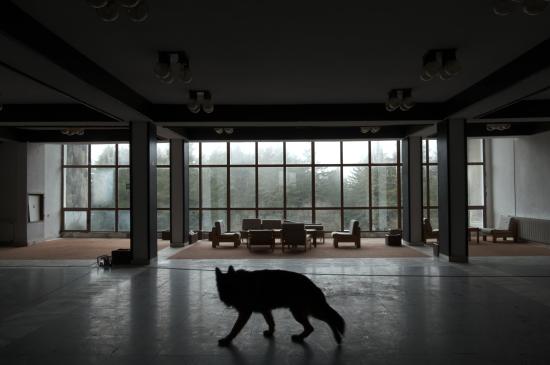
Hotel Utopia
They develop software, work as lifestyle coaches, own marketing agencies or an Amazon shop, travel around the world without paying for accommodation: digital nomads for whom a laptop on a suitcase is sometimes enough of a workplace. Some of their aspirations fall by the wayside in the process and become the project of an enterprising Munich-based developer: Mathias is courting rootless individualists and clever investors to become backers of a project that is to turn a deserted former luxury hotel in the Bulgarian mountains into a hip coworking space. He promises a sense of community, intense human connections and few taxes, an outdoor pool and a campfire idyll. While the nomads who dream of home are waiting for the utopia to become reality, the residents of the surrounding villages sense a new “Wind of Change” with some scepticism. A brilliant structural analysis of a business model that capitalises on modern longings and knows how to carve out the necessary space.
Jan Künemund
Screenings & Tickets
Credits
Contact
hannahbuhr@outlook.de