Topic
- Activism
- Animated Documentary
- Archival Footage
- Arts/Culture
- Coming of Age
- Digital Culture
- Eastern German
- Environment
- Experimental
- Family
- Gender
- History
- Human Rights
- Labour/Economy
- LGBTQIA2S+
- Music
- Politics/Current Affairs
- Portrait/Biography
- Psyche/Mind
- Religion/Spirituality
- Science/Technology
- Social Issues
- Sports
- Underrepresented Communities
- War/Conflict
- Youth
Filmtype
Accessibility
Custom type
Topic
- Activism
- Animated Documentary
- Archival Footage
- Arts/Culture
- Coming of Age
- Digital Culture
- Eastern German
- Environment
- Experimental
- Family
- Gender
- History
- Human Rights
- Labour/Economy
- LGBTQIA2S+
- Music
- Politics/Current Affairs
- Portrait/Biography
- Psyche/Mind
- Religion/Spirituality
- Science/Technology
- Social Issues
- Sports
- Underrepresented Communities
- War/Conflict
- Youth
Accessibility
Patronymic
Seggen Mikael
Contains mentions of war scenes
Trailer
Screenings & Tickets
Credits
Contact
shortsfit@gmail.com
Petrolheads
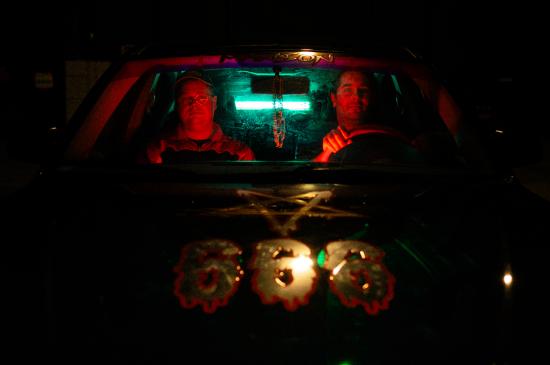
Martin doesn’t dream of a life full of riches. His greatest wish is a 1994 Honda Civic and a driver’s license. He joined his foster family at five months old. At nine, he received a diagnosis of autism, ADHD, and so-called attachment disorder. Then he met Casper, and the two formed a bond born out of their shared love for cars, Trabant jokes, and an understanding of each other’s struggles, shaped by their disabilities and early days spent in an orphanage that affected their self-esteem. Lensed by his brother, director Emil Langballe, with honesty and care, the film follows Martin as he is caught in a spiral of drug addiction and troubles. All the while, he and Casper continue patching up their Honda Civic. A film about ruptures and repairs, of cars and relationships, support systems, and the tenderness of friendship.
Sevara Pan
Contains depictions of drug-use, mental health conditions
Trailer
Screenings & Tickets
Credits
Contact
jasmina@verita-films.com
Pintando con el pueblo
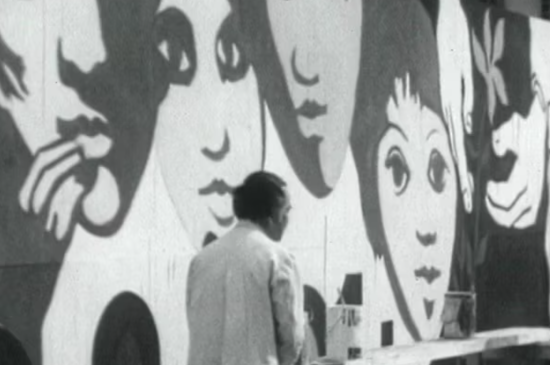
During the Unidad Popular election campaign in 1970, the Ramona Parra Brigades mobilised young activists across the country. They painted political messages on facades and walls using brushes and buckets of paint. In “Brigada Ramona Parra” (1970), Álvaro Ramírez – who continued to work as a filmmaker in exile in the GDR – documents the sometimes daring work of one of these groups. Leonardo Céspedes’ “Pintando con el pueblo” in turn shows the new direction of Chilean cultural politics under Salvador Allende. Artists and art students create a huge mural in front of the presidential palace, La Moneda, in Santiago, under the eyes of passers-by. The site becomes a stage for a rally organized by the Unidad Popular.The film ends with a speech by Allende about art as “an art for all the people”. The 16mm distribution print held by the Arsenal archive is probably the only surviving copy of “Pintando con el pueblo”. It was digitised for this retrospective.
Florian Wüst
Screenings & Tickets
Credits
Contact
Private Universe
Lars Meyer, DOK Leipzig Catalogue 2012
Screenings & Tickets
Credits
Contact
René
Helena Třeštíková won the 2008 Golden Dove in Leipzig for “René”.
Grit Lemke, DOK Leipzig Catalogue 2008
Screenings & Tickets
Credits
Contact
Second Course
At a vocational college for the hotel industry, Alma, Moussa, Chaïli, Sarah and their classmates swap their everyday clothes, smartphones and chewing gum for uniforms and serving trays. At the college restaurant and in the classroom, they learn the rules and precisely processes linked to French restaurant service: a field in which tradition, discipline and perfection are a priority. Strict, yet fair, the teachers convey the value of a profession that demands patience and putting one’s needs to the side above all else. Between teaching sessions and the different components of service, the portrait of a generation confronted with the expectations of the labour market comes into focus: they need to learn a profession and conform while simultaneously looking for recognition and their own path. The film observes these young people in their training routines with sympathy and attentiveness and explores the contrasts between the idealised image of gastronomy and the harsh reality. For them, this training isn’t always a decision based on conviction, but merely one of the few possible paths into professional life. A lively, unadorned look at becoming an adult and looking for one’s place in a future that offers little and demands many compromises.
Lina Dinkla
Screenings & Tickets
Credits
Contact
samy@andanafilms.com
Silicon Saxony
Cranes on flat country. A Taiwanese chip giant is building Europe’s biggest semiconductor factory north of Dresden. The “building blocks of modern economy” play a central role against China, the USA, the rest of the world … Yet it is precisely in this place, where the new is grandly heralded, that a “forgotten future” lies buried. This was the centre of GDR semiconductor research, which strove to realise a social utopia by means of microelectronics. Some see the chip as a “weapon” in the fight for economic dominance and profit, others saw it as a political programme on the path to the “new human”. Jonas Meschede mixes neon-coloured images of a futuristic setting from the cleanrooms of the present with GDR science fiction and archive footage, unearthing what was buried. Once more, the promises of a golden future appear at the end. And the certainty that in the ground on which its gleaming factories are built what was declared dead only lies dormant.
Grit Lemke
Trailer
Screenings & Tickets
Credits
Contact
meschedeleon@gmail.com
Somos +
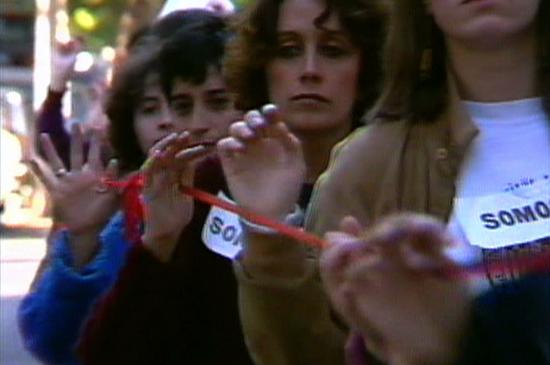
Encouraged by the UN Resolution of 6 November 1974, which condemned the human rights violations of the Chilean military dictatorship, relatives of imprisoned and disappeared persons first began to join forces. Whether in this or other initiatives fighting for a return of democracy to Chile, the resistance was always primarily driven by women. It became more and more visible in the 1980s, not least due to the creativity of their forms of action. One example: On 30 October 1985, the “Mujeres por la vida” organised a protest in the Providencia district of Santiago under the slogan “Somos+” (We are more). The women formed three rows moving towards each other, each holding a ribbon in one of Chile’s national colours. The video documentation of the protest and its violent breakup by the police won multiple awards at the 1986 West German Short Film Festival in Oberhausen.
Florian Wüst
Contains depictions of physical violence
Screenings & Tickets
Credits
Contact
spicher@kurzfilmtage.de
Staßfurt – Windhoek
Philip Zengel
Screenings & Tickets
Credits
Contact
defa-filmverleih@deutsche-kinemathek.de
Sumo: Spirit Weighs Nothing
Carolin Weidner
Screenings & Tickets
Credits
Contact
ESPN
Ten to Twenty Spoil Heaps
Mansfeld, an East German mining region: The land is gone, but the slag heaps are still there. As a mighty colossus on a barren plain, as the top of a pyramid behind a terraced house, as a dark line on the horizon. These piles of former mining waste have become imposing landmarks. Emerson Culurgioni views them as sediments of history. The carefully framed tableaus of an empty, post-industrial landscape, crossed only occasionally by a Simson moped gang whizzing by, recall James Benning’s exploration of a human-made environment. In contrast to the stillness of the images, a stream of far-reaching reflections about soil and resources, war and crises, labour and destruction, East and West, origin and identity, home and belonging meanders on the soundtrack. Layer by layer, long-dumped memories are uncovered. At the end is the question: What value do we attach to them.
Grit Lemke
Screenings & Tickets
Credits
Contact
emerson@posteo.de
The Snake Charmer
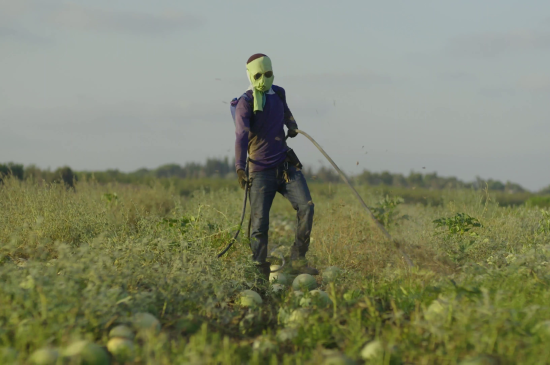
Luscious avocado plantations. Smoke rising on the horizon. Then echoes of explosions. In the “Envelope”, just before the border with Gaza, Yo, Tom, Yan, Piak and Lee work in Israeli fields. Like many other migrant workers, they were recruited from Thailand. They work for below-market wages, often seven days a week, up to 17 hours a day, to support their distant families. They are being observed by a robot snake that crawls through the fields looking for Hamas tunnels beneath the farmland. Bullet casings among the weeds, makeshift shelters in front of the barracks – a psychogeography of fear and vulnerability. Sometimes, in brief moments of leisure, the light-hearted games and the community of young men provide a distraction. On 7 October 2023, the underworld opens up and interrupts the film, which then shifts to the families of the victims. On the banks of the Mekong, the mythical snake god Naga guards the threshold between the living and the dead. An intangible, floating and empathic narrative about precarious labour movements through a military-agrarian complex.
Jan Künemund
Contains mentions of physical violence, war scenes
Contains depictions of death
Screenings & Tickets
Credits
Contact
mel@madeingermany-film.de