Topic
- Activism
- Animated Documentary
- Archival Footage
- Arts/Culture
- Coming of Age
- Digital Culture
- Eastern German
- Environment
- Experimental
- Family
- Gender
- History
- Human Rights
- Humour
- Labour/Economy
- LGBTQIA2S+
- Music
- Politics/Current Affairs
- Portrait/Biography
- Psyche/Mind
- Religion/Spirituality
- Social Issues
- Sports
- Underrepresented Communities
- War/Conflict
- Youth
Filmtype
Länge
Accessibility
Section
Custom type
Topic
- Activism
- Animated Documentary
- Archival Footage
- Arts/Culture
- Coming of Age
- Digital Culture
- Eastern German
- Environment
- Experimental
- Family
- Gender
- History
- Human Rights
- Humour
- Labour/Economy
- LGBTQIA2S+
- Music
- Politics/Current Affairs
- Portrait/Biography
- Psyche/Mind
- Religion/Spirituality
- Social Issues
- Sports
- Underrepresented Communities
- War/Conflict
- Youth
Length
Accessibility
Section
Nicole Nicole
Alberte and Nicole are mother and daughter, three decades apart. At 55 and 87, they still live together in a villa by Lake Geneva, having settled into a codependent dynamic: Nicole is reluctant to leave her mother, while Alberte struggles to let her go, fearing living alone. In a house filled with memorabilia, cats, and too many clocks, the familiar feels safe for the mother‑daughter duo who often doze off like synchronised swimmers. However, as time passes, the family grows concerned about Nicole’s autonomy. Nicole is considered neuroatypical, “ambivalent” regarding the perceived condition, and few facilities are equipped to provide adequate support. Nicole’s sister, Danielle, then decides to assist her in a search for a flat and a job. These scenes unfold alongside the family’s daily life and the intimate conversations in front of the camera. Nicole also embarks on a playful creative exercise with her filmmaker niece Lauren, imagining life’s many scenarios.
Sevara Pan
Contains depictions of mental health conditions
Trailer
Screenings & Tickets
Free entry
Credits
Contact
Nuestra voz de tierra, memoria y futuro
Marta Rodríguez and Jorge Silva made their first appearance in Leipzig in 1972, with “Planas, testimonio de un etnocidio” (1971) in the retrospective “Film in the People’s Struggle for Freedom: Latin America” as well as in the television competition and in the cinema competition with “Chircales” (1972). Both films were awarded Golden Doves, Rodríguez and Silva became instant stars of the festival. In 1975, “Campesinos” brought them back to Leipzig. This film marks the beginning of their exploration of the centuries-old oppression of indigenous communities in the Cauca region in southwestern Colombia and their equally long resistance against colonial exploitation and dispossession. Years later, the theme culminated in “Nuestra voz de tierra, memoria y futuro”, in which they used some shots from “Campesinos”. Rodríguez and Silva document the process of political organisation in the Coconuco community during the land reform movement of the 1970s, with extensive critical collaboration by their protagonists. At the same time, it was an attempt to leave the naturalism of the documentary format behind and approach the subconscious mind of the indigenous culture, “to depict its magical world in all its complexity and beauty”, as Silva put it in a conversation with Peter B. Schumann in the information leaflet of the 1982 Berlinale Forum. The film re-celebrated its world premiere in its restored digital version at the 2019 Forum.
Florian Wüst
Screenings & Tickets
Credits
Contact
Petrolheads
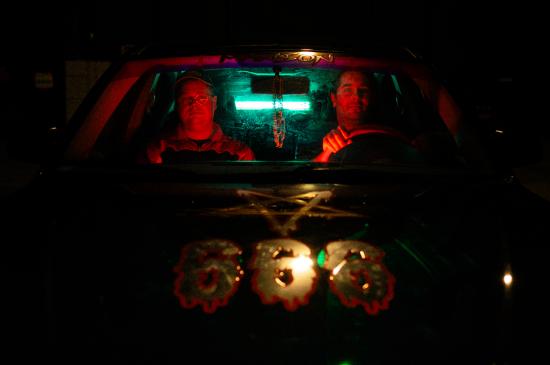
Martin doesn’t dream of a life full of riches. His greatest wish is a 1994 Honda Civic and a driver’s license. He joined his foster family at five months old. At nine, he received a diagnosis of autism, ADHD, and so-called attachment disorder. Then he met Casper, and the two formed a bond born out of their shared love for cars, Trabant jokes, and an understanding of each other’s struggles, shaped by their disabilities and early days spent in an orphanage that affected their self-esteem. Lensed by his brother, director Emil Langballe, with honesty and care, the film follows Martin as he is caught in a spiral of drug addiction and troubles. All the while, he and Casper continue patching up their Honda Civic. A film about ruptures and repairs, of cars and relationships, support systems, and the tenderness of friendship.
Sevara Pan
Contains depictions of drug-use, mental health conditions
Trailer
Screenings & Tickets
Credits
Contact
jasmina@verita-films.com
Prelude and Fugues – The Wood Thrush
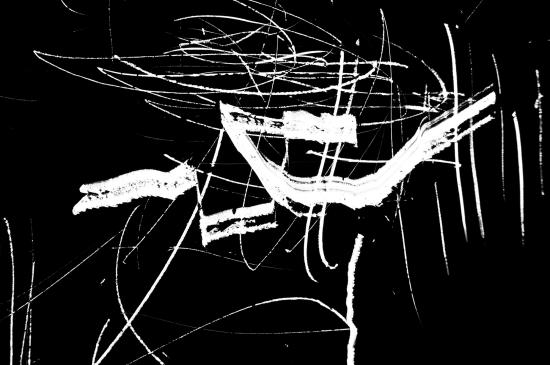
A distant wood thrush is singing against the pitch-black backdrop of the image. A fly acoustically approaches with a massive, bass-heavy hum, abruptly stopped in its flight by the sound of a crash. Sounds so familiar that we are usually not even aware of them provided the main sonic material for the renowned sound designer Claude Beaugrand. His long-standing artist friend, filmmaker Pierre Hébert, dedicated his five animated fugues to him. Field recordings like those of the bird and insect derive their vitality from their recognisability through repetition, as well as from their ephemeral nature, with its random inflections and variations. Hébert forms a sonic body through stretching, echo loops and granulated sounds. And he scratches directly onto the film material, working against the physical resistance of the emulsion. Each “brushstroke” created this way has an unpredictable, intuitive element. Each powerful or tender graphic gesture radiates vitality. Just as the thrush and the fly meet acoustically, abstract bundles of lines flutter nervously on the surface of the screen and into its depth, circling the pared-down silhouette of a human being in free fall. Intertitles lyrically describe a pain that must be expressed but for which there are no direct words. “Prelude and Fugues – The Wood Thrush” is an indescribable experience of choreographed sounds, an inner cinema born of the delicate essence of animation and the irresistible enticement to listen intently.
André Eckardt
Photosensitivity warning: Contains flashes of light that may trigger seizures for people with visual sensitivities.
Screenings & Tickets
Credits
Contact
distribution@videographe.org
Private Universe
Lars Meyer, DOK Leipzig Catalogue 2012
Screenings & Tickets
Credits
Contact
René
Helena Třeštíková won the 2008 Golden Dove in Leipzig for “René”.
Grit Lemke, DOK Leipzig Catalogue 2008
Screenings & Tickets
Credits
Contact
Second Course
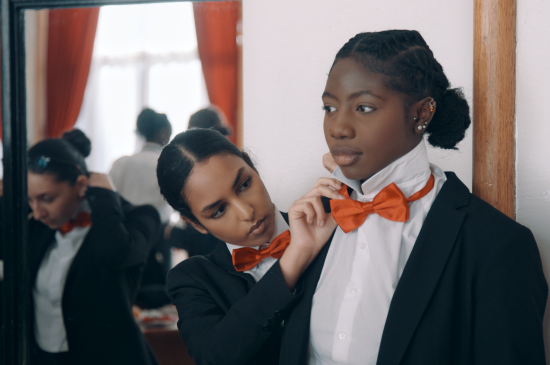
At a vocational college for the hotel industry, Alma, Moussa, Chaïli, Sarah and their classmates swap their everyday clothes, smartphones and chewing gum for uniforms and serving trays. At the college restaurant and in the classroom, they learn the rules and precisely processes linked to French restaurant service: a field in which tradition, discipline and perfection are a priority. Strict, yet fair, the teachers convey the value of a profession that demands patience and putting one’s needs to the side above all else. Between teaching sessions and the different components of service, the portrait of a generation confronted with the expectations of the labour market comes into focus: they need to learn a profession and conform while simultaneously looking for recognition and their own path. The film observes these young people in their training routines with sympathy and attentiveness and explores the contrasts between the idealised image of gastronomy and the harsh reality. For them, this training isn’t always a decision based on conviction, but merely one of the few possible paths into professional life. A lively, unadorned look at becoming an adult and looking for one’s place in a future that offers little and demands many compromises.
Lina Dinkla
Screenings & Tickets
Credits
Contact
samy@andanafilms.com
Son of a Bitch
Franka Sachse
Contains depictions of murder, physical violence, nudity
Screenings & Tickets
Free entry
Credits
Contact
daniela@lancafilmes.com.br
Staßfurt – Windhoek
Philip Zengel
Screenings & Tickets
Credits
Contact
defa-filmverleih@deutsche-kinemathek.de
Sumo: Spirit Weighs Nothing
Carolin Weidner
Screenings & Tickets
Credits
Contact
ESPN
The Snake Charmer
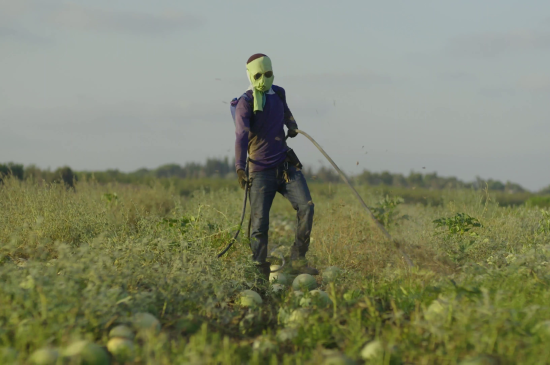
Luscious avocado plantations. Smoke rising on the horizon. Then echoes of explosions. In the “Envelope”, just before the border with Gaza, Yo, Tom, Yan, Piak and Lee work in Israeli fields. Like many other migrant workers, they were recruited from Thailand. They work for below-market wages, often seven days a week, up to 17 hours a day, to support their distant families. They are being observed by a robot snake that crawls through the fields looking for Hamas tunnels beneath the farmland. Bullet casings among the weeds, makeshift shelters in front of the barracks – a psychogeography of fear and vulnerability. Sometimes, in brief moments of leisure, the light-hearted games and the community of young men provide a distraction. On 7 October 2023, the underworld opens up and interrupts the film, which then shifts to the families of the victims. On the banks of the Mekong, the mythical snake god Naga guards the threshold between the living and the dead. An intangible, floating and empathic narrative about precarious labour movements through a military-agrarian complex.
Jan Künemund
Contains mentions of physical violence, war scenes
Contains depictions of death
Screenings & Tickets
Credits
Contact
mel@madeingermany-film.de
The Class of 1990
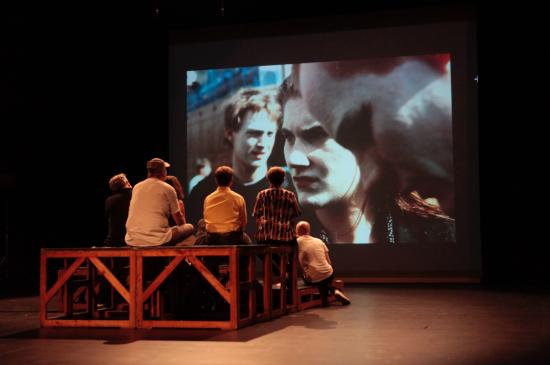
A theatre stage, Hamlet: the "call for freedom": The ones who declaim it have learned their craft. Right here, in Rostock, they had begun their studies a month before the German reunification. 35 years later, they remember. 1990: They come from different backgrounds, from East and West. They are strangers, live in prefabricated homes. And they quickly find themselves in a maelstrom sweeping across the whole of the East: Like the factories around them, the theatre school is to be "phased out". At the same time, the "Sonnenblumenhaus" is burning in Rostock-Lichtenhagen. They must learn to organise themselves. Like pieces of a jigsaw, individual tales, supplemented by archive images and historical rehearsal videos, come together to form a picture of those times. Embodied by today’s students, who re-enact scenes from the past, the past is reflected in the present. The story of the East German student movement of the early 1990s has been almost completely erased from the collective memory today. As in Rostock, nothing at Leipzig University reminds us that the existence of a number of scientific or artistic institutes and institutions is owed solely to their commitment. "Die Klasse von 1990" is an urgently needed corrective to a Western-dominated historiography, and a lesson in self-empowerment and democracy.
Grit Lemke
Screenings & Tickets
Credits
Contact
office@poison-berlin.com