Topic
- Activism
- Animated Documentary
- Archival Footage
- Arts/Culture
- Coming of Age
- Digital Culture
- Eastern German
- Environment
- Experimental
- Family
- Gender
- History
- Human Rights
- Humour
- Labour/Economy
- LGBTQIA2S+
- Music
- Politics/Current Affairs
- Portrait/Biography
- Psyche/Mind
- Religion/Spirituality
- Science/Technology
- Social Issues
- Sports
- Underrepresented Communities
- War/Conflict
- Youth
Filmtype
Accessibility
Custom type
Topic
- Activism
- Animated Documentary
- Archival Footage
- Arts/Culture
- Coming of Age
- Digital Culture
- Eastern German
- Environment
- Experimental
- Family
- Gender
- History
- Human Rights
- Humour
- Labour/Economy
- LGBTQIA2S+
- Music
- Politics/Current Affairs
- Portrait/Biography
- Psyche/Mind
- Religion/Spirituality
- Science/Technology
- Social Issues
- Sports
- Underrepresented Communities
- War/Conflict
- Youth
Accessibility
Is Heaven Blue? #2
The collaborative artistic work of Menno de Noojer (son), Paul de Noojer (father) and Françoise de Noojer (mother), which oscillated between photography and experimental film, spanned almost fifty years. Rather than allowing posterity to label, categorise and, as the case may be, mothball their work, the three realised a final film together just before Paul de Noojer died, when he was already seriously ill. A last joint film as an exuberant self-homage, in which they combine experimental-documentary storytelling, performance, pixilation and stop motion, funny and sad moments, pathos and trash, a joy of putting on costumes and vulnerable nudity. With “Heaven is Blue? #2”, the Noojers celebrate life as a total work of art in which all processes of becoming human and all symptoms of decline have their place and death is a natural part of the whole.
Marie Ketzscher
Screenings & Tickets
Credits
Contact
claus@trollfilm.no
Joeri is verliefd (maar...) + Zijn hart ligt op de grond (maar...)
André Eckardt
Screenings & Tickets
Credits
Contact
antoncla.contact@gmail.com
Lavra Dor
After the military coup in Brazil in March 1964, the new rulers stopped the fairer distribution of land that had already begun. The agrarian reforms implemented instead favoured big land owners and the agribusiness sector; unions were suppressed. Against this backdrop, Paulo Rufino and Ana Carolina address the struggles and hardships of agricultural labourers. In a free and poetical style, they assemble photographs, film sequences, quotes in words and images into an experimental collage that probes the limits of the documentary. In particular, they play with the instrument of repetition – in a kind of non-linear interpretation of “Lavra Dor” (1962) and other poems by Mário Chamie. The film was screened in the “Week of New Cinema: Latin America” section of the 1970 Berlinale which was compiled by Peter B. Schumann. Four years earlier, Schumann had already shown a cross section of the Brazilian “Cinema Novo” in West Berlin as part of the festival’s retrospective.
Florian Wüst
Screenings & Tickets
Credits
Contact
Leave This Room Buried
James Lattimer
Trailer
Screenings & Tickets
Credits
Contact
vanja@bonobostudio.hr
Magic Atlas
Marie Ketzscher
Contains depictions of physical violence, drug-use, child abuse
Screenings & Tickets
Credits
Contact
g362005@163.com
Moon Flight
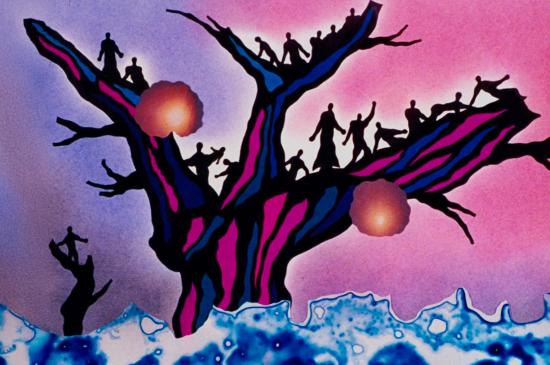
A Slavic legend whose essence can also be found in Tibetan records inspired the two Soviet scientists Mikhail Vasin and Alexander Shcherbakov to formulate their “Hollow Moon” hypothesis in 1970. In this hypnotic film, the Hungarian director, autodidact and graphic designer Sándor Reisenbüchler probes the theory in a highly poetical manner, sending us across the centuries from an imagined past to a distant future. His unmistakeable collages, which he brought to life with meticulous precision working alone at the animation table, combined with experimental moving image material, recall memories of analogue projections and the liquid light shows of the 1960s. Organic shapes and colourful patterns generate a fascinating pull which carries us through a magical portal into a hypothetical space ship inside the moon.
Franka Sachse
Photosensitivity warning: Contains flashes of light that may trigger seizures for people with visual sensitivities.
Screenings & Tickets
Credits
Contact
Neighborhood Autobahn
A cinematic observation of a landscape shaped and still marked by borders. Even 35 years after reunification, borders are still present in Marienborn. There is the memorial recalling the violence of the SED regime. Just a stone’s throw away, new borders have been added. Refugees now live in the former NVA barracks, which have been converted into a collective accommodation centre. To get here, they, too, had to cross borders, often clandestinely and at the risk of their lives. Now another border separates them from the outside world: a combination of wall and fence that inevitably brings to mind the former border security facilities of the GDR. In long tracking shots whose wide-angle view makes them seem almost otherworldly, the film observes this coexistence of opening and delineation. While the images make continuities visible, the sound brings out the subtle differences between the various locations.
Luc-Carolin Ziemann
Contains mentions of racism
Trailer
Screenings & Tickets
Credits
Contact
luci.schwingen@gmail.com
Nothing Happens After Your Absence
Seggen Mikael
Screenings & Tickets
Credits
Contact
Nothing to Expect
André Eckardt
Photosensitivity warning: Contains flashes of light that may trigger seizures for people with visual sensitivities.
Screenings & Tickets
Credits
Contact
franz.impler@gmail.com
Out of Bounds
André Eckardt
Trailer
Screenings & Tickets
Credits
Contact
franz.impler@gmail.com
Prelude and Fugues – The Wood Thrush
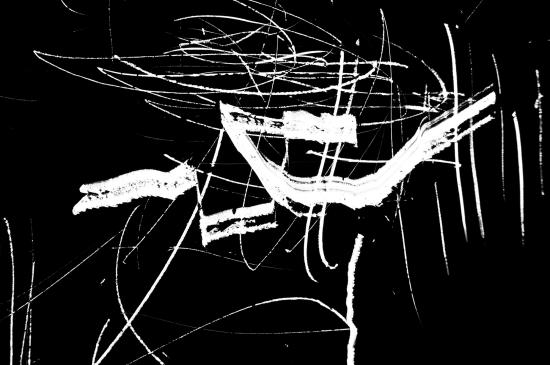
A distant wood thrush is singing against the pitch-black backdrop of the image. A fly acoustically approaches with a massive, bass-heavy hum, abruptly stopped in its flight by the sound of a crash. Sounds so familiar that we are usually not even aware of them provided the main sonic material for the renowned sound designer Claude Beaugrand. His long-standing artist friend, filmmaker Pierre Hébert, dedicated his five animated fugues to him. Field recordings like those of the bird and insect derive their vitality from their recognisability through repetition, as well as from their ephemeral nature, with its random inflections and variations. Hébert forms a sonic body through stretching, echo loops and granulated sounds. And he scratches directly onto the film material, working against the physical resistance of the emulsion. Each “brushstroke” created this way has an unpredictable, intuitive element. Each powerful or tender graphic gesture radiates vitality. Just as the thrush and the fly meet acoustically, abstract bundles of lines flutter nervously on the surface of the screen and into its depth, circling the pared-down silhouette of a human being in free fall. Intertitles lyrically describe a pain that must be expressed but for which there are no direct words. “Prelude and Fugues – The Wood Thrush” is an indescribable experience of choreographed sounds, an inner cinema born of the delicate essence of animation and the irresistible enticement to listen intently.

André Eckardt
Photosensitivity warning: Contains flashes of light that may trigger seizures for people with visual sensitivities.
Screenings & Tickets
Credits
Contact
distribution@videographe.org
Quiet
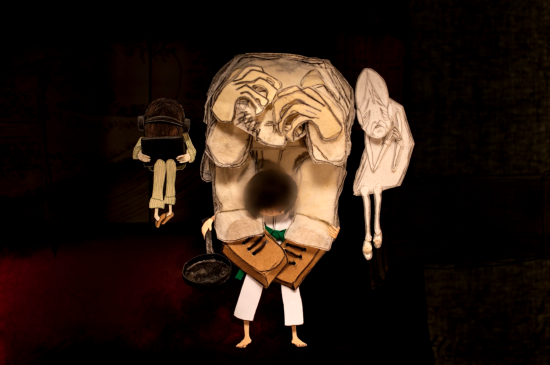
Dramas that many children have to endure play out in silence and hiding: The girl cuddling her dog because her own mother is staggering about with a glass of red wine, probably pregnant again. The boy as a toy ball caught between his aggressive parents who rain their arguments down on him with hacking beaks. Another girl who balances a dangerously wobbling seesaw with her family members on it. With her intimate cut-out animation, Marianne Bundgaard Nielsen metaphorically leafs through the family albums and shows the stories hidden by the staged photos. The adults are dreary puppets, sometimes fading drawings, addressing suicides within the family. The children, on the other hand, are much more lively figures with big accusing eyes, small read hearts and sometimes even coloured butterfly wings. You have to let them flutter and fly instead of unloading so much of your own misery on them.
Marie Ketzscher
Contains mentions of suicide, addiction
Screenings & Tickets
Credits
Contact
claus@trollfilm.no