Topic
- Activism
- Animated Documentary
- Archival Footage
- Arts/Culture
- Coming of Age
- Digital Culture
- Eastern German
- Environment
- Experimental
- Family
- Gender
- History
- Human Rights
- Humour
- Labour/Economy
- LGBTQIA2S+
- Music
- Politics/Current Affairs
- Portrait/Biography
- Psyche/Mind
- Religion/Spirituality
- Science/Technology
- Social Issues
- Sports
- Underrepresented Communities
- War/Conflict
- Youth
Filmtype
Accessibility
Custom type
Topic
- Activism
- Animated Documentary
- Archival Footage
- Arts/Culture
- Coming of Age
- Digital Culture
- Eastern German
- Environment
- Experimental
- Family
- Gender
- History
- Human Rights
- Humour
- Labour/Economy
- LGBTQIA2S+
- Music
- Politics/Current Affairs
- Portrait/Biography
- Psyche/Mind
- Religion/Spirituality
- Science/Technology
- Social Issues
- Sports
- Underrepresented Communities
- War/Conflict
- Youth
Accessibility
El primer año
“El primer año” documents the first year of the Unidad Popular: the rude awakening of the ruling classes of Chile as they are faced with the democratically elected socialist government. From the immediate economic sabotage of the right wing through celebrating workers, the situation of the Mapuche, the agrarian reform, the nationalisation of coal and copper mining and Fidel Castro’s visit, up to the “March of the Pots” by bourgeois women crying for bread, of which they have plenty, the cycle of achievements and difficulties is complete. Besides their journalistic interest, Patricio Guzmán and his collaborators sought to capture the atmospheric aspect of the departure towards a fairer society under Salvador Allende, which is what makes “El primer año” such a moving document of its time. Chris Marker offered to produce a French version with the help of the SLON film collective, which is preceded by photographs by Raymond Depardon, accompanied by a foreword on the history of Chile. Guzmán continued his work on the chronicle of events until he was forced to leave the country after the military coup of 11 September 1973. It was only in Cuban exile that he was able to successively finish his masterpiece “La Batalla de Chile” (1975-79) together with Pedro Chaskel. Each of its three parts was acclaimed at the International Leipzig Documentary and Short Film Week and the Berlinale Forum.
Florian Wüst
Screenings & Tickets
Credits
Contact
alexandra@bfdistribution.cl
El tigre saltó y mató, pero morirá... morirá...
Five days after the coup, Chile’s most famous singer-songwriter, Víctor Jara, was brutally murdered. In recognition of his oeuvre, his political stance and also of the “victims of the fascist sadism perpetrated by the military and the CIA in Chile after 11 September 1973”, Santiago Álvarez immediately created a cinematic “report in four songs”. The musical and rhythmic structure and the simultaneous reportage style arising from found news footage and recordings of Jara reflect the agitprop language that is so typical of Álvarez. The title of the film is taken from the poem “Nuestra América” (1891) by Cuban poet José Martí. The end, too, alludes to the continuity of the anti-colonial struggle: A collage of international examples of state repression against insurgents from Puerto Rico to Vietnam and Indonesia is followed by depictions of legendary battles of liberation in 19th century South America.
Florian Wüst
Contains depictions of physical violence
Screenings & Tickets
Credits
Contact
Garden of Hope
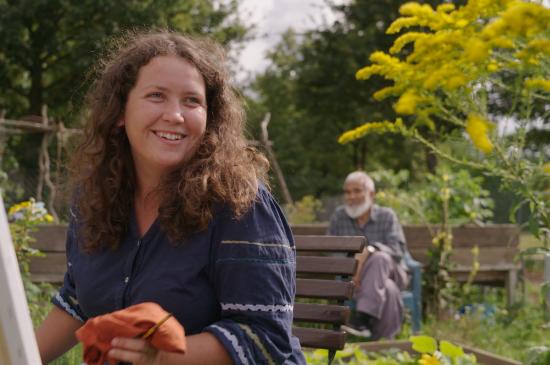
“We don’t fit together”, one of them says of the “motley crew” tending a garden plot in a pre-fab estate in Schwerin. At first, everyone “muddles through” alone: Omar from Syria, who struggles with being voiceless in a foreign land. Manfred, a widower who thinks of his wife every day and looks after everyone. Kateryna from Ukraine, who tries to paint over the war with colourful pictures. Fawze, who lost his homeland three times. Ronny, Wiebke and Max, who are trying to make a fresh start after a life of drugs and violence. Sabine, whose laughter and mischief flare up briefly and vanish again. Petra, who cannot afford to go to a concert after a lifetime of hard work. Richard, who hangs up mirrors not to be alone. Abdul from Afghanistan, master of okra. They communicate with their hands, feet and “russki jasyk”, swap tips on the right way to plant garlic and on tools, soon sit together under the chestnut tree, singing, fighting for the project … And from her balcony Mrs. Müller recites Goethe, following it up with a peace poem. DEFA veteran Dieter Schumann and his cinematographer Michael Kockot achieve what was once the origin and virtue of documentary film: giving the unheard a voice through precise observation, a voice based on closeness, trust and respect. The neighbourhood garden is a site of “small miracles”. One of them is this film.
Grit Lemke
Screenings & Tickets
Credits
Contact
mueller@neuevisionen.de
Heat
Carolin Weidner
Trailer
Screenings & Tickets
Credits
Contact
sales@taskovskifilms.com
Herminda de la Victoria
In a large-scale operation, a group of homeless families occupy some wasteland on the outskirts of Santiago in March 1967. When the police attempt to evict them, a little girl, Herminda, dies in her mother’s arms. The eviction is called off, the people are allowed to stay and, without any existing infrastructure, build the settlement that exists to this day: Herminda de la Victoria. “Full of errors and mistakes, [the film] is my first approach to cinema, albeit to a ‘new cinema’, a Latin American cinema marked by underdevelopment. Nonetheless, the cinematic process, editing and sound represent a fully valid experience to me. ‘Herminda de la Victoria’ champions the interests of the homeless in Chile, suffers with them, is both testimony and a ‘document’ that forces you to take sides.” (Douglas Hübner)
Florian Wüst
Screenings & Tickets
Credits
Contact
Holy Wood Dust
“Trees are life itself”, renowned botanist Stefano Mancuso says, leading a band of kids through what was once a densely wooded area. This becomes the setting for Victor Kossakovsky and Mancuso’s cinematically sprawling journey across Europe, even reaching Vatican City, following the fates of trees. In the Dolomites, trees stand like ghosts after the Storm Vaia devastated the forests. They became more vulnerable due to a planted monoculture of economically valuable fir trees. More damage then followed after the storm, as weakened and fallen trees became breeding ground for bark beetles. What do trees think or feel? Delving into their depths, the camera captures life that’s still sprouting and persisting. However, as winter matures, trees might not make it through the festivities. Chainsaws work tirelessly at fir-tree farms. Like strange cocoons, they are now packed in nets and bundled tightly, waiting for their send-off to homes and public squares. But people’s affection for them might be short-lived.
Sevara Pan
Screenings & Tickets
Credits
Contact
Hotel Utopia
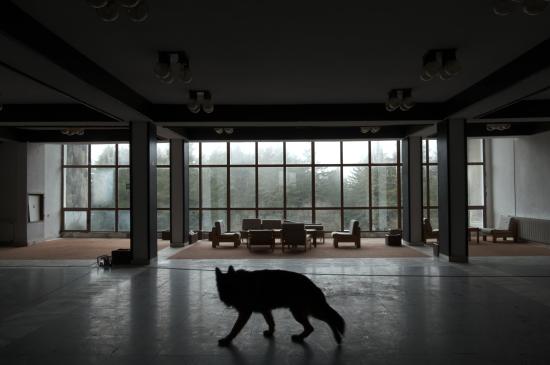
They develop software, work as lifestyle coaches, own marketing agencies or an Amazon shop, travel around the world without paying for accommodation: digital nomads for whom a laptop on a suitcase is sometimes enough of a workplace. Some of their aspirations fall by the wayside in the process and become the project of an enterprising Munich-based developer: Mathias is courting rootless individualists and clever investors to become backers of a project that is to turn a deserted former luxury hotel in the Bulgarian mountains into a hip coworking space. He promises a sense of community, intense human connections and few taxes, an outdoor pool and a campfire idyll. While the nomads who dream of home are waiting for the utopia to become reality, the residents of the surrounding villages sense a new “Wind of Change” with some scepticism. A brilliant structural analysis of a business model that capitalises on modern longings and knows how to carve out the necessary space.
Jan Künemund
Screenings & Tickets
Credits
Contact
hannahbuhr@outlook.de
How to Catch a Butterfly
Carolin Weidner
Contains mentions of murder, racism
Contains depictions of racism
Screenings & Tickets
Credits
Contact
purplerayfilm@gmail.com
I’d Love to See You
Documentary films for children rarely venture to this place: prison. Four kids in Belgium take us there. They show us the way from the entrance to the visiting area, where they visit their mother or father, usually twice a week. Prisons are definitely not designed for children and yet there are many who regularly enter them. In Belgium alone, more than 16,000 children have a parent behind bars. This film gives a voice to children of prison inmates who tell us how they cope with a situation they did not choose.
Lina Dinkla
Screenings & Tickets
Credits
Contact
sebastien@dokma.be
Kitzel
Franka Sachse
Screenings & Tickets
Credits
Contact
mkeil.animation@gmail.com
Last Round
Schnapps is carefully poured into hip flasks and handed to the men. Their faces are marked by the traces of homeless life. A housing project in Berlin Kreuzberg gives them more than a roof over their head. The people who work here listen to them, accompany them to the doctor and hand out controlled amounts of alcohol. The project’s approach is consistently addiction-accepting – without the enforcement of abstinence and with the goal of relieving the affected persons from existential pressure. In this protected space, the men can breathe freely again after many years of living in the streets, rediscover their own personality and dignity. The camera follows some of the residents and social workers over several years, always at eye-level, showing the work of this institution and leaving space for the men’s personal stories. A fragile community emerges in front of the lens.
Anke Leweke
Contains mentions of addiction, death, mental health conditions, drug-use
Contains depictions of addiction
Screenings & Tickets
Free entry
Credits
Contact
kuehn@realfictionfilme.de
Líber Arce, liberarse
Líber Arce was the name of a communist student who was shot dead by the police at a protest on the university campus of Montevideo. The film documents the events before and after his burial, its title transforming the name of the victim into a call for action: liberarse, to liberate oneself. The fact that the film is silent and the indictment of the social and economic conditions as well as US imperialism is spelled out in intertitles turns the lack of resources for a soundtrack into an aesthetic quality. We look more closely because there is nothing to hear. Mario Handler is a cofounder of the “Cinemateca Tercer del Mundo” (1969-1974) film collective, which sought to build its own cinema of counter-information and published a magazine. Above all, however, it screened the militant films from the other Latin American countries and popularised them far beyond the circles of bourgeois culture in Uruguay.
Florian Wüst
Contains depictions of physical violence