Topic
- Activism
- Animated Documentary
- Archival Footage
- Arts/Culture
- Coming of Age
- Digital Culture
- Eastern German
- Environment
- Experimental
- Family
- Gender
- History
- Human Rights
- Humour
- Labour/Economy
- LGBTQIA2S+
- Music
- Politics/Current Affairs
- Portrait/Biography
- Psyche/Mind
- Religion/Spirituality
- Science/Technology
- Social Issues
- Sports
- Underrepresented Communities
- War/Conflict
- Youth
Filmtype
Accessibility
Custom type
Topic
- Activism
- Animated Documentary
- Archival Footage
- Arts/Culture
- Coming of Age
- Digital Culture
- Eastern German
- Environment
- Experimental
- Family
- Gender
- History
- Human Rights
- Humour
- Labour/Economy
- LGBTQIA2S+
- Music
- Politics/Current Affairs
- Portrait/Biography
- Psyche/Mind
- Religion/Spirituality
- Science/Technology
- Social Issues
- Sports
- Underrepresented Communities
- War/Conflict
- Youth
Accessibility
The Miracle
Lina Dinkla
Screenings & Tickets
Credits
Contact
Through the Dust of Time
Anca Păunescu
Trailer
Screenings & Tickets
Credits
Contact
qaz196626@gmail.com
Tire dié
“Tire dié” begins with aerial shots of Santa Fe, Fernando Birri’s hometown. We hear a litany of statistical data that gradually and parodically turn into more and more trivial facts about the city. The camera approaches the town’s outskirts with their informal settlements, drops from its airy heights down to the eye-level of those who talk about their daily struggle for survival. Often it is the children who bring the necessary coins home. Every afternoon, they go begging along the nearby two-kilometre railway bridge. Running barefoot along the train that connects Santa Fe with Buenos Aires, they hold their hands up to the travellers at the windows, incessantly calling “tire dié” (throw a dime). The last third of the film, which marks the birth of the new Latin American cinema, is an equally breathtaking and harrowing montage of this daring endeavour.
Florian Wüst
Screenings & Tickets
Credits
Contact
Transition
On New Year's Eve 2023, Thomas Heise begins to shoot his new film. It is to be called “Übergang”. His idea: A film in the “Heimatfilm” tradition revolving around Berlin’s Schönhauser Allee, where he has lived for decades. The author is to be a character in the film. A few months later, Heise falls seriously ill and dies. The small team continues to work on the film, unearthing unpublished texts and images from Heise’s estate and archives. “Images are […] encompassing”, Heiner Müller is quoted, but dreams curdle quickly. As soon as the personal story becomes a false image, it is gently but persistently put into perspective. A touching email exchange Heise had with a female high-school graduate in Karlsruhe who is searching for truth contains a whole primer for documentary filmmaking: “See what you would not otherwise see. Stay patient. […] Never expect financial security. Be happy about that. Because it won’t change.” Peter Badel and Chris Wright have not produced a hermetic artist tribute, but have, utterly in the spirit of Heise, pieced together fragments of lived history.
Jan Künemund
Contains mentions of death
Screenings & Tickets
Free entry
Credits
Contact
Un día yo pregunté
“A polemical short film lasting only a few minutes which lines up images of the institution from which the underprivileged expect miracles and liberation from their daily misery: the Catholic Church, which is particularly reactionary in Colombia”, Peter B. Schumann writes about “Un día yo pregunté”. Julia de Álvarez and Carlos Álvarez frequently met with hostility for their political work and, along with other filmmakers, were imprisoned, even tortured, in July 1972. Their release from prison in February 1974 may well have been due, to a not inconsiderable extent, to the joint diplomatic efforts of the Friends of the German Cinematheque (today: Arsenal Filminstitut), the West German Short Film Festival in Oberhausen and others. For Leipzig, too, the couple represented an important voice – and an example of how close the German-German connections were regarding safeguarding, copying and distributing the analogue film material of the revolutionary Latin American cinema.
Florian Wüst
Screenings & Tickets
Credits
Contact
juliasabogal1@hotmail.com
Uncle Thuận
He is „always sad“, says Uncle Thuận. Connected via mobile phone with his family who are scattered across the world he sings sentimental songs about spring in Hanoi. Meanwhile, his wife Thúy tirelessly looks after the restaurant that the two have been managing in North Rhine-Westphalia for twenty years. They came to the GDR as contract workers at the age of 19. In conversations with their daughters, life stories unfold in which they were rarely expected to decide anything but always to work hard and to function. A role they accept without complaint and justify even today. But the protective shell accumulated over decades increasingly begins to show cracks. And somewhere in the endless routines and tasks of a restaurant kitchen which also structure the film, a question quietly emerges: the question of happiness. In Minh Anh Nguyễn, a post-migrant generation speaks up who regard contract work and racism in the GDR not as a closed chapter but as part of their history. Casual and very close to her protagonists, she tells of colonial legacies that have inscribed themselves into biographies and across generations. At the same time, she shows how this cycle can be broken: By the daughters asking questions which – even outside the Vietnamese community and above all in the East – are long overdue.
Grit Lemke
Trailer
Screenings & Tickets
Credits
Contact
nguyen.minh-anh@web.de
White Lies
Alba Zari was born in Bangkok inside what was said to be “a hippie community” that her grandmother, Rosa, and her mother, Ivana, had joined. But she doesn’t recall much of her childhood. Longing for answers, Alba delves into the painful work of remembering: trying to understand her grandmother’s decision to join the Children of God sect, the far‑reaching consequences of her mother’s indoctrination, and her father’s identity. In conversations and everyday moments with her grandmother and mother, Alba learns more about the cult, the ‘Flirty Fishing’ practice, and widespread sexual and psychological abuse of its members, including children. The traces of pain are still tangible years later, showing in Alba’s tears rushing out before words, in the trembling of hands, and in her mother’s constant over-apologising. Alba “lives the questions”, hoping to find answers; however, as the journey unfurls, she realises it may not be about answers but about accepting absence as a constant presence, and not being defined by it. A film about family wounds, memory, and the resilience of ties that bind us.
Sevara Pan
Contains depictions of mental health conditions
Trailer
Screenings & Tickets
Credits
Contact
manuela@slingshotfilms.it
Yawar Mallku
Jorge Sanjinés’ short film “Revolución” (1963) was one of the first Latin American films, beside the Cuban films, to be screened in Leipzig in 1964. With his documentary feature “Yawar Mallku” (Sangre de Condor), Sanjinés took a step towards a cinema that makes history. Told in flashbacks, the film is based on real events: US American development aid workers secretly sterilise indigenous women. The chief of a Quechua community discovers the crime; the village community takes revenge. He is finally shot down by the police and survives, badly injured. He is taken to town, but the rescue attempt fails: There is no money for a blood transfusion. The film challenges both “Yankee Imperialism” and the Bolivian class society. As a consequence of the initially banned public screening, the so-called Peace Corps had to leave the country. “Yawar Mallku” had its premiere in West Berlin as part of the 1970 Berlinale’s “Week of New Cinema: Latin America”. Thereafter the Friends of the German Cinematheque (today: Arsenal Filminstitut) showned Sanjinés’ film multiple times at the Arsenal Cinema over the years, including under the heading “Birth Control as Genocide” in the context of the First International Women’s Film Seminar in November 1973. It enjoyed the same esteem in the East: One of only three Latin American films found in the “Film-Blätter: Kurzmonographien zu klassischen Filmen" (Film Sheets: Brief Monographs on Classical films) of the GDR’s State Film Archive, “Das Blut des Condors” (The Blood of the Condor) is listed under No. 183.
Florian Wüst
Screenings & Tickets
Credits
Contact
pedro@ukamau.org
You Should Dream of Flying
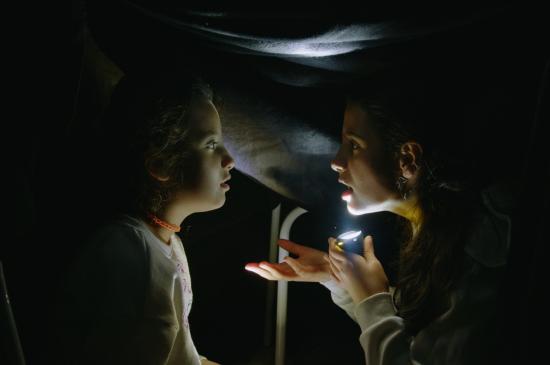
Playing hide and seek, reading out a school essay, taking a driving lesson. These scenes seem casual at first glance, but they turn out to be snapshots of life in exceptional circumstances. Only when the camera pulls back for a long shot does it reveal the refugee homes. The man behind the wheel drives briskly, explaining to the instructor that he obtained his driving license back home long ago. Two girls under a blanket tell each other stories of the time before they fled. What keeps this luminous round of scenes together is the hope of a return to normality.
Anke Leweke
Trailer
Screenings & Tickets
Credits
Contact
laura.staab@gmx.de